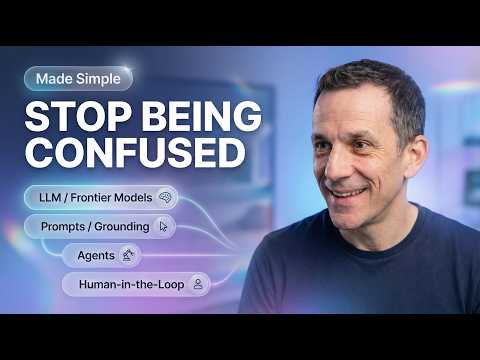
AI Jargon: LLMs to Agents, Simplified
Power Platform Cloud Solutions Architect @ Microsoft | Microsoft BizApps MVP 2023 | Power Platform | SharePoint | Teams
Microsoft expert explains LLMs, grounding, AI agents and human-in-the-loop with Azure AI, Copilot and Power Platform
Key insights
- Frontier Models and LLMs
Large Language Models learn patterns from huge text collections and predict the next words to generate replies.
They do not "think" like humans but use statistical patterns to produce fluent language. - Multimodal & Orchestration
Multimodal systems handle images, audio, and text together so AI can see, hear, and read inputs.
Orchestration coordinates these parts so the system delivers a single, useful result. - Grounding and RAG (Retrieval-Augmented Generation)
Grounding ties AI answers to trusted sources to reduce mistakes and made-up facts.
RAG lets models fetch current facts from external data instead of relying only on training content. - Action Layer — Automation vs AI Tools
Automation follows fixed rules; AI tools interpret context and adapt their actions.
Combining both gives reliable execution plus smarter decision-making. - AI Agents and Autonomy
AI agents plan and use multiple tools to complete tasks across steps and systems.
Human oversight remains key: humans guide priorities, check safety, and correct errors. - Why Terminology Matters
Using clear, shared AI terms helps teams align goals, speed implementation, and avoid miscommunication.
Simple glossaries and consistent language make AI projects run smoother and safer.
Video overview
In a concise YouTube explainer, Damien Bird walks viewers through common AI terms in plain language, and he aims to remove the confusion that often surrounds modern systems. The video frames concepts such as Frontier Models, LLMs, Grounding, and Agents as parts of a layered AI architecture, and it uses everyday examples to make abstract ideas tangible. Moreover, Bird emphasizes practical implications so that both beginners and experienced professionals can connect vocabulary to real projects. Consequently, the piece serves as a useful primer for teams that need a shared language around AI.
Bird’s background as a Power Platform Cloud Solution Architect informs his pragmatic approach, and he consistently links theory to implementation concerns. For instance, rather than diving into math, he explains how an LLM “thinks” by describing how it predicts the next word and uses context to shape output. This conversational tone makes the material accessible, while still highlighting the risks and limits of current systems. Therefore, the video balances clarity with caution about overclaiming what AI can do.
Core concepts explained
First, the video separates broad categories to build a foundation: AI as the overall field, Machine Learning as the method for learning from data, and LLMs as specialized models trained on large text corpora. Bird then clarifies that NLP and NLU are distinct goals—processing versus genuine understanding—and he stresses that many systems still rely on pattern matching rather than true comprehension. In addition, he points out that transformers are the architecture behind most modern language models because they capture context efficiently. As a result, viewers gain a coherent mental model of how these pieces fit together.
Next, Bird introduces the idea of a layered AI stack so viewers can see responsibilities and limits at each level. He explains that the foundation contains high-capability models—sometimes called Frontier Models—and that higher layers add grounding, actions, and orchestration. This structure helps distinguish where hallucinations originate and where control mechanisms must be applied. Consequently, the layered view supports clearer conversations about accountability and integration when teams adopt AI tools.
Grounding and the accuracy layer
Bird gives special attention to Grounding as the accuracy layer that prevents models from inventing facts. He describes Retrieval-Augmented Generation (RAG) in plain terms, saying it allows a model to consult trusted sources before responding, much like a student checking a textbook. This approach improves factual correctness and currency without retraining the entire model, but it also introduces complexity around source trust and retrieval latency. Therefore, teams must weigh the benefits of accuracy against the engineering and data governance required to maintain reliable references.
Moreover, the video highlights that grounding reduces hallucination but does not eliminate it, particularly when retrieved sources are incomplete or ambiguous. Bird notes that retrieval pipelines can introduce bias if the indexed material reflects narrow perspectives, so curating sources remains essential. In addition, enterprises must balance speed and depth because richer retrieval usually costs more time and compute. Thus, the accuracy layer represents a tradeoff between trustworthiness and operational constraints.
Multimodal, orchestration, and the action layer
Bird then turns to multimodal capabilities and orchestration, explaining how combining vision, audio, and text extends practical use cases beyond pure chat. He likens orchestration to a conductor coordinating specialized models—one that decides when to call a vision module or a database lookup. This orchestration improves capability, but it also increases system complexity, making end-to-end testing and monitoring more challenging. Consequently, organizations should plan for additional integration work and observability to keep these components reliable.
The distinction between simple automation and the broader Action Layer is another core point in the video. Bird contrasts rule-based automation, which executes preset steps, with AI tools that interpret intent and decide among actions dynamically. While the latter offers flexibility, it also raises questions about predictability and control, especially in regulated environments. Therefore, teams must design clear guardrails and fallback behaviors when deploying autonomous actions.
Agents and the role of human oversight
Bird concludes by discussing Agents—systems designed to plan and act across tools—and he argues that the most important principle today is the Human-in-the-loop. He explains that agents can chain tasks and interact with external systems, which creates powerful workflows but also amplifies risk if left unchecked. Consequently, human oversight remains essential for validation, exception handling, and ethical judgment. In short, Bird frames human involvement as a safety and quality control mechanism rather than a temporary concession.
Additionally, the video reviews how agents introduce tradeoffs between automation scale and responsibility. On the one hand, autonomous agents can reduce repetitive work and speed decision cycles; on the other hand, they can propagate errors quickly if their policies lack transparency. Therefore, organizations adopting agents must invest in monitoring, explainability, and escalation paths to manage edge cases safely. This balanced view supports careful, staged rollouts instead of unchecked experimentation.
Tradeoffs, challenges, and practical takeaways
Overall, the video provides a clear map of the modern AI landscape while acknowledging tradeoffs between accuracy, speed, cost, and governance. Bird recommends focusing first on alignment between business goals and model capabilities, and then layering grounding and orchestration where value and risk justify added complexity. He also stresses that teams should start with human oversight and automate gradually, which helps reduce costly mistakes and build trust over time. As a result, the guidance favors a pragmatic path to adoption rather than chasing the latest capability without guardrails.
In conclusion, Damien Bird’s explainer simplifies dense terminology and connects each concept to real project decisions, making it a helpful resource for organizations planning AI initiatives. Moreover, by highlighting practical tradeoffs and the central role of the Human-in-the-loop, the video offers a responsible roadmap for deploying AI tools. Therefore, readers and practitioners will find the video useful for aligning teams and managing expectations as they explore modern AI.

Keywords
AI jargon explained, LLMs explained, AI agents explained, AI terminology guide, Generative AI basics, Prompt engineering basics, AI glossary for beginners, Large language models guide