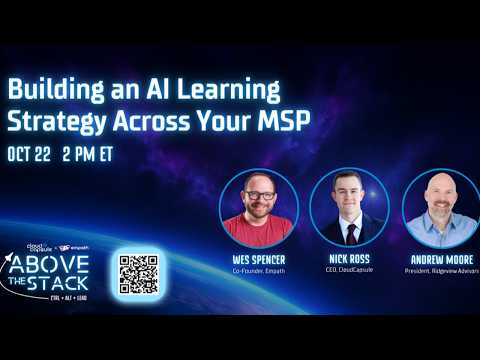
All about AI for MSP learning strategy
Nick Ross and guests discussed how MSPs can build a shared AI learning strategy across sales, engineering, support, and leadership.
Key insights
- The episode focuses on building an AI learning strategy across an MSP, not a single product.
- It brings together Andrew from Ridgeview Advisors, Wes Spencer of Empath, and Nick Ross.
- The discussion covers sales, engineering, delivery, service desk, and leadership.
- It frames AI readiness around Copilot, agents, Azure AI, governance, and support.
- The goal is to help MSPs deliver AI services consistently and securely.
Nick Ross [MVP] (T-Minus365) recently published an Above the Stack episode titled Building an AI Learning Strategy Across Your MSP. The session featured Andrew from Ridgeview Advisors and Wes Spencer of Empath, alongside Nick Ross. The takeaway is straightforward: MSPs need a shared way to learn AI so they can advise, deploy, govern, and support it consistently.
The video itself is presented on YouTube, but the research notes describe it as a live LinkedIn event. That matters because the topic is not a feature demo for one Microsoft product. Instead, it is about organizational AI readiness across the whole service provider, from leadership to the service desk.
What's new
The episode centers on how an MSP can create an internal AI learning strategy that reaches more than one team. The notes say the approach should cover Microsoft Copilot, AI agents, Azure AI, and related services. It also includes the practical work that follows adoption, such as security, privacy, governance, and responsible use.
This is different from narrow product training. The discussion is about building knowledge, processes, and practical experience so teams can support AI-related customer work at scale. In other words, the focus is on readiness across the business, not just individual certification or one-off demos.
The notes also position this as part of Microsoft’s partner direction. Microsoft is described as treating AI adoption as a broad stack that includes Copilot, agents, intelligent applications, business data, cloud infrastructure, and governance.
Why it matters
For MSPs, AI changes the kind of support customers expect after a solution is purchased or deployed. The notes say customers need help with adoption, security, data access, user enablement, governance, performance, and ongoing improvement. That means the MSP needs more than product knowledge; it needs a repeatable operating model.
Sales teams need to identify realistic customer use cases. Technical teams need to design secure and integrated solutions. Delivery teams need to implement and manage those services. Service desk staff need to support AI-enabled environments. A common learning strategy helps these groups work from the same understanding rather than giving conflicting advice.
The material also points to recurring-service opportunities. These include Copilot adoption programs, agent lifecycle management, AI governance, security reviews, user training, data readiness, and optimization. For MSPs that want to turn AI from a one-time project into an ongoing service line, that distinction matters.
This matters for internal operations too. The notes mention that an MSP can gain practical experience by using AI inside the business first. Examples include service-desk assistance, documentation, proposal development, ticket summarization, knowledge retrieval, and operational reporting. Internal use can help teams see where AI works well and where it needs guardrails.
How it works
The episode’s approach is not presented as a formal framework with named stages, but the notes describe several functions that an MSP should cover. A practical learning strategy would move across the business in a coordinated way.
- Start with leadership so the business has a shared view of what AI adoption should achieve.
- Train sales and account teams to spot customer use cases that are realistic, not speculative.
- Prepare technical teams to design solutions that connect AI with identity, data, and existing services.
- Equip delivery teams to implement, manage, and optimize AI-related services over time.
- Give the service desk enough understanding to support users in AI-enabled environments.
- Build governance, privacy, security, and responsible-use practices into the learning plan.
The notes also describe the content areas that such a strategy should include: Microsoft Copilot, AI agents, Azure AI, business data, cloud infrastructure, and governance. That combination suggests the learning path should cover both the technology stack and the service processes around it.
Another practical point is alignment. The research notes emphasize that sales and technical staff need to understand both customer outcomes and technical constraints. That shared context helps prevent mismatches between what is sold and what can actually be delivered or supported.
Limitations and open questions
The source material is light on the video’s detailed examples, agenda, or live-demo content. It does not give a step-by-step curriculum, slide deck, or checklist from the episode itself. The published YouTube description is also minimal and does not add technical detail.
The notes refer to Microsoft partner guidance and Microsoft AI learning resources, but those items are not fully reproduced in the source material. As a result, we can describe the themes with confidence, but we cannot verify exact training modules, timelines, or partner requirements from the provided sources alone.
The material also does not say whether the advice is tied to a specific licensing model, tenant setup, or rollout stage. It speaks in general terms about MSP readiness, which means readers should treat it as strategic guidance rather than product-specific implementation instructions.
Sources
Frequently asked questions
Is this episode about one Microsoft product?
No. The notes say it focuses on organizational AI readiness across an MSP, including Copilot, agents, Azure AI, governance, and support.
Who is featured in the discussion?
The research notes name Andrew from Ridgeview Advisors, Wes Spencer of Empath, and Nick Ross.
What is the main benefit for MSPs?
A shared learning strategy can help sales, technical, delivery, and support teams give consistent advice and manage AI services more effectively.
Does the material give a step-by-step training plan?
Not in detail. It describes the themes and team areas to cover, but it does not provide a full curriculum or checklist in the source material.