Dynamics 365 WEM explained in plain language
Microsoft MVP | Dynamics 365 CE Presales Engineer - Director at RSM US LLP | LinkedIn Learning Author
Dian Taylor’s video introduces Workforce Engagement Management in Dynamics 365 Contact Center and explains forecasting and capacity planning.
Key insights
- This is Part 1 of a WEM series for Dynamics 365 Contact Center.
- The video says no WEM experience is required.
- WEM is explained with forecasting and capacity planning as the starting point.
- The aim is to put the right reps, skills, and capacity in place at the right time.
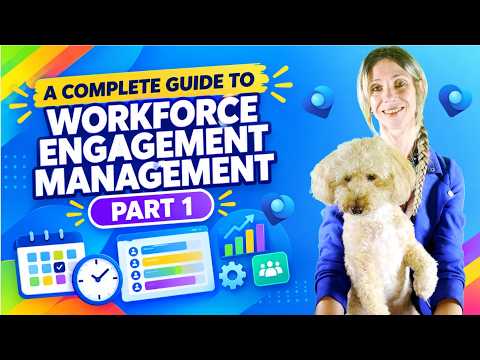
Dian Taylor - [MVP] (Dynamics 365 Talk) recently published a short video titled A Complete Guide to Workforce Engagement Management Part 1. The video introduces Workforce Engagement Management, or WEM, in Dynamics 365 Contact Center and focuses on forecasting and capacity planning. The core takeaway is simple: WEM is about getting the right reps, with the right skills, available at the right time.
The description says this is Part 1 of a series on WEM in Dynamics 365 Contact Center. It is aimed at people who manage a contact center, work with Dynamics 365, or are just starting to learn workforce management, and it says no WEM experience is required. Based on the material, this first part is an entry point rather than a full product walkthrough.
What's new
The video introduces WEM as part of Dynamics 365 Contact Center. According to the research notes, Microsoft has positioned WEM as an integrated capability in Dynamics 365 Customer Service and Dynamics 365 Contact Center. That matters because it puts workforce planning closer to daily service operations instead of treating it as a separate planning exercise.
The material highlights two starting points: forecasting and capacity planning. Forecasting estimates future demand, while capacity planning helps decide how many people or resources are needed to meet that demand. The goal is to avoid both understaffing and overstaffing.
The research notes also describe WEM as connecting planning with service interactions, cases, conversations, routing, quality evaluation, and AI-powered operations. In other words, it is presented as more than scheduling alone. For readers who follow Dynamics CRM topics, this is another sign that workforce planning is being pulled closer to the customer service platform itself.
Why it matters
This topic matters most to contact center managers, service operations teams, and Dynamics 365 admins or consultants who support workforce planning. If staffing decisions are made in one place and service demand is visible in another, planning can become disconnected from what is happening on the floor. The material suggests Microsoft wants to close that gap.
For day-to-day work, the value is in aligning schedules with actual demand and skill requirements. The video frames the problem around having the right reps available at the right time, which is a practical issue for service teams that need to cover channels, shifts, and customer load. The research notes also say Microsoft’s approach is meant to support human representatives and AI agents together as one service workforce.
Licensing and rollout details are not covered in the video description itself. The research notes say Microsoft announced general availability on June 30, 2026 and that WEM is included with Dynamics 365 Customer Service Enterprise and Premium, and available with the Dynamics 365 Contact Center Voice + Digital SKU. Those points are useful for evaluation, but they are not explained in the video itself.
How it works
The material only goes as far as the foundations, so the mechanics are described at a high level. Forecasting uses historical information and AI-driven models to estimate future demand across service channels. Capacity planning then uses those forecasts to determine staffing needs, so managers can prepare the right level of coverage.
The research notes outline a broader WEM cycle that includes scheduling, monitoring, and adjustment. Scheduling is intended to balance customer-service targets, employee availability, business requirements, and cost efficiency. Real-time adherence and intraday management are also mentioned as part of the broader approach, meaning planners can compare scheduled work with what is actually happening during the day.
- Estimate demand using forecasting.
- Translate that demand into staffing and capacity needs.
- Create schedules that balance service goals and availability.
- Track adherence and operational changes during the day.
The notes also say the model can support shift swapping and bidding, depending on organizational policies. That suggests WEM is not only for planning at the start of the week or month, but also for handling change after the schedule is published. The video itself, however, only explicitly introduces forecasting and capacity planning.
Limitations and open questions
The published video description is brief, and the transcript excerpt does not include detailed product demonstrations. Because of that, we cannot verify which screens, menus, or configuration steps Dian Taylor showed in the video. We also cannot confirm whether the walkthrough included scheduling, adherence, analytics, or coaching in this first part.
The material says this is Part 1 of a series, so it is clearly not the full story. The description promises plain-language basics, which means readers should expect an overview rather than a deep technical implementation guide. The research notes mention broader WEM capabilities, but those details go beyond what the video description itself confirms.
Another open question is how the feature is being rolled out in each tenant or region. The research notes give licensing and general-availability context, but the source video does not discuss tenant eligibility, deployment timing, or prerequisites. For teams planning adoption, those details would need separate verification.
Sources
- YouTube video: A Complete Guide to Workforce Engagement Management Part 1
- Dian Taylor - [MVP] (Dynamics 365 Talk) website
Frequently asked questions
What does the video say WEM is about?
It introduces Workforce Engagement Management in Dynamics 365 Contact Center and frames it around forecasting and capacity planning.
Who is the video for?
The description says it is for contact center managers, people working with Dynamics 365, and anyone getting started with workforce management.
Does the video require prior WEM knowledge?
No. The description explicitly says no WEM experience is required.
Does the source explain full setup steps?
No. The material is an introductory Part 1, and it does not provide a full configuration or implementation walkthrough.