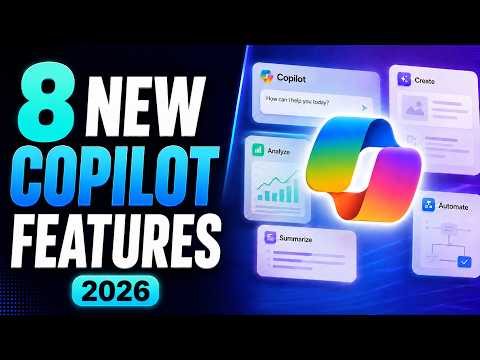
Microsoft 365 Copilot: 8 Updates
Principal Group Product Manager - Microsoft Education
Microsoft Copilot updates add OpenAI and Anthropic models plus Office agents, Copilot Chat, Notebooks and Prompt Library
Key insights
- New models (GPT-5 and Anthropic): Microsoft is rolling out GPT-5 in Copilot Chat and adding support for Anthropic models to give users more model choices.
Expect faster, more capable responses with a phased release that reaches Microsoft 365 Copilot license holders first. - Inline App Agents (Word/Excel/PowerPoint): You can add Word, Excel, or PowerPoint agents directly inside Copilot Chat to run app-specific actions without leaving the chat.
This saves time by letting the agents create, edit, or analyze documents inline. - Copilot Notebooks: Notebooks are now widely available for commercial and education customers and sync with OneNote.
They support infographics and PowerPoint output, improved referencing, and richer content generation inside the Copilot app. - SharePoint dashboards & page prompts: Copilot can build interactive dashboards from SharePoint lists, Excel, or CSV that stay linked to the source data and refresh automatically.
You can also add a page button that runs a custom Copilot prompt with one click to guide visitors or automate tasks. - Cowork integration & multi-agent workflows: The update adds Cowork features and multi-agent workflows so agents can coordinate tasks across Teams, SharePoint, and files.
It also brings mobile meeting recording and deeper Copilot actions inside file previews and PDFs. - Faster grounding & improved UI: Typing “/” in Copilot Chat now inserts files, people, or meetings quickly for better context, while the chat UI and skill cards are more compact and easier to scan.
The Copilot Prompt Library and Suggested Edits in Copilot Pages help you reuse prompts and refine outputs faster.
Introduction
In a recent YouTube walkthrough, author Mike Tholfsen showcases eight notable updates to Microsoft 365 Copilot for August 2026. The video serves as a step-by-step tutorial and highlights changes across chat, notebooks, dashboards, and model options that many workplaces and educators will notice quickly. For editorial readers, this article summarizes the key points and explains what the changes mean in practice, while noting both benefits and tradeoffs.
Video overview and structure
Tholfsen organizes the video with clear timestamps, so viewers can jump to sections like new model support, inline agents, and the refreshed prompt library. Consequently, the presentation feels practical and task-focused, showing live examples of workflows in Excel, Word, and PowerPoint. The stepwise approach helps viewers see not only what the features do but also how they behave when applied to real documents and lists.
Major feature highlights
The update expands model choices inside the Copilot ecosystem, including broader access to GPT-5 and additional third-party models from providers such as OpenAI and Anthropic. Moreover, Tholfsen demonstrates adding Word, Excel, and PowerPoint agents inline within Copilot Chat, which speeds up content creation and makes editing more seamless. He also shows the new SharePoint dashboard flows that generate live dashboards from lists, Excel files, and CSVs so reports refresh automatically rather than requiring manual exports.
Copilot Notebooks and collaboration tools
The video emphasizes the wider availability of Copilot Notebooks for commercial and education customers, along with deeper integration into the Copilot app and ongoing sync with OneNote. In addition, features like infographics and PowerPoint generation inside notebooks let users turn analysis into slides faster, while new reference features help trace where prompts sourced their data. Tholfsen also highlights the arrival of the Cowork integration, which aims to streamline shared workflows but may add coordination needs for teams.
User experience and prompt improvements
Tholfsen notes improved grounding in chat: typing “/” lets users insert files, people, and meetings directly into prompts, reducing context gaps and speeding responses. The updated Copilot Prompt Library and a feature that lets a SharePoint page button trigger a Copilot prompt further lower friction for common tasks. Also, the chat UI is more compact and the citation hover card is cleaner, which helps verification, though users will still need to verify sensitive or mission-critical outputs manually.
Tradeoffs and governance challenges
While these updates offer clear productivity gains, they introduce tradeoffs around control, cost, and compliance. For example, richer model choices and more powerful agents may increase licensing complexity and require admins to decide which models are permitted across teams, while tighter integrations with SharePoint and OneDrive raise governance questions about data access. Therefore, organizations must balance the convenience of automation with strong policies for data handling and user training.
Accuracy, verification, and model choice
Tholfsen demonstrates useful verification features, yet the video underscores ongoing challenges in grounding and citations, especially as multiple models become available. Consequently, teams should adopt review workflows for outputs used in reports or public-facing material, since faster generation does not eliminate the need for human checks. Moreover, choosing between models such as GPT-5 or other providers involves tradeoffs in latency, cost, and output style, so testing remains essential.
Practical advice for rollout
For IT leaders and educators, Tholfsen’s examples point to a staged rollout strategy: pilot the most relevant agents with a small user group, collect feedback on accuracy and impact, and then expand while aligning governance and training. This approach reduces risk and helps measure real gains in time saved or quality improved, and it also gives admins a chance to configure model restrictions and data controls before broader adoption. In short, a measured deployment both preserves oversight and accelerates useful adoption.
Conclusion
Mike Tholfsen’s video provides a clear and practical look at the August 2026 Copilot updates, showing how new models, inline agents, and dashboard flows can change day-to-day work in Microsoft 365. However, the update also raises important tradeoffs around governance, cost, and the need for human verification, so organizations should pilot thoughtfully and set policies early. Overall, the changes point toward a more agent-driven, context-aware Copilot that aims to reduce manual steps while shifting some responsibility for oversight to IT and end users.

Keywords
Microsoft 365 Copilot new features August 2026, Copilot August 2026 update, Microsoft Copilot AI features 2026, Copilot productivity tools Microsoft 365, Copilot integrations Teams Outlook SharePoint, How to use Microsoft 365 Copilot, Copilot generative AI improvements 2026, Copilot security and compliance updates