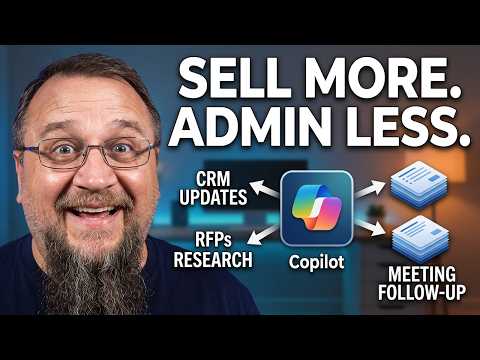
AI Agents: 5 Picks for Sales Teams
Lead Consultant at Quisitive
Microsoft expert: Copilot Studio AI automates sales, fixes CRM, adds governance, and boosts deals in Teams
Key insights
- Copilot Studio AI agents for sales: The video by Steve Corey shows five practical AI agents that cut busywork, improve CRM data, and free reps to spend more time selling.
- Corey’s five agents: CRM Guardian (captures commitments and updates CRM), AI Sales Coach (analyzes calls and gives coaching), Pipeline Forecasting (flags stalled deals and risks), Competitive Intelligence (delivers battle cards and objection help), and Proposal & RFP Agent (drafts proposals from approved content).
- Microsoft Dynamics lineup: Microsoft highlights five sales agents—Sales Qualification, Sales Opportunity, Sales Close, Sales Research, and Recommended Actions—that increasingly act autonomously across Dynamics 365 and Microsoft 365 to research, prioritize, and advance deals.
- Principal benefits: Agents reduce manual research, speed lead response, sharpen pipeline focus, enable natural‑language access to sales data, and give sellers more time for customer conversations.
- Data and governance caveat: Agents only perform well with good data quality, strong CRM hygiene, secure knowledge stores, and clear governance and business rules to avoid unreliable or risky automation.
- Practical next steps: Start with a controlled pilot, ensure tight integration with Teams/Outlook/SharePoint/Dynamics or your CRM, use approved content sources, and track clear KPIs for adoption and deal impact.
Steve Corey, a Microsoft MVP, outlines practical ways sales teams can use AI in a recent YouTube video that his blog post summarizes, and this article reports on that material for our newsroom. In the video, Corey presents five specific AI agents built with Microsoft Copilot Studio designed to reduce repetitive work, improve CRM quality, and help close deals faster. The piece positions these capabilities inside the Microsoft 365 ecosystem and highlights both potential gains and the limits that come with data and governance challenges. Overall, the message is pragmatic: agents can free sellers to sell, but only when the data and rules behind them are solid.
The five agent use cases
Corey describes a set of five targeted agents that aim to solve common sales pain points directly inside tools teams already use, such as Teams, Outlook, SharePoint, and CRM systems. First, the CRM Guardian Agent identifies commitments, meeting actions, and new contacts from emails and meetings to reduce manual CRM entry. Second, the AI Sales Coach analyzes call transcripts against a company’s sales playbook to deliver coaching and flag missed opportunities for managers and reps.
Third, the Pipeline Forecasting Agent monitors opportunities for signs of stall or risk using activity and historical trends, which helps prioritize follow-up. Fourth, the Competitive Intelligence Agent serves approved battle cards and objection-handling guidance in the seller’s workflow so reps can respond consistently. Fifth, the Proposal & RFP Agent drafts proposals from approved content and coordinates reviews, speeding up the proposal cycle while keeping content compliant.
Integration and technical trade-offs
The video emphasizes that these agents work best when they are tightly integrated with existing systems like Dynamics 365 or Salesforce and with Microsoft 365 context. However, integration requires careful mapping of data sources and permissions, because agents that act on incomplete or out-of-date information can create more work than they save. Moreover, connecting multiple systems raises latency and synchronization issues that IT teams must manage.
On the other hand, tighter integration enables more autonomous behavior: agents can monitor, suggest, and sometimes take actions without constant human prompts, which increases efficiency. Yet autonomy comes with a clear trade-off between speed and control, and organizations must decide how much decision-making to delegate to an agent. In short, better integration boosts utility but also demands stronger data hygiene and system maintenance.
Data quality, governance, and risk
Corey warns that the usefulness of any AI agent depends directly on the quality of the underlying data, and poor CRM hygiene will limit reliable outcomes. In addition, governance rules, approved content libraries, and clear business policies are essential so agents recommend or create content that meets legal and branding standards. Without those guardrails, you face potential compliance breaches or inconsistent messaging that could hurt deals and reputation.
Furthermore, the video discusses how model behavior must be auditable and that organizations should log agent actions and decisions for review. This transparency helps mitigate risk and supports human oversight, but it also creates additional storage and review workloads. Therefore, leaders must balance the gains from automation against the overhead of maintaining governance logs and review processes.
Operational challenges and team trade-offs
Implementing agentic AI touches people, process, and technology, so the real-world challenges are often organizational rather than purely technical. Sales reps and managers may initially resist changes that alter their workflows, and training is required so teams trust and use agent recommendations effectively. In addition, deciding whether to automate specific tasks involves weighing speed and consistency against the need for human judgment in complex negotiations.
Moreover, the cost and timeline for building and tuning agents vary based on data readiness and the number of integrations, which forces leaders to prioritize use cases that deliver fast, measurable returns. Consequently, starting with high-impact, low-friction agents—such as CRM hygiene improvements or proposal drafting—often produces better early outcomes than trying to automate end-to-end deal closing at once. That staged approach reduces risk and builds momentum for broader adoption.
Practical next steps for IT and sales leaders
Corey closes by suggesting practical next steps: audit CRM data, define governance rules, and pilot one or two agents that address immediate pain points while keeping humans in the loop. He also recommends aligning stakeholders from sales, legal, and IT early so the pilot can scale with fewer surprises. This approach helps organizations validate value quickly and adjust business rules before rolling agents out more widely.
In conclusion, the video delivers a clear, usable roadmap for sales teams curious about AI agents: when data and governance are sound, targeted agents can cut busywork and sharpen seller focus, and when those foundations are weak, automation risks unreliable outcomes. Therefore, teams should move deliberately—test, measure, and govern—so agents become reliable tools that improve productivity rather than create new problems.

Keywords
AI sales agents, AI sales automation, AI lead generation tools, AI sales assistant, conversational AI for sales, predictive sales analytics, AI prospecting tools, AI CRM integration