- All of Microsoft
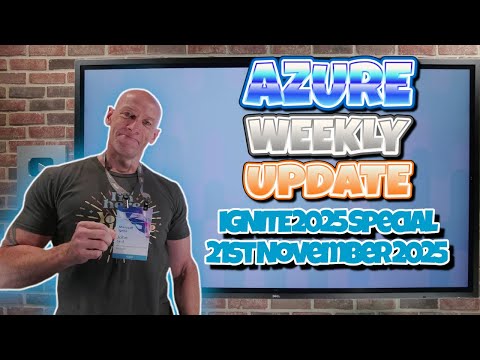
Azure Update - IGNITE SPECIAL - 21st November 2025
Principal Cloud Solutions Architect
Azure Ignite highlights AKS, App Service, Azure Functions, Azure Monitor, Cosmos DB, Microsoft Fabric and Entra identity
Key insights
- Azure Copilot, Microsoft Foundry and Foundry Agent Service are now production-ready and tightly integrated to run and manage AI agents at scale.
They provide agent orchestration, observability, fine-tuning, and step-by-step lifecycle controls so teams can deploy agentic workflows with governance and monitoring. - Azure DocumentDB, SQL Server 2025 and Azure HorizonDB target modern AI workloads with built-in vector support and RAG-ready features.
Microsoft Fabric databases amplify real-time analytics and vector search for apps that need fast retrieval and hybrid transactional/analytical processing. - AKS and Kubernetes Fleet Management received important updates: automatic node updates, improved network features, and broader SKU support for VMs and GPUs.
Container registry controls now include ACR granular ABAC, letting teams enforce fine-grained access for images and CI/CD pipelines. - App Gateway, ExpressRoute and cloud network services improved security and scale with new WAF rules, slow-start tuning for container backends, and a scalable ExpressRoute gateway option.
Microsoft also reinforced DevSecOps with tighter integration between Defender for Cloud and GitHub security scans to detect issues earlier in the pipeline. - Storage and data protection saw targeted enhancements: Blob storage archive expanded regionally, Azure Files Entra-only auth adds identity-first access control, and Storage smart tiering optimizes costs automatically.
Azure NetApp Files introduced single-file restore and Azure Managed Lustre added easier import paths for HPC workloads. - Azure Monitor and recovery tools added richer telemetry and protection features, including OpenTelemetry SDK stats, query-based metrics, dynamic thresholds, and VM backup threat detection.
Disaster recovery (ASR) gained failback to Hyper-V and broader Linux OS upgrade support, helping operations teams maintain resilience and observability.
Overview of the Ignite Special Video
The YouTube summary by John Savill's [MVP] presents a fast-paced roundup of announcements from Microsoft Ignite 2025, and it covers a broad range of topics from AI-driven tooling to infrastructure updates. Consequently, the video serves as a single reference for many incremental product launches, previews, and general availability notes that enterprises and engineers should watch. The narration emphasizes practical implications for cloud architects and platform teams, while the chaptered timeline helps viewers jump to areas of interest quickly. Therefore, this article extracts the main themes and explains tradeoffs and challenges teams will face when adopting these features.
Developer Tooling and Agent Platforms
The video highlights deeper integration of Azure Copilot into the portal, command-line tools, and development workflows, aiming to accelerate provisioning and troubleshooting. Moreover, Microsoft Foundry and the Foundry Agent Service are positioned as production-ready components for building and operating agent-driven applications, which could simplify agent orchestration and lifecycle management. However, teams must weigh the benefits of agentic automation against the operational burden of governance, observability, and model maintenance, since automation can hide failure modes until they surface in production.
In addition, the presenter outlines how Copilot and Foundry together promise to reduce repetitive tasks, yet they introduce new security and compliance responsibilities. For example, organizations will need clear policies for model access, data handling, and fine-tuning processes, and they should evaluate auditability and provenance from day one. Thus, while productivity gains appear significant, the tradeoff involves investing in governance tooling and personnel to manage increased complexity. Ultimately, firms that balance automation with strict controls will gain the most immediate advantage.
Data Services and AI-Ready Databases
Significant updates to the data stack include general availability and preview releases across several database services, notably Azure DocumentDB, SQL Server 2025, and the preview of Azure HorizonDB based on PostgreSQL. Additionally, the video notes that Microsoft Fabric databases now support vector search and retrieval-augmented generation, which helps teams build intelligent applications that combine structured and unstructured data. While these additions open new possibilities for AI workloads, teams must consider the performance, cost, and skill tradeoffs tied to running vector stores and real-time analytics at scale.
Furthermore, managed storage and caching updates—such as enhancements to Azure Managed Lustre and managed Redis—support higher throughput and lower latency for data-intensive workloads. Yet, integrating these systems into existing pipelines can be complex and may require refactoring applications to get the best performance. Consequently, teams need to prioritize workload profiling and cost modeling before a full migration, balancing immediate gains against migration time and operational risk. In short, careful planning reduces surprises when shifting to AI-optimized data platforms.
Security, Governance, and DevSecOps
The video describes tighter integration between security services and developer pipelines, including connector updates that bring runtime-aware protections into the CI/CD process. For instance, the linkage of runtime security with source control and pipeline scanning promises improved threat detection and faster remediation, which helps teams reduce mean time to detect and respond. Nonetheless, this integration imposes its own complexity because security teams must coordinate rules, thresholds, and exception handling across multiple tools and environments. Therefore, the practical challenge is aligning operational priorities without slowing down development velocity.
Moreover, Foundry and agent services raise governance questions around access control and data residency, and the presenter stresses the need for observability and policy enforcement frameworks. Consequently, organizations should adopt a layered approach that combines policy-as-code, telemetry, and regular audits to reduce risk. Balancing strict security controls against developer autonomy will remain a key decision point, and striking the right balance requires clear roles, automated guardrails, and continuous review.
Cloud Infrastructure and Operational Updates
Operationally, the video covers several platform updates—from container orchestrators like AKS to improvements in networking, storage, and migration tools—that collectively aim to simplify cloud operations and increase resiliency. Updates to VM SKUs, NAT gateways, flow log filtering, and App Gateway features indicate an ongoing focus on performance and security for both microservices and legacy lifts. Still, adopting new SKUs or networking models often requires testing and validation, because changes can impact cost, compatibility, and latency in unexpected ways.
Finally, the presenter calls attention to migration and backup enhancements designed to support hybrid scenarios and disaster recovery, which many enterprises still rely on. While these tools lower the barrier to cloud adoption, they also shift responsibility for testing and governance to the user, especially around restore scenarios and cross-region failover. Consequently, teams should validate backup, failover, and update strategies before rolling out large-scale changes, thereby minimizing operational surprises during incidents.
Conclusions and Practical Takeaways
Overall, the John Savill's [MVP] Ignite special video provides a compact, actionable overview of major Azure announcements from Ignite 2025, with an emphasis on AI integration, data platform evolution, and stronger operational controls. However, the benefits come with tradeoffs: faster development paths demand stronger governance, new data capabilities require careful cost and performance planning, and infrastructure upgrades need validation. As a result, teams should adopt a phased approach that pairs pilot projects with governance guardrails to capture value while limiting risk.
In conclusion, this update is a useful digest for engineers and decision-makers who want a high-level roadmap of Azure's direction and immediate items to evaluate. Therefore, viewers and readers will benefit most by combining the highlights from this video with hands-on testing, cost analysis, and governance planning. By doing so, organizations can adopt new features with confidence while managing complexity and cost.

Keywords
Azure Ignite 2025, Azure updates November 2025, Microsoft Ignite Azure highlights, Azure new services 2025, Azure announcements Ignite 2025, Azure cloud roadmap 2025, Azure security updates 2025, Azure hybrid cloud innovations