- All of Microsoft
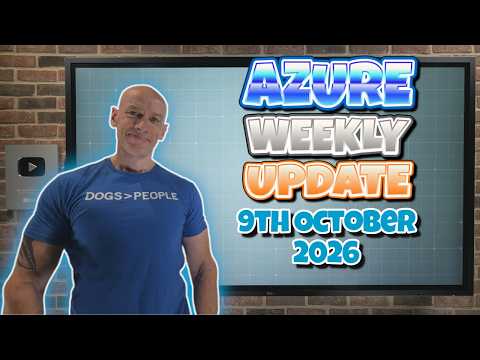
Azure Weekly: Oct 9 - Key Announcements
Principal Cloud Solutions Architect
Azure update: AKS bare metal, App Service and Dev Box retirements, WAF IPv six, PostgreSQL, OneLake, SQL Server Linux
Key insights
- Azure Weekly Update (9 Oct 2026) — concise overview of the video highlights and platform changes.
Watch for guidance on AI agents, databases, networking, retirements, and new regional rollouts explained in the update. - AI agents and developer guidance: Microsoft published an Agent Experience Practitioner Playbook and shows Dynamic Workflows in Azure Functions Hosted Skills.
These help teams build reliable agent-driven workflows and long-running, AI-led serverless processes. - AKS and networking: new items include AKS bare metal on Ubuntu, AKS Anyscale, and NAT Gateway standardv2 default for clusters.
Expect improved bare-metal deployment choices, easier scale options, and updated default outbound networking behavior for AKS. - Platform retirements and planning: the update lists retirements such as App Service Java 8/11/17, ADE retirement, Microsoft Dev Box retirement, and Azure SQL DB always encrypted with Intel SGX enclaves.
Plan migrations now, review timelines, and test alternatives to avoid service disruption. - Database and data integration: highlights include PostgreSQL flexible in East US 3, PostgreSQL Elastic major version upgrades, Azure Backup v2 support for flexible/elastic Postgres, a native Confluent Cloud connector for Azure Cosmos DB, and SQL Server admin role changes on Linux.
These updates improve regional availability, simplify upgrades, add backup enhancements, and enable native streaming-to-database integration. - Data discoverability, regions, and tooling: new features include OneLake catalog table discovery, Azure HorizonDB additional regions, and MAI Code 1.1 Flash local updates.
Expect better metadata discovery, broader regional coverage, and local improvements for MAI Code tooling.
Overview of the Weekly Update
The latest Azure Weekly Update video from John Savill's [MVP] walks viewers through a broad set of platform changes and product retirements announced in early October 2026. In the clip, the author summarizes new features, platform improvements, and region expansions across Compute, networking, data, and Developer Tools. He also notes channel growth and explains that he can no longer read or reply to viewer questions, asking the community to use other forums instead. Consequently, the video serves mainly as a curated briefing for engineers and IT decision-makers who want a concise digest of what changed across Azure this week.
Developer and AI platform updates
The video highlights Microsoft’s push toward agent-driven development by spotlighting resources and patterns for building reliable AI agents. Moreover, it covers the arrival of dynamic workflows in Azure Functions, which allow serverless logic to orchestrate longer, AI-informed processes rather than completing everything in a single short-lived invocation. These additions aim to simplify building stateful, event-driven applications that require decision-making over time, and they can speed development while reducing custom orchestration code. However, adopting agent-led patterns introduces tradeoffs around testing, observability, and governance that teams must plan for.
For example, although agents can accelerate routine coding tasks and decision flows, they can also produce inconsistent implementations if teams lack standards or verification steps. Therefore, organizations should pair agent-driven development with rigorous validation, testing, and version control to avoid drift and technical debt. In addition, the update emphasizes the need for better tooling to monitor agent decisions and retries, especially in production. Consequently, teams should weigh the productivity gains against the extra investment required for governance and observability.
Kubernetes and networking changes
Infrastructure news in the video includes several notable items for container and networking operators, particularly around AKS. Viewers learn about an AKS bare metal offering on Ubuntu and a related Anyscale initiative, which together aim to give customers more control over on-premises and hybrid Kubernetes deployments while keeping cloud-native compatibility. The update also mentions a change making the NAT Gateway standardv2 the default, which can simplify deployments but may require teams to revisit existing NAT behaviors and costs. These choices reflect Azure’s focus on consistency across environments, yet they also demand careful planning when upgrading or migrating clusters.
Network security changes such as IPv6 support for the Application Gateway WAF and new WAF exception handling were covered as well, promising improved compatibility and reduced false positives. However, enabling IPv6 and adjusting WAF rules can introduce complexity for teams that rely on legacy tooling or tightly scoped firewall rules. Thus, network architects should test these features in staging environments and update their IDS/IPS and monitoring integrations before broad rollout. Ultimately, these enhancements boost flexibility but also increase configuration and testing responsibilities.
Database and storage developments
On the data side, the video lists important enhancements for PostgreSQL and Cosmos DB interoperability. Among them are support for PostgreSQL Flexible in a new region, improvements to major version upgrade flows for elastic offerings, and an upgraded Azure Backup pathway for PostgreSQL flexible and elastic instances. In related news, a native connector experience between Confluent Cloud and Azure Cosmos DB aims to simplify streaming-to-database pipelines, enabling faster event-based architectures and better integration with analytics and AI services. These improvements can accelerate real-time data scenarios, although teams should consider differences in consistency, latency, and operational cost when choosing integration patterns.
Further, the video mentions progress on metadata discovery for OneLake catalog tables and broader SQL Server offerings in new environments, which help centralize governance and lower friction for data teams. While OneLake table discovery enhances discoverability, it also raises questions about metadata hygiene and access controls that organizations must address. Consequently, data teams will need to balance the convenience of discovery against the need to maintain clear ownership and secure sensitive information. In short, the platform advances simplify many workflows but require disciplined governance to be effective.
Retirements, governance, and practical tradeoffs
Several product retirements also feature in the update, including the planned phase-out of older runtimes and services such as legacy Java versions in App Service, Azure Dedicated Edge (ADE), and Microsoft Dev Box in certain forms. The presenter calls out these retirements so teams can plan migrations, security updates, and refactoring well in advance to avoid disruption. Although retirements push organizations toward newer, supported platforms that provide better security and features, they also create short-term migration costs and compatibility work. Therefore, engineering leaders must balance the long-term benefits of modernization with the immediate operational impact of moving away from deprecated platforms.
Finally, the host touches on other items like expanding regions for managed services and changes to always-encrypted deployments relying on specific hardware enclaves, which create further choices for architects juggling performance, compliance, and cost. In addition, administrative enhancements such as enabling a bulk admin role for SQL Server on Linux demonstrate ongoing work to streamline operations at scale, though these changes require role-based access reviews and updated automation. Overall, the video offers a pragmatic view of innovation across the Azure stack: the features help solve real problems, yet each choice comes with tradeoffs that teams must manage through testing, governance, and careful rollout planning.

Keywords
Azure Weekly Update October 9 2026,Azure updates October 2026,Azure news 2026,Azure service updates October,Azure security updates 2026,Azure new features 2026,Azure roadmap October 2026,Azure platform changes 2026