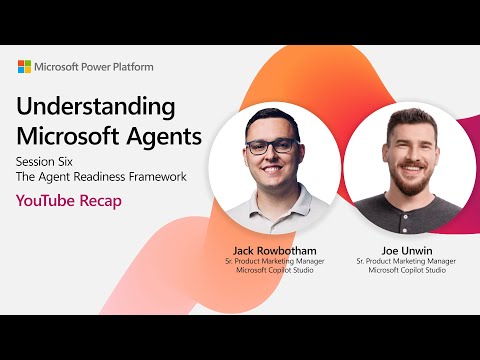
Overview of the video and the Agent Readiness Framework
The YouTube recap, produced by Microsoft, summarizes Episode 6 of the "Understanding Microsoft Agents" series and focuses on the new Agent Readiness Framework. The hosts, Joe Unwin and Jack Rowbotham, presented the framework during a live call on January 14, 2026, and the video walks viewers through how organizations can evaluate readiness for scaling AI agents. As a result, the session aimed to move teams from pilot projects to enterprise-wide deployments with clearer priorities and measurable outcomes. Consequently, the video frames the framework as a practical tool rather than a theoretical model.
The presentation is meant for IT decision makers and enterprise leaders who must balance strategy, technology, governance, and operations. The session also referenced research involving 500 IT decision makers to ground its recommendations in observed trends. Thus, the video blends research findings with actionable guidance to help organizations plan next steps. This context sets expectations for both executives and technical teams who will implement agent programs.
The five-pillar structure and what each pillar means
The framework presented in the video rests on five pillars that together aim to guide successful agent adoption: strategy, value tracking, integration, security governance, and operational management. First, the hosts emphasized that a clear business and AI strategy helps define which agent scenarios truly drive impact and where to focus investments. Then, they showed how measuring outcomes keeps teams accountable and helps prioritize further rollout. Overall, the five-pillar view encourages balanced progress rather than chasing isolated technical wins.
Moreover, the framework links strategic choices to practical actions such as governance roles, tooling, and change management, which the presenters describe in plain terms. The video suggests that organizations should translate high-level vision into quarter-by-quarter commitments and measurable milestones. This approach helps leaders spot blockers early and align stakeholders. Therefore, the framework aims to reduce uncertainty as projects scale.
Finally, the video highlights that these pillars are interdependent: weak governance will erode measured value, while unclear strategy will slow integration across teams. Consequently, Microsoft frames the five pillars as a checklist for sustainable change rather than a recipe for immediate transformation. The intent is to provide a repeatable path that teams can adapt to their own maturity and risk profile. That adaptability is crucial for enterprises with diverse legacy systems and compliance needs.
Organizational segments and adoption patterns
The recap explains that Microsoft’s research divides organizations into four segments—discoverers, operators, visionaries, and achievers—based on how they adopt AI agents. Each segment shows different strengths and gaps: for example, visionaries may set ambitious plans but struggle with execution, while operators excel at steady rollout but may miss strategic innovation. This segmentation helps leaders pick targeted interventions rather than one-size-fits-all solutions. Therefore, mapping an organization to a segment guides the next steps.
Furthermore, the speakers discussed how maturity varies on three fronts: whether firms treat AI as a core investment, how well they measure AI value, and how broadly they integrate agents across the enterprise. These distinctions matter because they influence resourcing, governance design, and the pace of scaling. For instance, firms that already track outcomes can expand faster, while those still exploring use cases may need stronger executive sponsorship. Thus, understanding where an organization sits helps prioritize resources effectively.
In practice, the video encourages leaders to run simple assessments that reveal which segment they belong to and what capabilities to build next. This pragmatic step keeps planning grounded and avoids overcommitting to technologies before organizational readiness is in place. As a result, teams can test hypotheses and iterate with lower risk. That iterative stance balances ambition with operational reality.
Security, governance, and regional considerations
The hosts devoted significant time to security and governance, stressing that clear roles and accountability reduce risk as agents gain access to sensitive data. They recommend defining who acts as makers, approvers, and managers of agents to avoid confusion and to enforce consistent policies. Additionally, the video highlights how governance must span the agent lifecycle—from design to decommissioning—to maintain compliance. Consequently, governance becomes a continuous discipline rather than a one-time setup.
Regional differences also featured in the discussion, with the presenters noting that regulatory regimes in Europe and North America influence governance choices. For example, privacy rules and data residency requirements may force different deployment architectures and controls. Hence, organizations should factor local regulation into their readiness plans and avoid a uniform global approach that ignores legal nuances. This regional sensitivity helps reduce unexpected compliance costs and implementation delays.
Balancing control with speed remains a key tension: stricter controls reduce risk but can slow innovation, while looser rules speed rollout but increase exposure. The video advises teams to choose guardrails that reflect acceptable risk levels and to automate policy enforcement where possible. In this way, organizations can protect assets while maintaining momentum. The presenters argue that automation in governance is often the best compromise between security and agility.
Tradeoffs, challenges, and practical next steps
The video does not shy away from tradeoffs: scaling agents requires investment, cross-team collaboration, and tolerance for iterative learning, which can clash with short-term delivery pressures. Teams often struggle to balance quick wins with the long-term investments needed for integration and reliable measurement. Thus, leaders must decide when to prioritize rapid pilots versus building durable platforms that support scale. This tradeoff affects budgets, timelines, and organizational design.
To address these challenges, the presenters recommend a staged approach: start with clear business scenarios, measure outcomes, then expand while strengthening governance and operations. They also suggest aligning senior sponsorship with quarterly milestones so that blockers get attention and resources. Finally, practical actions include mapping current capabilities, assigning accountability, and setting measurable value targets. These steps help transform the framework from guidance into actionable plans.
In summary, the Agent Readiness Framework is positioned as a pragmatic guide to scale AI agents responsibly, balancing strategic vision with operational detail. By acknowledging tradeoffs and offering concrete next steps, the recap aims to help organizations move from experimentation to sustained impact. For teams planning agent initiatives, the video provides a clear starting point and a roadmap to navigate complexity without losing momentum.