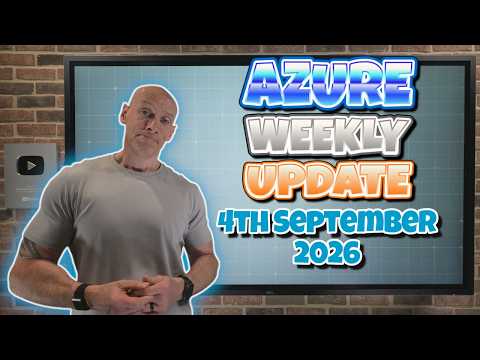
In a concise weekly briefing, a YouTube video from John Savill's [MVP] channel summarized a wide range of Azure updates for the week of 4 September 2026. The episode presents product launches, previews, and ecosystem changes that affect cloud architects, developers, and operations teams. Overall, the update emphasizes Microsoft’s continued push toward managed services, scalable AI platforms, and tighter multicloud connectivity.
Overview of the episode
The video opens with a quick rundown of new material and a note about a charity event, setting a practical tone for the update. Then, it walks through a chaptered list of topics, ranging from VM image tooling to AI model rollouts and networking improvements. Consequently, viewers get a compact but broad view of Azure developments and areas to follow in the coming weeks.
Major platform releases and AI advances
Most notably, the briefing highlights that Managed Instance on Azure App Service moved to general availability, offering a 99.95% SLA and wider regional reach, which should simplify migrations of legacy .NET Framework apps. Moreover, the update calls out several major AI platform items in Microsoft Foundry, including broader availability of advanced models like GPT-5.6 and the early roll-out of GPT-6 Astra through limited access, indicating a rapid cadence of model updates.
However, viewers are reminded that advanced AI and platform releases bring tradeoffs: while new models improve capability, they also raise questions about cost, governance, and data residency. For example, organizations will need to balance the benefits of higher-performing models against budget constraints and compliance responsibilities. Therefore, planning for data governance and staged rollouts remains essential when adopting these offerings.
Scaling Kubernetes and developer tooling
The update reports that AKS Hyperscale Control Plane is available in preview, allowing more predictable tiered capacity guarantees for Kubernetes control planes, which should help large-scale workloads. In addition, several AKS features gained attention: support for Windows Server 2025, artifact streaming, and confidential Linux VMs, all of which target performance, platform modernization, and security for containerized apps.
At the same time, the video covers improvements to developer and migration tools such as azqr v4.0.0 which improves operational analysis, and increased availability for VM deployment and image building tooling. Yet, the presenter notes that upgrades to tooling can bring breaking changes, so teams must test automation scripts and CI/CD pipelines before applying updates to production systems.
Networking, multicloud, and connectivity
On networking, a standout announcement is Azure Multicloud Interconnect for AWS, intended to simplify private connectivity between Azure and AWS for hybrid and multicloud workloads. Additionally, features like improved firewall SNAT route learning and edge WAF policy association were highlighted, which aim to reduce operational friction and tighten traffic control.
Despite these advances, multicloud connectivity carries inherent complexity: private links reduce latency and exposure to the public internet, but they require careful configuration, cost planning, and cross-cloud governance. Thus, organizations must weigh the benefits of private, high-throughput links against management overhead and the need for consistent security policies across providers.
Security, observability, and platform operations
The briefing also covers updates in security and observability, including expanded Defender for Cloud integrations, new log types for the Copilot observability agent, and auxiliary table support for Azure Monitor Logs in sovereign clouds. Furthermore, enhancements to recovery tools such as ASR Linux NVMe support and refinements in IPAM for virtual network managers were noted as practical operational improvements.
Even so, adopting enhanced observability and security capabilities introduces tradeoffs between telemetry volume and cost, as well as the need to tune alerting to reduce noise. Therefore, teams should plan phased telemetry rollouts and define retention and sampling strategies to balance insight with budget and performance.
Implications for organizations and next steps
Overall, the episode provides a useful snapshot of where Azure is focusing: managed platforms, scalable AI, and stronger multicloud networking, combined with practical improvements for developers and operators. Consequently, organizations should assess which updates align with their modernization, security, and cost objectives, while testing changes in controlled environments before broad adoption.
Finally, the video serves as a reminder that fast-moving cloud platforms require disciplined change management and governance to realize benefits without unintended consequences. As a result, teams that combine staged testing, cost modeling, and governance planning will be best positioned to take advantage of these Azure updates.