- All of Microsoft
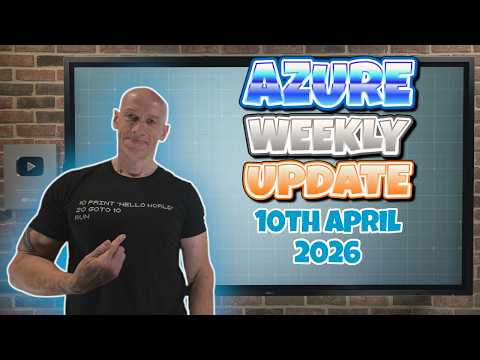
Azure April 2026: Top Updates You Need
Principal Cloud Solutions Architect
Azure update spotlights AI model releases, AKS CIDR expansion, Azure Functions triggers, OpenShift GPU support
Key insights
-
Azure Update video (10 Apr 2026) gives a short pack of platform and AI changes across Azure.
It highlights infrastructure, pricing, developer, and database updates you should track. -
ephemeral OS disk caching for VMs and VM Scale Sets caches the full OS disk to local storage.
This reduces dependency on remote storage, improves performance, and raises VM resiliency in production. -
Windows 365 price cut reduces Business list prices by about 20% starting 1 May 2026.
The new on-demand start keeps Cloud PCs powered for one hour after sign-out, with slightly longer resume times after that window. -
Platform and developer updates include PHP 8.5 on App Service for Linux and a simpler code-deploy flow for Linux apps.
Database improvements include PgBouncer 1.25.1 now GA on Azure Database for PostgreSQL Flexible Server for better connection pooling. -
Storage and migration changes: Azure Files assessments are now available through Azure Migrate and Premium SSDv2 expanded into more regions.
The release also covers Azure Red Hat OpenShift region expansion and new NVIDIA GPU support for container workloads. -
Enterprise and AI updates: License Mobility for Windows Server and SQL bought under the Microsoft Customer Agreement starts 1 Apr 2026, easing license flexibility.
The update also mentions new MAI models, Grok 4.2, AKS observability and networking improvements, and other AI/tooling advances to watch.
In a concise YouTube update, John Savill's [MVP] highlighted a range of fresh Azure developments on 10 April 2026, focusing especially on infrastructural resilience, cost improvements, and artificial intelligence additions. The video runs through a compact set of chapters that summarize changes affecting Kubernetes, virtual machine behavior, storage, databases, and several AI-related launches. Consequently, the update offers IT teams a practical snapshot of platform changes they should consider when planning deployments in the coming months. For readers and operators, the video aims to prioritize clarity and immediate operational impact over deep technical tutorials.
Container Networking and Observability
First, the update draws attention to several changes around AKS that will matter to cluster operators and networking teams, including an overlay CIDR expansion and an option to disable HTTP proxy settings. These updates make it easier to scale pod addressing and to handle special proxy scenarios that can complicate containerized workloads, and they therefore reduce common roadblocks in larger deployments. Additionally, Savill mentions improvements to AKS observability, which should help teams detect and resolve issues faster by providing richer telemetry and more integrated troubleshooting tools. However, teams must weigh the benefits of richer telemetry against the additional cost and potential complexity of collecting and storing more data.
Virtual Machine Resilience and Performance
Notably, Microsoft introduced ephemeral OS disk caching for Virtual Machines and VM Scale Sets, a change that shifts how OS images are read and cached locally. By caching the full OS disk on local storage rather than relying on remote storage reads, VMs gain improved resilience against remote storage failures and lower boot latencies in many scenarios. On the other hand, this approach increases dependence on local node health and available local disk capacity, which means administrators must balance performance gains with the risk of node-level failures and plan capacity accordingly. In practice, organizations will need to test caching behavior against their fault domain strategies to ensure gains in speed do not accidentally raise operational risk.
Storage, Databases, and Migration Tools
Savill covers several storage-oriented changes, including the availability of Azure Files assessments in Azure Migrate and broader region support for Premium SSDv2. These updates aid migration planning and give teams more performance options near their users, while also simplifying cost and performance forecasting. The update also notes that PgBouncer 1.25.1 is now generally available on Azure Database for PostgreSQL Flexible Server, which improves connection pooling for workloads that require many short-lived connections. Nevertheless, teams must evaluate pooling parameters carefully, because misconfigured pooling can cause connection starvation or uneven load distribution across database instances.
AI, Models, and Developer Experience
The video touches on additions to Microsoft’s model ecosystem, mentioning new models in the Microsoft AI Infrastructure and tools such as Grok 4.2 and Foundry Local, which signal a continuing push to deliver on-premises and edge-capable AI options. Furthermore, Developer experience enhancements include simpler deployment workflows for App Service on Linux and updates to Azure speech synthesis capabilities, which speed up common developer tasks and enable richer application features. However, adopting new AI models or local inference solutions often requires careful evaluation of data governance, latency, and cost tradeoffs, and teams may need to update pipelines and testing to ensure parity with cloud-hosted alternatives. Therefore, developers should plan staged rollouts and run controlled benchmarks to understand real-world performance implications.
Cost, Licensing, and Enterprise Flexibility
On the cost front, Microsoft announced a significant price reduction for Windows 365 Business, dropping list prices by 20% starting 1 May 2026, along with an on-demand start behavior that keeps Cloud PCs available for a short period after sign-out. This change can lower monthly costs for many teams and smooth user experiences during frequent sign-ins, yet organizations should evaluate how the new start behavior interacts with their power management and security policies. In addition, License Mobility rights for subscriptions purchased under the Microsoft Customer Agreement now offer flexibility similar to legacy Software Assurance, which simplifies licensing conversations for enterprise customers working with partners. Still, customers must carefully map their licensing entitlements against legacy contracts to avoid unexpected costs or compliance issues during transitions.
Overall, the YouTube update from John Savill's [MVP] provides a practical, operations-focused tour of recent Azure changes, balancing new capabilities with the tradeoffs they bring. While many updates promise performance, cost, or manageability gains, they also introduce choices about where to run workloads, how to configure telemetry and caching, and what licensing model best fits organizational needs. Accordingly, teams should prioritize testing and phased rollouts, use pilot environments to measure impact, and update runbooks to reflect new behaviors so that the platform improvements translate into reliable production benefits. Finally, the concise format of the video makes it useful as a quick briefing for engineering and IT leadership who need to align strategy with current platform capabilities.

Keywords
Azure update April 10 2026, Azure April 2026 announcements, Azure new features April 2026, Azure security updates April 2026, Azure service releases April 2026, Azure pricing changes April 2026, Azure governance compliance April 2026, Azure hybrid AI updates April 2026