- All of Microsoft
- Microsoft 365
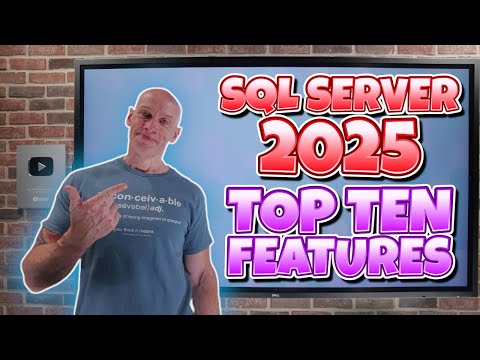
SQL Server 2025: 10 Must-Know Features
Principal Cloud Solutions Architect
SQL Server highlights vector AI, JSON and fuzzy search, REST GraphQL endpoints, new Python driver, Azure Arc and Fabric
Key insights
- Native AI Integration: SQL Server 2025 lets you call and host AI models directly from T‑SQL (for example via sp_invoke_external_rest_endpoint and CREATE EXTERNAL MODEL).
It includes functions to chunk and process large text inside the database and integrates with frameworks like LangChain for retrieval‑augmented generation workflows. - Vector storage and search: The engine adds a native vector data type to store embeddings in tables and uses DiskANN indexing for fast similarity searches.
This removes the need for external vector databases and enables efficient semantic search inside SQL Server. - JSON native type and indexes: SQL Server now supports a true JSON data type and allows indexed JSON path queries.
Queries over semi‑structured data (APIs, logs) run much faster because JSON is parsed and indexed natively. - REST and GraphQL endpoints: You can expose and call REST and GraphQL endpoints directly from the database, simplifying integration with web APIs and microservices.
Change event streaming also helps push real‑time data to analytics or downstream systems. - Query optimization & locking improvements: New features like Optional Parameter Plan Optimization (OPPO), better cardinality feedback, and improved memory‑grant handling reduce bad plans and parameter sniffing problems.
Locking improvements lower blocking and lock memory use, boosting concurrency in busy workloads. - Backup, availability and security: Backups can run on secondary replicas and write to immutable blob storage with faster ZSTD compression options.
Always On enhancements, Fabric/Arc integration for hybrid scenarios, and Microsoft Entra identity support (plus TLS 1.3) strengthen recovery and security.
In a new YouTube video, John Savill's [MVP] offers a concise walkthrough of the most notable additions in SQL Server 2025, and the clip highlights how Microsoft is pushing databases toward native intelligence and modern data handling. The presentation runs through ten headline features, from Native AI Integration and vector support to storage and engine improvements, while also touching on security and backup enhancements. Consequently, this update aims to close the gap between traditional relational systems and AI-first application patterns, making it relevant to developers, DBAs, and IT leaders planning future architectures.
AI and Vector Features: Bringing Models Inside the Database
Savill emphasizes that SQL Server 2025 embeds AI more directly than previous releases, enabling calls to external models from T-SQL using procedures such as sp_invoke_external_rest_endpoint and the ability to register models with CREATE EXTERNAL MODEL. Moreover, the platform introduces a native vector data type and integrates DiskANN indexing, which together let databases store embeddings and run similarity searches without a separate vector database.
However, this convergence carries tradeoffs. On the one hand, colocating embeddings and inference simplifies data movement and reduces latency for retrieval-augmented generation workflows. On the other hand, it raises questions about operational complexity, model lifecycle management, and storage costs when high-dimensional vectors and indexes grow large, so teams must weigh convenience against resource planning and governance.
Enhanced Data Types: JSON, RegEx, and Flexible I/O
The video points out native support for a JSON type with indexable paths, along with built-in RegEx and fuzzy string matching capabilities that remove the need for CLR extensions. These changes make SQL Server more attractive for semi-structured workloads such as API payloads and log analytics, because queries can now parse and index nested content more efficiently within relational tables.
Still, using native JSON and RegEx increases the responsibility on DBAs to design appropriate indexes and monitor query patterns, since naive indexing can bloat storage or slow writes. Therefore, teams must balance the benefits of richer querying against maintenance overhead and carefully test performance implications before adopting broad schema changes.
Integration and Streaming: Fabric, REST, GraphQL, and Change Events
Savill also covers integration touchpoints that aim to modernize data flow, including REST and GraphQL endpoint support and near real-time change event streaming, plus tighter ties to Microsoft Fabric and Arc. These capabilities help bridge operational systems and analytics platforms, enabling low-latency mirroring to warehouses and smoother hybrid cloud scenarios for analytics teams.
Nevertheless, integrating transactional systems with analytics platforms introduces consistency and latency tradeoffs. While streaming and mirroring support speed analytics, they require robust change-data-capture patterns and observability to avoid drift. As a result, architects should plan for monitoring, schema evolution, and potential rate-limiting to preserve transactional performance.
Engine, Backup, and Availability Improvements
The video highlights several engine-level improvements such as optimized locking, optional parameter plan optimization to reduce parameter sniffing, and better memory grant feedback for more stable query performance. Additionally, backup and disaster recovery gained features like differential backups on secondaries, immutable blob backups, and a new ZSTD compression option that promises faster and smaller backups.
These operational upgrades reduce downtime risk and improve concurrency, yet they also require updated runbooks and testing. For example, immutable backups and new compression algorithms change restore procedures and storage planning, so organizations must validate that recovery objectives still meet business requirements after adopting these features.
Security, Editions, and the Path to Production
Finally, Savill discusses modernized security and identity management with support for Microsoft Entra managed identities and TLS 1.3 for improved transport security. The update also brings improvements for Express and Standard editions, widening the base of users who can benefit from new features without immediately moving to enterprise tiers.
Despite these gains, introducing AI functions and broader integration points widens the attack surface and demand for governance. Consequently, teams must balance rapid feature adoption with stronger identity controls, monitoring, and data protection policies to meet compliance and security expectations.
Overall, the YouTube video by John Savill's [MVP] presents SQL Server 2025 as a pragmatic step toward embedding intelligence and modern data patterns into the core database engine. While many features promise clear productivity gains, the real-world value depends on careful planning around costs, operations, and governance to manage the tradeoffs inherent in modernization.
https://hubsite365cdn001img.azureedge.net/SiteAssets/TopicImages/marvin-meyer-SYTO3xs06fU-unsplash.jpgKeywords
SQL Server 2025 top features, SQL Server 2025 new features, SQL Server 2025 performance improvements, SQL Server 2025 security enhancements, SQL Server 2025 AI integration, SQL Server 2025 T-SQL enhancements, migrate to SQL Server 2025, SQL Server 2025 upgrade guide