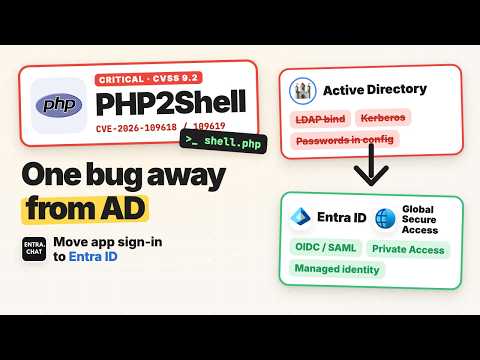
Microsoft Entra ID Limits App Compromise Damage
Product Manager @ Microsoft 👉 Sign up to Entra.News my weekly newsletter on all things Microsoft Entra | Creator of cmd.ms & idPowerToys.com
Merill Fernando explains how moving app identities away from Active Directory can limit the damage after a server is compromised.
Key insights
- The video says patching is the first response; identity changes do not fix PHP, GitLab or Node.js vulnerabilities.
- Applications can expose Active Directory through LDAP sign-in, service accounts, domain joins and Kerberos delegation.
- Fernando recommends moving app sign-in to Entra ID with OpenID Connect or SAML where possible.
- Managed identities and workload identity federation can replace passwords stored in application configuration.
- Defender for Identity and Private Access application discovery can help identify risky or unused app connections.
Merill Fernando recently published a short video about PHP2Shell, a critical GitLab vulnerability and a Node.js security issue, and what a compromised application server might reach next. His main point is that patching closes the known vulnerability, while reducing an app's dependence on Active Directory can limit the damage if another server is breached. The video presents Microsoft Entra ID as part of that longer-term identity approach, not as a substitute for applying security updates.
What's new
The video brings together three remote code execution vulnerabilities and shifts attention from the initial software flaw to the identity and network connections available to a compromised server. It identifies PHP2Shell as CVE-2026-109618 and CVE-2026-109619, GitLab's issue as CVE-2026-110264, and a Node.js issue as CVE-2026-111497 and others. The description lists fixed PHP, GitLab and Node.js versions, and says end-of-life Node.js releases do not receive the listed fixes.
Fernando's practical ordering is explicit: patch first, then contain. The video's description says temporary PHP mitigations do not make a server safe, so administrators should not treat identity hardening as a replacement for upgrading affected software. The longer-term goal is to reduce how much an application relies on Active Directory and to limit what its server can reach.
The risk comes from common application connections to a directory environment. These include LDAP sign-in, service accounts, domain-joined servers, unconstrained Kerberos delegation and network access to domain controllers. Any of these can make a compromised application server a stepping stone toward broader access, depending on its configuration and permissions.
Why it matters
For administrators, the video reframes patch management as only one part of incident containment. A server may be patched against a specific flaw, but security teams also need to know what credentials it holds, which identities it uses and which systems it can contact. That assessment helps distinguish a compromise limited to one workload from one that could reach directory services.
For identity and security teams, the recommendation is to modernize application authentication where feasible. With OpenID Connect or SAML, an application can sign in through Entra ID and receive a signed token rather than using a password, according to the video. The description says Entra can then handle controls such as multifactor authentication, passkeys and Conditional Access; it does not claim that every legacy app supports these protocols.
For teams responsible for older applications, the video also covers a transition path rather than assuming every system can immediately leave Kerberos behind. It suggests publishing legacy Kerberos applications through Microsoft Entra Private Access with Kerberos single sign-on. The accompanying documentation describes this configuration, but the video does not specify licensing, rollout scope or prerequisites for particular environments.
Makers and application owners should also review secrets in configuration and the permissions assigned to workload identities. Replacing stored passwords with managed identities or workload identity federation can remove a password from that particular authentication path. It does not make the application itself invulnerable, and the video does not provide a full implementation guide or permission design.
How it works
The video outlines several complementary steps. They address authentication, stored credentials, access to legacy services and discovery of applications. The order below reflects the video's guidance, but organizations will need to account for their own application dependencies.
- Patch the vulnerable software. Apply the listed PHP, GitLab and Node.js fixes that match the deployment. The video stresses that this is the immediate response and that temporary PHP mitigations are not enough to make a server safe.
- Move application sign-in to Entra ID where possible. Use OpenID Connect or SAML so the app receives a signed token instead of handling a password directly. Entra can apply sign-in controls such as MFA, passkeys and Conditional Access.
- Replace configuration passwords. The video recommends managed identities or workload identity federation as alternatives to passwords stored in configuration. Microsoft documentation explains these identity approaches, but the video does not walk through setup.
- Constrain legacy access. For applications that still require Kerberos, publish them through Entra Private Access with Kerberos SSO. Remove bind accounts that are no longer needed and firewall application servers away from domain controllers, as appropriate.
- Find the connections first. The video says Defender for Identity can flag services sending LDAP credentials in clear text. It also points to Private Access application discovery as a way to see which private applications people use.
These steps reduce exposure in different ways: modern authentication changes how an app obtains identity, workload identity options avoid some stored passwords, and network restrictions limit server reach. Discovery matters because administrators may not know which applications still rely on LDAP, Kerberos or directory connectivity. The video does not claim that these controls prevent exploitation of the underlying software bug.
Limitations and open questions
The clearest limitation is that identity modernization does not repair vulnerable code. Fernando's advice is to patch first, and he specifically warns that temporary mitigations do not make the affected PHP server safe. The same principle applies to the other named vulnerabilities: the video's containment recommendations are not a replacement for the relevant software fixes.
The video gives strategic steps, not a migration runbook. It does not explain how to assess compatibility for every application, how to scope permissions for managed identities, or what licensing and deployment requirements apply to each Entra feature. Those details must be checked for the specific application and environment before a change is planned.
It also does not quantify how much risk each measure removes or say that all applications can be moved off Active Directory. Its recommendation is conditional: modernize authentication wherever possible, and contain the remaining legacy dependencies. The fixed versions and vulnerability details in the description are stated as of October 22, 2026; readers should verify current vendor guidance before acting.
Sources
- Merill Fernando's video on PHP2Shell, GitLab and identity containment
- Microsoft documentation on managed identities
- Microsoft documentation on workload identity federation
- Microsoft documentation on Kerberos SSO with Private Access
- Microsoft documentation on Private Access application discovery
- Microsoft documentation on Defender for Identity account posture assessments
Frequently asked questions
Does moving an app to Entra ID fix PHP2Shell or the GitLab vulnerability?
No. The video says patching is the immediate fix; identity changes are intended to limit what a compromised application can reach.
What authentication methods does the video recommend?
It recommends OpenID Connect or SAML for app sign-in to Entra ID where possible, so the app receives a signed token rather than a password.
What can replace passwords stored in app configuration?
The video names managed identities and workload identity federation. It does not provide setup steps or a permissions design.
How can teams identify legacy app dependencies?
The video says Defender for Identity can flag services sending LDAP credentials in clear text, and Private Access application discovery can show which private apps people use.