- All of Microsoft
AI Agents: Guide to Modern Architectures
IT Program Manager @ Caterpillar Inc. | Power Platform Solution Architect | Microsoft Copilot | Project Manager for Power Platform CoE | PMI Citizen Developer Business Architect | Adjunct Professor
Agentic AI: use cases and scalable architecture with Microsoft Foundry, Copilot Studio and Three Sixty Five Copilot
Key insights
- AI agent: An AI agent uses a large language model plus tools and memory to act for a user, plan tasks, call services, and update its internal state as it works. It goes beyond single prompt-response chatbots by chaining steps and actions.
- Why agents matter: Agents handle open-ended problems and multi-step processes that need planning, tool use, and learning from feedback. They work well when tasks require orchestration across systems rather than a single answer.
- Microsoft Agent Framework: Microsoft highlights a framework that gives developers abstractions and building blocks to manage agent complexity so they can focus on application logic, not plumbing. The framework supports both autonomous agents and workflow-style orchestration.
- Core architecture: Key parts include the language model as the reasoning core, external tools (APIs and services) for actions, memory to keep context, and a repeating agent loop that reasons, acts, and updates state.
- Microsoft ecosystem: The series focuses on Microsoft tech like Foundry, Copilot Studio, Microsoft 365 Copilot, and Agent 365, showing how these tools fit into production agent designs and real enterprise scenarios.
- Series outcome: The course walks from fundamentals to real implementations, offers GitHub repos for each episode, and aims to help you design and build scalable, production-ready agentic systems for real projects.
Episode Snapshot
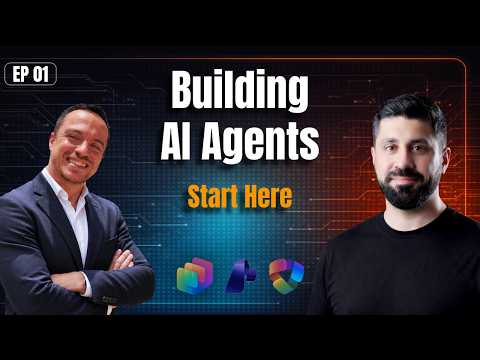
Rafsan Huseynov’s YouTube video, titled “Episode 1: Introduction to AI Agents & Modern Architectures”, launches a multi-part series that aims to guide developers through building production-grade agentic systems. In this first episode, he outlines real-world use cases and previews the topics that the series will cover, from foundational ideas to hands-on implementations. The presenter frames the material around Microsoft tools and platforms, making the session particularly useful for teams invested in that ecosystem. Overall, the episode sets expectations and explains how viewers can follow along with code and examples.
Core Concepts Explained
Huseynov defines an AI agent as more than a prompt-response chatbot; he describes it as a system that combines a language model with tools and memory so it can act, reason, and update state across steps. He further emphasizes that agents excel at open-ended tasks and multi-step processes, where planning and tool use matter more than single-turn answers. The video also introduces the repeating cycle of reasoning, tool calls, and memory updates, often called the agent loop, to explain how execution progresses in practice. These explanations are direct and use real examples to make abstract ideas tangible.
Microsoft Ecosystem and Technologies
The episode highlights Microsoft platforms such as Microsoft Foundry, Copilot Studio, Microsoft 365 Copilot, and Agent 365 as the focal tools for the series. Huseynov positions the company’s offerings as a coherent stack that supports both agent autonomy and workflow orchestration, which he calls the practical distinction developers should note. Consequently, the guidance leans toward Microsoft’s own abstractions, like the Microsoft Agent Framework, that aim to reduce plumbing and let engineers focus on application logic. For practitioners, this means a smoother path to production if they adopt those services, but it also means tighter coupling to a vendor platform.
What the Episode Promises to Build
In addition to concepts, the presenter outlines what viewers will build across the series and provides timestamps to guide learning. He explains that every episode will include a GitHub repository with full implementations so developers can replicate the projects in their own environments. Therefore, learners can study design patterns, implementation details, and the practical tradeoffs of different choices while following along. This hands-on approach aims to close the gap between theory and production-ready systems.
Tradeoffs in Design Choices
Huseynov discusses tradeoffs explicitly and shows that choosing between agent autonomy and workflow orchestration is rarely clear-cut. On one hand, fully autonomous agents can simplify user interactions and handle complex tasks; on the other hand, they raise concerns around control, predictability, and safety, so workflows often add needed governance. Memory and tool integration improve capability but increase cost and system complexity, especially when managing long-term state and secure access to external services. Therefore, teams must weigh agility against cost, security, and operational overhead when designing agentic systems.
Challenges to Address
The video makes a pragmatic case for addressing common challenges such as scaling, observability, and error handling in agentic systems. Huseynov notes that production systems need orchestration, logging, and clear retry strategies so agents behave reliably across failures and complex tool chains. Additionally, data privacy and access control become harder when agents interact with multiple services and persistent memory, which requires careful design and governance. Consequently, teams must invest in monitoring and safety mechanisms early to avoid costly rework later.
Practical Guidance and Resources
For developers who want to follow the series, Huseynov commits to providing GitHub repositories for each episode, enabling reproducible learning and direct experimentation. He also outlines a series structure that moves from basics to implementation, which should help learners build confidence before tackling production concerns. Moreover, the timestamps and episode plan lets viewers jump to segments that match their current needs while planning a longer learning pathway. This mix of theory, demo, and code supports both quick wins and deeper study.
Why This Matters Now
The emphasis on agentic architecture reflects broader shifts in how applications integrate generative models with real systems. As Huseynov and Microsoft stress, agents work best for tasks requiring planning, tool interaction, and incremental learning, so enterprise use cases like customer support, automation, and decision assistance stand to benefit. However, adopting these patterns also forces teams to confront operational maturity, security, and cost in new ways. Thus, the episode serves as both an introduction and a prompt for responsible engineering choices.
Looking Ahead
Finally, Huseynov previews upcoming episodes and encourages viewers to subscribe to track the full series and hands-on builds. He promises deeper dives into production patterns and the Microsoft Agent Framework, which suggests future discussions on orchestration, testing, and deployment strategies. Therefore, teams considering agentic designs should watch the series for practical guidance while keeping in mind the tradeoffs and governance needed for enterprise adoption. Overall, the episode provides a clear and measured start to a practical learning path in modern agent architectures.

Keywords
AI agents tutorial, Introduction to AI agents, AI agents for beginners, Modern AI architectures, Agent-based AI, Multi-agent systems, Autonomous AI agents, AI system architecture overview