- All of Microsoft
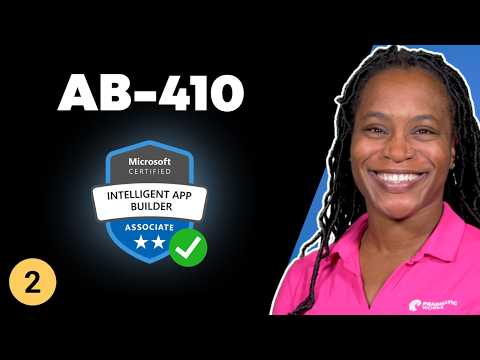
AB-410 Exam: Proven Study Strategies
Microsoft expert AB four one zero prep with Microsoft Learn, Dataverse, Power Apps, Power Automate and AI in a month
Key insights
- Microsoft Learn first: start the official AB-410 learning path and use the built-in knowledge checks to find weak areas before deep study.
Use the checks to avoid wasting time on topics you already know. - Study selectively, not linearly: skip reading every module start-to-finish and target only the modules and hands-on labs that cover your weak points.
Hands-on practice beats passive reading for retention. - Prioritize the heaviest domain: focus most study time on Domain 3 (business application logic and automation) and practice real flows with Power Automate cloud flows.
Domain 3 typically carries the largest exam weight and is scenario-heavy. - Master Dataverse basics: be confident with Dataverse concepts like tables, relationships, views, forms, security roles, and prompt or formula columns.
These fundamentals appear across many exam scenarios. - Cover AI and copilots practically: practice with AI Hub and Copilot Studio concepts such as prompt design, agents, AI models, and knowledge grounding.
The exam emphasizes generative AI workflows and agent-based scenarios. - Build one integrated mini-solution end-to-end: include a model-driven or canvas app, Dataverse tables, a flow, an AI prompt component, and security, then package it for ALM.
Review governance and ALM, avoid memorizing dumps, and validate mistakes against official docs.
Overview of the Video
Pragmatic Works published a concise YouTube walkthrough that outlines a focused approach to preparing for the AB-410 exam, which leads to the Intelligent Applications Builder Associate certification. The presenter, Monica, frames the exam as new and scenario-heavy, so she stresses practical preparation over wide but shallow reading. In particular, she recommends starting with the official Microsoft Learn path and then using learning modules, hands-on labs, and knowledge checks to guide study priorities.
Moreover, Monica offers a 30-day study blueprint that emphasizes the highest-weighted exam domain: building application logic and automation. Consequently, the video focuses on how to allocate time, what to practice in a sandbox, and which topics to prioritize. This article summarizes those points and explores tradeoffs candidates should weigh while preparing.
Study Workflow and the 30-Day Plan
The core workflow Monica promotes begins with a diagnostic step: take knowledge checks first to reveal weak areas. Then, rather than reading every module end-to-end, return only to the materials and labs that address those gaps, which saves time and reduces cognitive overload. She pairs the diagnostic approach with a four-week schedule that concentrates effort on hands-on tasks and scenario building.
In practice, the four-week plan pushes candidates to build integrated solutions early and iterate on complexity as time allows. This method balances quick wins and deeper learning by front-loading the highest-value topics. As a result, candidates get relevant experience in the areas that matter most on exam day while avoiding wasted time on low-impact content.
Key Focus Areas and Tradeoffs
Monica identifies several topics that deserve close attention, including Dataverse, Power Apps, Power Automate, and AI-related features such as AI Hub and Copilot. She highlights that the exam is shifting toward generative AI and agent-based scenarios, so studying prompt design, AI Hub prompting, and Copilot Studio components becomes more important than in past low-code tests. Therefore, candidates must decide whether to lean deeper into AI features or maintain broader coverage across traditional app building.
Those choices involve tradeoffs: focusing heavily on AI can raise competence in new, high-weight areas, but may leave gaps in governance, ALM, or classic app architecture. Conversely, equal distribution of study time across every topic risks superficial understanding in the exam’s heaviest domain. Monica suggests prioritizing the heavy domains first and planning targeted reviews of other sections later to balance depth and breadth effectively.
Practical, Hands-On Strategy
Throughout the video, the presenter urges building a single, end-to-end mini-solution that includes Dataverse tables, a model-driven app, a canvas app, at least one flow, an AI prompt component, and solution packaging with security roles. This integrated approach mirrors the scenario-based nature of the exam and trains candidates to connect features in realistic ways. Consequently, hands-on practice helps bridge the gap between conceptual knowledge and practical troubleshooting skills that the test favors.
However, hands-on practice has constraints: trial environments and lab time are limited, and not every candidate can replicate complex enterprise configurations. Therefore, Monica recommends using guided labs where available and focusing on exercises that exercise the core workflows tested on the exam. By doing so, candidates can gain meaningful experience without trying to re-create a full production stack.
Challenges and Final Recommendations
One of the biggest challenges Monica highlights is the exam’s novelty, which means fewer practice exams and community write-ups exist compared with older certifications. This scarcity increases the value of official resources like Microsoft Learn and validated hands-on labs, while making caution essential when encountering third-party “question bank” shortcuts. As a result, she warns against memorization strategies and encourages scenario practice and understanding design tradeoffs.
Finally, Monica closes with practical reminders: use knowledge checks to find weak spots, prioritize the highest-weighted domain, allocate time for AI topics, and package your practice into a repeatable mini-solution. In sum, the video from Pragmatic Works offers a balanced, time-boxed plan that helps candidates focus on real-world integration, but it also calls for candidates to make conscious tradeoffs between depth and breadth and to acknowledge the limitations of available practice material.

Keywords
AB-410 exam prep, AB-410 study guide, AB-410 practice tests, AB-410 exam tips, AB-410 study plan, AB-410 practice questions, AB-410 passing score, AB-410 review course