- All of Microsoft
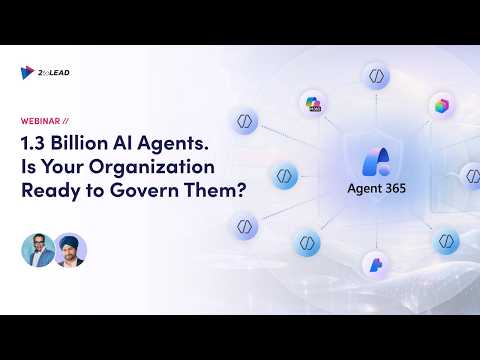
Microsoft Agent 365: Secure & Govern AI
Guide to secure AI agents with Agent Three Sixty Five control plane for identity, permissions, DLP and Microsoft Purview
Key insights
- Agent 365 centralizes discovery, monitoring, and security for AI agents inside the Microsoft 365 Admin Center, letting IT manage agents with the same oversight used for human employees.
- Microsoft Entra Agent ID gives each agent a unique identity so actions are attributable, enabling clear accountability and reliable auditing.
- Lifecycle governance enforces onboarding, sponsor ownership, approval workflows, and retirement rules so agents start and stop operation under defined controls.
- Policy-based governance and runtime protection let teams set behavioral rules, conditional access, and live checks to block unsafe or out-of-policy agent actions.
- Audit trails, DLP, and compliance integration capture agent activity, protect sensitive data, and provide evidence for investigations and regulatory needs.
- Operational best practices include assigning owners, applying least-privilege permissions, running regular permission reviews, and documenting approvals and changes.
Introduction: Video Overview
The YouTube video from 2toLead offers a practical walkthrough of Microsoft Agent 365 and frames AI agents as a new category of “employees.” In the presentation, the creators explain how the platform acts as a centralized control plane to manage identity, permissions, data protection, and compliance for agents across an organization. As a result, IT and security teams can apply familiar governance models to software agents. This summary distills the key ideas, tradeoffs, and implementation considerations highlighted in the video.
What Agent 365 Aims to Solve
First, the video emphasizes that organizations face growing risk as AI agents proliferate without consistent oversight. Consequently, agents that access data, automate tasks, or call external services can introduce exposure if they lack identity or governance controls. By positioning Agent 365 inside the existing admin experience, Microsoft intends to bring visibility and policy enforcement to that agent lifecycle.
Moreover, the platform’s goal is to make agent operations auditable and controllable in ways similar to how enterprises govern human users. The presenters stress that treating agents like employees helps align accountability, logging, and risk management. Thus, organizations can reconcile agility from automation with the need for compliance and data protection.
Core Components and the Identity Model
The video details a core identity element called Entra Agent ID, which assigns each agent a unique identity similar to departmental or user identities. This identity enables clear attribution for actions, fine-grained permission assignment, and lifecycle management such as onboarding and retirement. Additionally, assigning sponsors or owners for each agent supports governance by connecting agents to accountable teams.
Through lifecycle workflows, teams can use approval gates and templates to ensure agents launch with least-privilege access and appropriate controls. Thus, identity becomes the foundation for monitoring, audits, and incident response. At the same time, the video notes that this approach requires careful mapping of who owns agents and how permissions mirror business needs.
Policy Controls, Runtime Protection and Integration
Next, the presenters describe policy-based governance and runtime protection as central features that enforce behavior at execution time. These controls aim to block or restrict risky agent actions automatically and to apply data loss prevention (DLP) rules, sensitivity labels, and conditional access. Because the platform ties into the Microsoft 365 Admin Center and existing security stacks, teams can leverage familiar consoles and signals.
Furthermore, the video highlights integration with Microsoft security tools so that detection, alerting, and response align with existing processes. Yet the presenters also warn that runtime enforcement can introduce latency or complexity, and that teams need to balance strict controls against agent performance and user experience. Therefore, testing policies in controlled environments before broad rollout becomes critical.
Balancing Tradeoffs: Security Versus Agility
The video candidly addresses tradeoffs between protecting data and preserving the speed benefits of automation. On one hand, tight restrictions and approval workflows reduce risk but can slow deployment and frustrate developers. On the other hand, looser policies accelerate innovation while increasing the possibility of data leakage or misbehavior. Consequently, organizations must weigh these factors according to their risk tolerance and business priorities.
In practice, the presenters recommend adopting a phased approach: begin with discovery and classification, then apply conservative controls to high-risk agents while allowing lower-risk agents more freedom. Moreover, the video stresses that collaboration between security, legal, and developer teams helps align policy granularity with practical needs. Thus, tradeoffs become manageable when organizations enforce guardrails that adapt over time.
Implementation Challenges and Practical Considerations
Finally, the video outlines several real-world challenges to adopting Agent 365, including agent discovery, ownership mapping, and the potential proliferation of third-party agents. Teams must inventory where agents operate, who sponsors them, and which data sources they access, otherwise blind spots will persist. Additionally, integrating agent controls with data governance tools such as sensitivity labeling and classification requires coordination and testing.
The presenters also highlight operational hurdles such as monitoring scale, handling false positives, and updating policies to reflect evolving agent behavior. Legal and compliance teams need to validate that agent actions meet regulatory obligations, which may require custom controls or additional logging. As a result, organizations should plan for cross-functional governance, ongoing tuning, and pilot programs to reduce friction during adoption.
Conclusion and Editorial Takeaways
Overall, the 2toLead video provides a clear, practical introduction to how Microsoft Agent 365 frames agents as governable entities rather than unmanaged tools. It offers useful guidance on identity, policy, runtime protection, and the tradeoffs between control and agility. By emphasizing lifecycle governance, the platform aims to bring agents into standard security operations while acknowledging the need for cultural and technical change.
For organizations evaluating agent governance, the key takeaway is to start with discovery and clear ownership, apply least-privilege policies to high-risk agents, and iterate policies as you learn. In addition, cross-team collaboration and measured pilots reduce operational surprises and align automation with compliance goals. Finally, the video serves as a practical primer for teams preparing to manage AI agents in enterprise environments.

Keywords
Microsoft Agent 365 security, Secure AI agents in Microsoft 365, Govern AI agents like employees, Enterprise AI agent governance, Microsoft Copilot security best practices, Identity and access management for AI agents, Compliance and auditing for AI agents, Managing AI agent permissions