- All of Microsoft
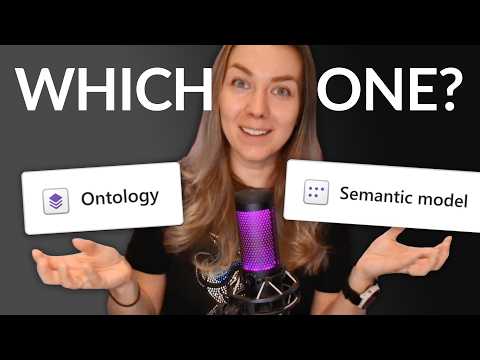
Ontology Replacing Semantic Models?
Why Microsoft Fabric Ontology beats semantic models for AI in Power BI by adding business meaning via knowledge graphs
Key insights
- Ontology does not replace the semantic model; it extends and unifies meaning across an organization.
Think of ontology as a shared, executable dictionary that connects BI, operations, and AI without discarding existing semantic models. - Tables show where data lives, semantic models explain how to analyze it, and ontologies define what business terms mean.
Each layer serves a different purpose and works together rather than competing. - Star schema (traditional analytics) organizes facts and dimensions, while a knowledge graph captures rich relationships and business context.
Knowledge graphs make cross-domain reasoning and flexible queries easier for modern use cases. - AI agents struggle with raw column names and flat models; they need business meaning to act reliably.
Ontology provides that grounding, so agents can answer questions and run workflows using company vocabulary instead of guessing from table fields. - You can create an ontology by generating from a semantic model (preview) or by building it manually from OneLake tables.
Generating speeds adoption when good semantic models exist; manual creation gives precise control over entities, properties, and relationships. - Preview limitations mean features and integrations are still evolving, so keep using semantic models while adopting ontology for cross-domain meaning.
Recommendation: maintain your analytic models for reporting and add ontology to unify definitions and improve AI-driven scenarios.
Overview
In a recent YouTube video from Guy in a Cube, Marthe takes viewers through a timely question: is Ontology replacing the semantic model in Microsoft Fabric. She begins by noting surface similarities, since both layers sit above raw data and help business users make sense of tables and columns. Yet, importantly, she argues that the similarity ends quickly because the two technologies solve different problems and serve distinct runtime needs. Consequently, the distinction matters more now as AI agents increasingly depend on clear business meaning.
Marthe frames the conversation around three core roles: locating data, defining analytical behavior, and expressing business meaning. In her explanation, tables tell you where data lives, semantic models tell you how data is analyzed, and Ontology tells you what the business actually means. Therefore, Ontology is positioned as a layer that provides executable business vocabulary for both people and AI systems. As a result, the video frames Ontology not as a replacement, but as an augmentation that can unify meaning across tools.
Core Differences Between Ontology and Semantic Models
Marthe distinguishes the two by functionality: semantic models focus on analysis and performance, while Ontology focuses on meaning and relationships. Semantic models, often implemented as tabular models or star schemas, optimize aggregation and reporting with familiar constructs such as measures and calculated columns. On the other hand, Ontology behaves more like a knowledge graph by defining entities, properties, relationships, and constraints that express business concepts consistently across domains.
Consequently, the choice is not always binary because each layer addresses complementary needs. For example, a semantic model excels when the goal is fast analytical queries and DAX-driven calculations, whereas Ontology excels when you need consistent business language that grounds conversational AI and cross-domain reasoning. Thus, teams will often use both, with semantic models handling reporting workloads and Ontology providing the shared vocabulary for governance and AI interactions. In short, Ontology amplifies semantic models rather than making them obsolete.
How Ontology Works in Microsoft Fabric
The video explains that Ontology in Fabric aims to become an enterprise-wide, executable dictionary that connects BI, operations, and AI. It can be built from existing semantic models or created directly from OneLake tables, allowing teams to bind data to entity types and define relationships. Furthermore, Ontology offers a graph-based view that supports richer context and cross-domain connections, which help AI agents provide answers using the company’s terms instead of raw column names.
However, Marthe highlights that many features are still in preview, so practical adoption requires planning and caution. For instance, automatic generation from all semantic models is limited in preview, and integrating Ontology with existing governance and deployment pipelines may demand extra effort. Therefore, organizations should pilot Ontology for specific scenarios where consistent meaning matters most, such as AI-driven assistants or cross-team reporting, before expanding broadly. This phased approach helps teams learn without disrupting critical reporting functions.
Trade-offs and Practical Challenges
Marthe carefully outlines the trade-offs involved in adopting Ontology alongside semantic models. On one hand, Ontology improves cross-domain consistency and helps AI agents understand business concepts, which reduces ambiguous interpretations and repetitive glossary maintenance. On the other hand, building and governing an enterprise Ontology adds modeling effort, requires clear stewardship, and raises questions about versioning and performance when used at scale.
Moreover, there are technical and organizational hurdles to consider. Integrating Ontology with existing data pipelines and semantic models can be complex, especially when teams use different modeling patterns or when legacy reports rely heavily on DAX optimizations. Additionally, because Ontology aims to serve both people and agents, governance must balance flexibility for analysts with constraints needed for reliable AI grounding. Consequently, success depends on strong collaboration between data engineers, modelers, and business owners.
What This Means for Analytics Teams
In conclusion, Marthe’s video offers a pragmatic perspective: Ontology is not a drop-in replacement but a complementary layer that elevates business meaning for modern analytics and AI. Teams should therefore evaluate Ontology for scenarios where consistent business language is essential, such as AI assistants, cross-functional reporting, and enterprise-wide governance, while retaining semantic models for optimized analytical queries. By doing so, teams can leverage the strengths of both approaches.
Moving forward, teams should pilot Ontology carefully, invest in governance, and prioritize use cases that benefit most from shared meaning. As a result, organizations will be better positioned to let AI agents act on reliable, company-approved definitions while keeping high-performance semantic models for reporting. Ultimately, the video makes clear that in an AI-first world, meaning becomes a critical layer—and Ontology offers a promising path to deliver it.

Keywords
ontology vs semantic model, ontology replacing semantic model, ontology vs semantic model comparison, ontology for data modeling, semantic model limitations, ontology advantages over semantic models, knowledge graphs vs semantic models, semantic modeling future trends