- All of Microsoft
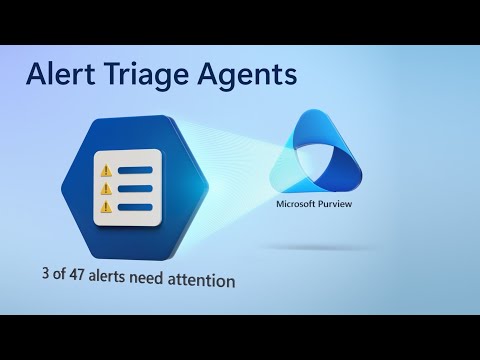
Microsoft Purview Alert Triage Agents Boost Data & Insider Risk Defense
Software Development Redmond, Washington
Microsoft Purview, Security Copilot, Data Loss Prevention, Insider Risk Management
Key insights
- Alert Triage Agents in Microsoft Purview use AI to automatically review and prioritize security alerts for Data Loss Prevention (DLP) and Insider Risk Management (IRM), helping organizations quickly identify the most serious data risks.
- Security Copilot-powered agents analyze many factors, such as user behavior, file details, content sensitivity, and policy rules, to determine which incidents need urgent attention.
- Organizations can customize these agents by setting their own risk tolerance levels, policy scopes, and timeframes. This makes the system flexible for different business needs.
- The agents provide transparent logic, giving clear explanations for why certain alerts are prioritized. This supports better decision-making and compliance tracking.
- DLP Triage Agent focuses on content risk (like sensitive info types), exfiltration risk (such as external sharing or label changes), and policy risk (rule actions), while the IRM Triage Agent looks at user behavior patterns, file history, and activity combinations.
- This approach uses advanced AI to reduce manual work, scales easily with high alert volumes, and helps security teams respond faster by focusing only on important incidents.
Microsoft Introduces AI-Powered Alert Triage Agents in Purview
Microsoft has recently unveiled its latest advancements in enterprise data security through the launch of Alert Triage Agents for Data Loss Prevention (DLP) and Insider Risk Management (IRM) within Microsoft Purview. This new feature, powered by Security Copilot, seeks to address the growing challenge organizations face in managing large volumes of security alerts. By leveraging artificial intelligence, Microsoft aims to automate and enhance how security teams identify and prioritize data risks, ensuring that critical threats are addressed promptly and efficiently.
As the volume of security alerts continues to rise, manual triage becomes impractical for most organizations. The introduction of these agents marks a significant step toward scalable, intelligent, and customizable risk management in modern enterprises.
Understanding Alert Triage Agents
The new Alert Triage Agents function as AI-driven assistants embedded within Microsoft Purview’s DLP and IRM solutions. Utilizing the capabilities of Security Copilot and Security Compute Units, these agents automatically process incoming alerts, analyze their context, and determine which incidents pose the highest risk to the organization. Unlike traditional rule-based filters, these agents apply advanced reasoning and contextual analysis to deliver more nuanced prioritization.
Organizations can tailor the agents’ parameters—such as risk tolerance, policy scope, and timeframes—to align with their unique security requirements. This adaptability ensures that the system remains effective across varying business environments and industry needs.
Advantages and Tradeoffs of Automated Alert Triage
One of the most notable benefits is automated prioritization. With the average enterprise encountering upwards of 66 security alerts per day, these agents help teams focus on the most pressing risks, significantly reducing response times. Furthermore, their comprehensive risk analysis—factoring in content, user behavior, file metadata, and policy compliance—ensures that no substantial threat is overlooked.
However, the move toward automation involves tradeoffs. While agents can process large volumes of alerts efficiently, there is always the risk of over-reliance on AI, potentially missing nuanced threats that require human judgment. Microsoft addresses this by allowing organizations to continuously calibrate and refine agent behavior based on feedback, but striking the right balance between automation and human oversight remains an ongoing challenge.
Key Features and Customizability
The Alert Triage Agents are divided into two main types: DLP Triage Agent and IRM Triage Agent. The DLP agent assesses risks associated with sensitive information types, exfiltration activities, and policy enforcement, while the IRM agent focuses on user behavior anomalies, file sensitivity, and activity patterns. These agents work together to analyze alert queues and prioritize incidents based on the organization’s predetermined parameters.
Another important advantage is the system’s transparency. The agents provide clear explanations for why certain alerts are flagged as high-priority. This not only aids in compliance efforts but also empowers security professionals to make informed decisions quickly. Nevertheless, the challenge lies in ensuring that the rationale provided by the AI aligns with real-world risks and the organization’s evolving security landscape.
Innovations and Challenges of the New Approach
Microsoft’s integration of AI-powered triage directly into Purview represents a major evolution from older, manual or rule-based systems. By leveraging Security Copilot, the platform moves beyond simple alert matching, offering context-aware reasoning and intent analysis. This shift enables the system to autonomously identify the most critical incidents, tackling the common issue of alert fatigue among security teams.
Despite these advancements, organizations must navigate the challenges of deploying AI at scale. Customizing risk parameters and interpreting AI-generated explanations require ongoing investment in both technology and training. Additionally, as threats evolve, continuous refinement of agent logic is essential to maintain effectiveness and mitigate the risk of false positives or missed alerts.
Conclusion
In summary, Microsoft’s Alert Triage Agents for DLP and IRM in Purview offer a forward-thinking approach to enterprise data security. By automating the prioritization and investigation of security alerts, the technology helps organizations respond to threats more efficiently while addressing the limitations of manual review. However, balancing automation with human expertise and adapting to evolving risks will remain key factors in the successful adoption of this innovative solution.

Keywords
Microsoft Purview Alert Triage Agents Data Loss Prevention Insider Risk Management Microsoft Purview DLP Alert Triage Insider Threat Detection Data Security Tools