- All of Microsoft
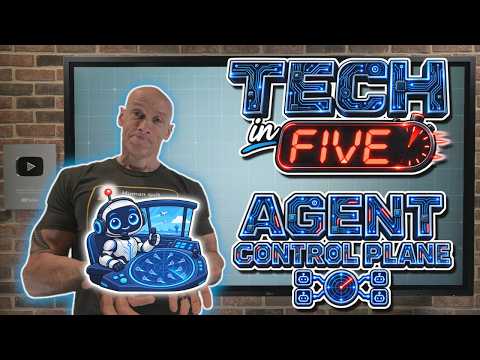
Agent Control Planes explained for AI agents
Principal Cloud Solutions Architect
John Savill explains why AI agents need a control plane for identity, governance, and lifecycle control.
Key insights
- The video focuses on why agent control planes are needed for AI agents.
- It frames a control plane as the management layer above agent creation and use.
- The chapters include discovery, identity, governance, monitoring, and improvement.
- The discussion also touches on FinOps and building on trusted systems.
John Savill’s recent Tech in Five video, What are Agent Control Planes?, looks at why AI agents need a management layer beyond the tools used to build them. The main takeaway is simple: as agents spread across teams and platforms, organizations need a way to identify, govern, observe, and retire them in a controlled way.
The video is structured around a short set of chapters, including what a control plane is, where agents sit, control planes for agents, and how to observe, evaluate, and improve them. It also includes a section on FinOps and a summary of the overall argument. In context, the topic matters because agents can act on behalf of people and systems, so unmanaged growth creates security and ownership problems quickly.
What's new
Rather than presenting agent development as only a build problem, Savill frames it as an operations and governance problem too. The video treats an agent control plane as the place where organizations can keep track of what agents exist, what they are allowed to do, and who is responsible for them. That shifts the discussion away from isolated agent projects and toward enterprise management.
The research notes for the topic describe two related control planes. One is Microsoft Foundry Control Plane, aimed at developers and engineering teams that build, test, run, and tune agents. The other is Microsoft Agent 365, aimed at IT administrators, security teams, and business leaders who need to govern agents across an organization. The distinction matters because it separates technical operations from organizational control.
Why it matters
For admins and security teams, the issue is visibility. If agents are created in different places and by different teams, it becomes hard to know which ones exist, who owns them, what data they can reach, and whether they are still needed. The notes describe this as a form of identity sprawl: each agent should have its own identity, permissions, and human owner.
For makers and developers, the control plane idea is a reminder that agent design does not end at deployment. If an agent is going to be used in a business setting, someone needs to manage access, review changes, and make sure its behavior still matches the original purpose. For business leaders, the practical value is accountability: a governed agent is easier to trust than one that cannot be traced or retired cleanly.
The material also links the topic to cost awareness through FinOps. That suggests agent control is not only about security and compliance; it also affects how organizations watch usage and avoid waste. The source does not give a detailed licensing or rollout story, so readers should treat the feature set as a high-level explanation rather than a deployment guide.
How it works
The available material does not show a product demo or step-by-step configuration, but it does describe the operating model behind an agent control plane. In practice, the sequence looks like this:
- Discover agents so the organization knows what is running.
- Identify each agent with a distinct identity.
- Apply permissions and access rules based on the agent’s purpose.
- Observe what the agent does and how it interacts with other systems.
- Review the agent over time and improve or retire it when needed.
The research notes also describe Microsoft Agent 365 as a centralized registry. That registry holds information about the agent’s owner, permissions, connections, and lifecycle status. In other words, it gives the organization a single place to answer basic governance questions before an issue turns into a security or compliance problem.
Another part of the model is policy-based governance. The notes say IT and security teams can define guardrails for which agents may be deployed, who may use them, what resources they may access, and under what conditions they may operate. The goal is to keep agents within least-privilege boundaries rather than letting them inherit broad access by default.
Limitations and open questions
The source material is short and does not provide a feature walkthrough, screenshots, licensing details, or rollout timing. It also does not confirm which Microsoft services or third-party agent frameworks are included in the control plane beyond the general description in the notes. Because of that, the article can explain the concept and the problem it solves, but not the full product scope.
The notes mention Microsoft Foundry Control Plane and Microsoft Agent 365, but the video transcript itself only gives chapter headings and the high-level topic. We therefore cannot verify implementation details from the source material alone. The material also does not say how these control planes relate to existing identity tools in operational terms.
Another open question is how organizations should divide responsibility between developers and central IT in real deployments. The video points to that split, but it does not spell out the handoff model. Readers who need implementation guidance will need more documentation than this short explainer provides.
Sources
- John Savill's [MVP] video Tech in Five What are Agent Control Planes?
- John Savill's [MVP] website
- John Savill's certification materials repository
Frequently asked questions
What is an agent control plane?
It is the management layer for AI agents, used to discover, identify, govern, observe, and retire them across an organization.
Who is the audience for this topic?
The notes split it between developers on one side and IT administrators, security teams, and business leaders on the other.
Does the source explain how to configure it?
No. The material is a short explainer with chapter headings and high-level context, not a setup guide.
Does the material say whether this is in preview or generally available?
No. The source does not state rollout status, licensing, or availability details.