- All of Microsoft
- Microsoft 365
Microsoft 365 Maturity Model - 2026 Guide
Software Development Redmond, Washington
Maturity Model for Microsoft three sixty five: expert guidance on staff training, competency, artifacts and community
Key insights
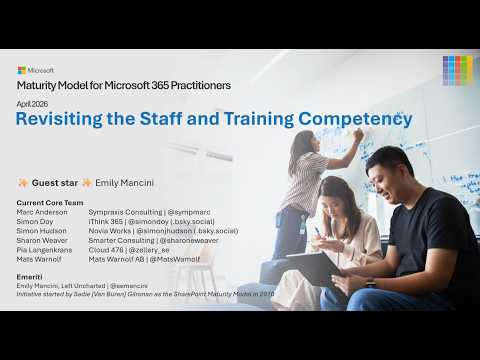
- Maturity Model for Microsoft 365 — April 21, 2026 recording: The public call revisited the Staff & Training competency and covered the practitioner overview, artifacts and updates, the model’s purpose, ways to join, and a group photo moment.
- Purpose and approach: The model centers on business competencies rather than platform features and delivers practical tools—guides, scenarios, and checklists—that teams can apply to real business processes.
- Five maturity levels: Level 100 (Initial) — ad hoc; Level 200 (Managed) — inconsistent processes; Level 300 (Defined) — standardized and signed-off; Level 400 (Predictable) — tracked metrics and reliable outcomes; Level 500 (Optimized) — proactive, efficient, and extensible.
- Staff & Training updates: The call highlighted new artifacts and elevate guides to build role-based skills, improve onboarding, and move teams past common Level 200 plateaus toward measurable competency.
- Community and involvement: The initiative runs public, monthly calls and hosts materials openly for collaboration. Teams can join discussions, contribute artifacts, and use scenarios (for example, Copilot or service health) to advance local practices.
- Core team and next steps: Guest Emily Mancini joined core contributors from Microsoft 365 community groups. Recommended actions: review the Staff & Training competency docs, try the practical scenarios, measure current level, and join the next community call to contribute or ask questions.
Introduction
The following article summarizes a YouTube recording published by Microsoft that covers the public call for the Maturity Model for Microsoft 365 held on April 21, 2026. The video focuses on revisiting the Staff and Training Competency and frames the model as a practical toolkit rather than a static document. The recording brings together community members who maintain and evolve the model, and it explains how organizations can use the guidelines to align people, process, and technology. As a result, viewers get both high-level context and concrete artifacts to apply in their own environments.
Overview of the Recording
The session opens with a practitioner overview that places the model in the context of a fast-moving platform and steadier business needs, contrasting the pace of change in Microsoft 365 with organizational realities. Presenters stress that the maturity model emphasizes business competencies—for example, Security, Collaboration, and Staff & Training—rather than focusing on individual product features. The call reviews recent artifact updates and explains the purpose of those artifacts, which range from scenario guides to elevation paths for moving between maturity levels. Finally, the recording closes with an invitation for viewers to get involved and a brief group photo moment in Together Mode to celebrate contributors.
Core Themes and Competencies
A central theme in the video is the model’s role as a bridge between IT capabilities and business outcomes. The presenters explain that each competency maps to five maturity levels so organizations can benchmark progress from ad hoc practices to optimized, predictable operations. For instance, the model uses defined levels like Level 100 through Level 500 to show progression from reactive work to extensible, measured practices. This framework helps teams speak the same language across departments, which is useful when they must coordinate on topics such as training, governance, and AI adoption.
Moreover, the hosts highlight practical scenarios that translate competency guidance into tasks, such as integrating Copilot into specific workflows or improving content lifecycle management. They also note the availability of “elevate” guides intended to help teams move from one maturity stage to the next in a targeted manner. As a result, the model offers both a strategic view and operational steps to reduce ambiguity during implementation. Importantly, contributors emphasize that the documents are living artifacts that benefit from community feedback.
Benefits and Tradeoffs
The recording describes clear advantages to adopting the model, including consistent benchmarking across teams and a focus on business value rather than chasing product features. This approach reduces the risk of fragmented efforts and technical debt by encouraging repeatable processes and role clarity. However, the presenters also discuss tradeoffs: standardization can sometimes limit local flexibility, and measuring maturity requires effort that busy teams may find burdensome. Therefore, organizations must balance the benefit of consistent practices with the need to allow context-specific adaptations.
Implementation Challenges
The video candidly explores common obstacles such as limited buy-in, inconsistent application of standards, and the tendency to plateau on intermediate maturity levels where partial success masks deeper problems. Stakeholders often need both leadership support and time to embed new practices, and training programs must be tailored to diverse skill levels across teams. Additionally, integrating cross-competency work—such as aligning Security and Staff & Training—adds complexity but is necessary to avoid gaps. Consequently, successful adoption typically requires a phased approach that pairs measurable goals with hands-on guidance.
Community, Participation, and Next Steps
Presenters emphasize the open, community-driven nature of the work and invite practitioners to join future calls or contribute to artifacts. The recording lists opportunities to engage with the core team and indicates how contributors can help refine competencies, update scenarios, or author elevation guides. While the model is hosted and promoted by a central team, its strength comes from community validation and real-world testing across different organizations. Thus, contributors can expect a practical forum for feedback rather than a top-down directive.
- Recorded: April 21, 2026
- Topic: Revisiting Staff and Training Competency
- Guest: Emily Mancini
Conclusion
The YouTube recording by Microsoft offers a useful update on the Maturity Model for Microsoft 365, especially around how to strengthen staff skills and training programs within a maturity framework. It balances optimistic guidance with realistic cautions about effort, measurement, and the need for leadership support. Furthermore, the session makes clear that the model is an evolving toolkit designed to encourage consistent, business-aligned practices across organizations. For teams planning adoption, the recording provides both next steps and an invitation to join a community that iterates on practical solutions.
https://hubsite365cdn001img.azureedge.net/SiteAssets/TopicImages/marvin-meyer-SYTO3xs06fU-unsplash.jpg
Keywords
Microsoft 365 maturity model April 2026, M365 maturity assessment, Microsoft 365 maturity roadmap 2026, M365 governance maturity, Microsoft 365 adoption maturity, M365 security maturity assessment, Microsoft 365 compliance maturity, M365 readiness checklist April 2026