- All of Microsoft
- Microsoft 365
Microsoft 365 Maturity Model 2025
Software Development Redmond, Washington
Maturity Model for Microsoft three sixty five: Business Process and Search update, tools, Teams, Microsoft Search
Key insights
- Maturity Model for Microsoft 365 (MM4M365): A practical framework that helps organizations measure and improve Microsoft 365 adoption.
Recorded on September 16, 2025, this session focused on aligning platform capabilities with real business needs. - Business Process & Search Competency: The update refines guidance for improving workflows and information retrieval across Microsoft 365.
It shows concrete steps to make processes faster and search results more relevant for users. - Practical Artifacts: The model provides tools, templates, and artifacts—not just theory—to support implementation and maturity progress.
Teams can use these resources to move from assessment to action more quickly. - Community Participation: Public calls and workshops invite practitioners to contribute, test artifacts, and share best practices.
Engaging with the community helps keep the model current and practical for diverse organizations. - Core Team and Contributors: The model is guided by experienced practitioners, including Marc Anderson, Simon Doy, Simon Hudson, Sharon Weaver, Pia Langenkrans, and Mats Warnolf.
Their experience shapes pragmatic updates and real-world examples. - Business Value and Roadmap: The model helps align Microsoft 365 with business goals, identify maturity gaps, and plan clear improvements.
Organizations gain a structured roadmap for governance, adoption, and measurable outcomes.
The newsroom reviewed a public YouTube recording published by Microsoft titled Maturity Model for Microsoft 365 - September 2025, which documents a live call held on September 16, 2025. The session focused on the Business Process & Search Competency within the broader maturity model and ran for about an hour. Importantly, the recording aims to move the model from abstract guidance toward practical tools that organizations can apply. Consequently, the video serves as both an update and an invitation for community involvement.
Session Overview and Key Messages
In the recorded call, hosts presented a concise overview of the Maturity Model for Microsoft 365 and emphasized its purpose: to align platform capabilities with steady business needs. The team explained that while the Microsoft 365 platform evolves quickly, core business processes change more slowly, and the model reflects that distinction. Therefore, the content centers on business competencies—such as process management and search—that help organizations adopt the platform more deliberately. Moreover, the session underlined that the model supplies artifacts and tools to move from planning to execution.
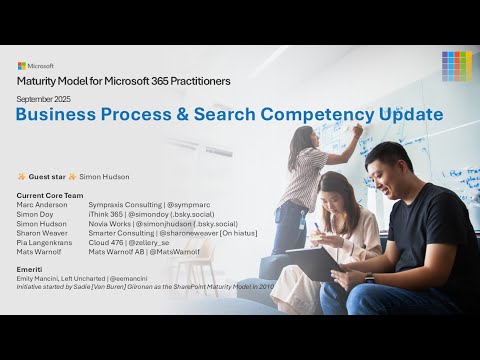
The agenda for the call included a practitioner overview, artifact updates, and guidance on how to join future calls. Guest contributor Simon Hudson joined the core team for the presentation and offered practical examples based on client work. Core contributors named in the video included Marc Anderson, Simon Doy, Sharon Weaver, Pia Langenkrans, and Mats Warnolf. Altogether, the presenters stressed collaboration and ongoing refinement of the model.
Practical Tools and Artifacts
The recording highlighted a shift from information-only guidance toward tangible artifacts that teams can use during projects. For example, the presenters demonstrated templates and assessment criteria that map maturity stages to measurable activities and outcomes. These artifacts aim to help organizations assess gaps and plan improvements across governance, adoption, and technical capabilities. As a result, practitioners gain more than conceptual lists; they receive practical instruments for action.
However, the presenters also noted tradeoffs when using standardized artifacts: they simplify decision making but can obscure context-specific details. In other words, templates speed adoption yet require adaptation to local processes and compliance needs. Consequently, effective use depends on blending the artifacts with organizational knowledge and stakeholder input. This balance between structure and flexibility was a recurring theme throughout the video.
Business Process and Search Competency Updates
Much of the session concentrated on refinements to the Business Process and Search competencies. Presenters described improvements in how the model addresses workflow automation, lifecycle management, and information retrieval within Microsoft 365. They also showed how search governance and taxonomy choices influence the user experience and operational efficiency. Therefore, teams are encouraged to treat search and processes as intertwined efforts rather than isolated tasks.
The presenters underscored common challenges, such as balancing search relevance with security and privacy constraints. For instance, making content easy to find can conflict with access controls that protect sensitive data. Moreover, automating business processes often requires cross-functional coordination and careful testing to avoid disrupting daily operations. Thus, the update advises phased rollouts and continuous monitoring to reduce risk while increasing value.
Community Involvement and Governance
The recording invited practitioners to join future public calls and contribute to ongoing model development, stressing a community-driven approach. The core team described how community feedback informs artifact design and helps expose real-world patterns and exceptions. In addition, the session offered clear steps for joining the calls and participating in working groups, which helps broaden perspectives and accelerate improvements. This collaborative model aims to keep the guidance practical and current.
At the same time, community participation raises governance questions about consistency and quality control. While open contribution expands insight, it also requires mechanisms to validate changes and prevent fragmentation. Consequently, the core group balances openness with curated stewardship to preserve model coherence. The approach tries to keep contributions useful without sacrificing clarity or accuracy.
Tradeoffs and Implementation Challenges
The video explored several tradeoffs that organizations must manage when applying the maturity model. For example, pursuing rapid automation can deliver quick wins but may create technical debt if teams skip documentation or testing. Similarly, centralizing governance can improve consistency yet reduce local agility that teams need to respond to unique business needs. Hence, the presenters recommended deliberate prioritization and incremental improvement cycles.
Another challenge concerns measurement: defining simple, meaningful metrics for maturity is difficult but necessary. Overly complex metrics discourage adoption, while simplistic measures risk missing important progress. Therefore, organizations should choose indicators that balance clarity and depth, and revise them as they learn. Ultimately, the recording framed these tradeoffs as solvable with careful planning, stakeholder engagement, and practical tools from the maturity model.
Conclusion
The YouTube recording of the September 16, 2025 call delivers a pragmatic update to the Maturity Model for Microsoft 365, especially around business process and search competencies. It presents artifacts, community pathways, and governance considerations meant to help organizations apply the platform in alignment with real business needs. Moreover, the session acknowledges tradeoffs and offers sensible suggestions for phased, measurable adoption. In short, the video serves as a practical checkpoint for teams aiming to increase Microsoft 365 maturity with community-backed resources.
https://hubsite365cdn001img.azureedge.net/SiteAssets/TopicImages/marvin-meyer-SYTO3xs06fU-unsplash.jpg
Keywords
Microsoft 365 maturity model 2025, M365 maturity assessment September 2025, Microsoft 365 adoption maturity model, M365 governance maturity framework, Microsoft 365 security maturity assessment, Microsoft 365 roadmap 2025, M365 deployment maturity best practices, Microsoft 365 compliance maturity model