- All of Microsoft
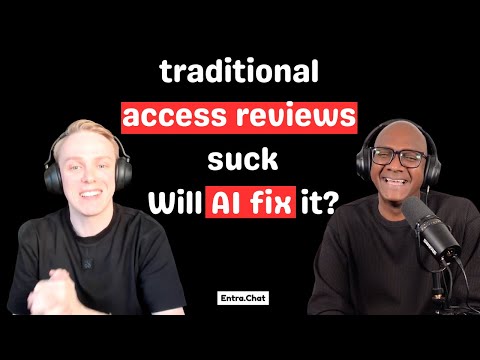
Entra: AI-Powered Access Review Agent
Product Manager @ Microsoft 👉 Sign up to Entra.News my weekly newsletter on all things Microsoft Entra | Creator of cmd.ms & idPowerToys.com
Microsoft Entra expert previews AI driven Access Review Agent transforming identity governance, security and compliance.
Key insights
- Entra Access Review Agent: A Microsoft AI assistant introduced in a YouTube interview with Merill and product manager Alexander Filipin.
It helps reviewers by surfacing context and recommendations during identity access reviews. - Identity governance challenge: Traditional access reviews are slow and often suffer from "rubber stamping."
The agent reduces repetitive work and raises decision quality by giving reviewers clear, evidence-based guidance. - How it works: The agent runs inside Microsoft Teams, uses Security Copilot and an LLM to analyze signals like sign-ins, group membership, and employment status.
It produces concise recommendations and a deterministic score to explain each suggestion. - Key benefits: Saves time, improves security, and supports compliance with an auditable decision trail.
Reviewers can act faster and keep access aligned with the principle of least privilege. - Licensing and cost model: Requires Entra governance capabilities such as Entra ID P2 or equivalent roles and uses Security Copilot compute units (SCUs) per decision.
Costs scale with review complexity and the amount of AI processing used. - Audit and future direction: The system keeps an audit trail for AI-generated decisions and aims toward greater automation of access management.
Microsoft plans ongoing improvements to accuracy, reviewer context, and compliance controls.
Merill Fernando’s recent YouTube conversation with Microsoft product manager Alexander Filipin lifts the veil on a new AI-driven tool for identity governance. The episode introduces the Entra Access Review Agent, which uses AI to help organizations run access reviews with more context and less manual work. Consequently, the video frames the feature as a response to long-standing operational and compliance challenges in access management.
What the Video Reveals
In the conversation, Filipin explains that the Entra Access Review Agent integrates AI insights into the access review workflow to reduce friction. He describes how the agent pulls together signals such as sign-in activity, group membership, and role relevance to produce reviewer-facing recommendations. Furthermore, the agent presents those recommendations inside Microsoft Teams so managers can act without leaving their collaboration environment.
Merill points to the agent’s use of Microsoft Security Copilot capabilities to generate natural language justifications and deterministic scores for each recommendation. This approach aims to avoid purely opaque AI outputs while still delivering helpful context to reviewers. As a result, teams can document decisions with clearer rationale, which supports auditability and compliance needs.
The video also outlines necessary prerequisites and the consumption model for the feature, including governance roles and the compute model used for AI-driven decisions. Filipin notes that the feature relies on assigned governance roles and licensing tiers to enable different capabilities. Therefore, organizations must weigh deployment benefits against licensing and compute costs.
Benefits Highlighted
Merill and Filipin emphasize several practical benefits, starting with time savings and reduced reviewer fatigue. By automating data collection and summarizing risk signals, the agent helps reviewers focus on decisions rather than research. Consequently, organizations can run reviews more frequently and with greater consistency.
Another benefit is improved decision quality through clearer, data-backed recommendations that reduce the risk of “rubber stamping.” The agent uses a deterministic scoring mechanism, which offers transparency and traceability over why a recommendation was made. In turn, this helps teams apply the principle of least privilege more reliably.
Finally, the video highlights tighter compliance trails because the agent captures AI-generated rationale alongside human decisions. This pairing aims to strengthen audit evidence for regulators and internal reviewers. Thus, organizations get both operational efficiency and stronger governance records.
Tradeoffs and Costs
Despite the benefits, the video stresses tradeoffs that organizations must consider before broad adoption. For example, AI-driven recommendations require compute resources and may incur additional costs based on the number and complexity of decisions, which calls for careful budgeting. Additionally, enabling agent capabilities often requires specific licensing and admin roles, which can complicate rollout plans for large or decentralized teams.
Moreover, the reliance on AI introduces subtle risks that teams must manage, such as potential overreliance on machine suggestions. Filipin and Merill both caution that automation should augment, not replace, human judgment—at least initially—and that clear policies must govern when to accept or override recommendations. Therefore, balancing speed and control becomes a key governance decision.
Data access and privacy pose further tradeoffs because the agent analyzes activity and identity signals to form recommendations. Organizations will need to ensure that data access aligns with privacy rules and internal policies, and that audit trails show who saw which recommendations and why. Consequently, IT and privacy teams must collaborate closely during deployment.
Challenges and Risks
The video does not shy away from challenges, especially around trust and model accuracy. Even with deterministic scoring, AI can misinterpret incomplete signals or surface misleading context if upstream identity data is stale. Therefore, the hosts stress the importance of clean identity inventories and reliable telemetry to support meaningful recommendations.
Another challenge is the potential for inconsistent human responses to AI prompts, which can still produce uneven outcomes across teams. Merill points out that some reviewers may follow AI suggestions uncritically while others remain skeptical, creating variance in access posture. Consequently, organizations should design review policies and training to align reviewer behavior.
Lastly, the video touches on regulatory scrutiny and the need for clear audit trails when AI influences access decisions. Filipin explains that the product captures rationale and decision metadata to help teams meet compliance checks. Nevertheless, organizations must validate that captured evidence satisfies applicable standards and internal audits.
Future Directions and Final Takeaways
Looking ahead, the discussion entertains the possibility of agents taking on more autonomous tasks, such as conditional remediation or automated expiration of stale access. However, both speakers acknowledge that fully automated access management requires strong safeguards and governance to avoid unintended privilege removals or business disruption. Thus, incremental automation with human oversight remains the likely near-term path.
Overall, the YouTube episode offers a pragmatic view of the Entra Access Review Agent: it promises operational gains and better compliance evidence, yet it brings tradeoffs around cost, data quality, and governance. For organizations weighing adoption, the message is clear: start with controlled pilots, align identity data, and define rules that balance efficiency with careful oversight.

Keywords
Entra Access Review Agent, AI identity governance, Microsoft Entra access reviews, automated access reviews, Entra AI access review, Azure AD identity governance, identity governance automation, access certification AI