- All of Microsoft
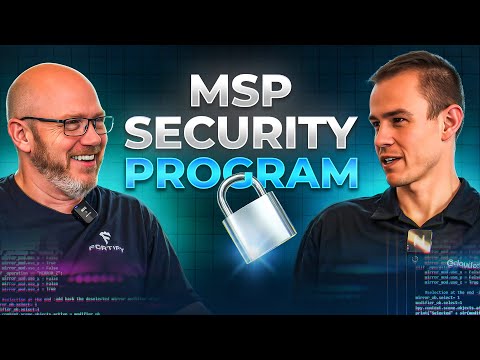
MSP Security: Turbocharge Your Program
MSP security: use AI data risk to sell Fortify identity and data, standardize on Defender and Intune, track Secure Score
Key insights
- AI/data risk
Use AI and data risk as the primary entry point to start executive conversations.
This reframes security from a product sale to a business outcome and opens doors with C‑level decision makers. - Fortify (F1–F4)
Follow the Fortify roadmap: F1 identity, F2 devices, F3 data usage, F4 sensitive data.
Deliver clear milestones at each stage to show progress and reduce client friction. - Packaging strategy
Sell separate offerings: MSP Core, Security, and Data/AI Governance rather than burying security in bundles.
Keeping services distinct preserves margin and clarifies value for customers. - Microsoft 365 + Defender + Intune
Standardize on Microsoft 365 productivity tools plus Defender and Intune to scale deployments and simplify management.
Built‑in sensors and EDR reduce complexity and speed up protection across endpoints. - 100% MFA & 24‑hour alert response
Prepare for Microsoft partner requirements effective October 1, 2025: full MFA coverage for tenant admins and alert response under 24 hours.
Enforce MFA with Security Defaults or conditional access and apply Zero Trust principles to cut identity risk dramatically. - Measure progress
Use metrics and assessments like Secure Score, CIS benchmarks, and automated executive reports to demonstrate measurable improvement.
Combine these with SIEM/AI detection and reliable backups to prove outcomes and justify phased investments.
Video overview and core argument
In a recent YouTube interview hosted by Nick Ross [MVP] (T-Minus365), Mike Hughes, CEO of Dura Cyber, outlines a practical playbook for MSPs aiming to scale security services profitably. The conversation frames security not as a bundled line item but as a distinct business offering that begins with explaining the risks around AI and data to executives. Moreover, the discussion emphasizes that tools alone do not create outcomes; instead, MSPs must reframe client conversations to sell measurable improvements. Consequently, the video stresses a roadmap that turns technical controls into clearly communicated business outcomes.
Throughout the interview, Hughes introduces the Fortify framework (F1–F4) as a way to sequence work and show progress. He argues that using data risk and AI concerns as conversation starters helps MSPs gain executive attention faster than talking about boxes or licenses. In addition, the hosts discuss how packaging and standardization create scale while still delivering tailored outcomes. As a result, the interview combines technical guidance with commercial tactics relevant to MSP leaders.
The Fortify roadmap: phased, measurable progress
The video lays out the Fortify roadmap in four phases: identity, devices, data usage, and sensitive data. Phase one focuses on strengthening identity controls because identity compromise remains a top attack vector, and phases two through four expand protection to endpoints and the ways data is accessed and stored. This phased approach allows MSPs to prioritize high-impact controls and demonstrate early wins that executives can understand. Therefore, the roadmap helps translate security activity into business-level milestones.
Hughes also stresses that each phase should map to measurable indicators so clients see tangible progress over time. For instance, improvements in Secure Score or alignment with CIS/CS benchmarks act as objective ways to validate work. At the same time, he warns that relying solely on tool-based metrics risks missing real behavioral and process gaps. Thus, combining automated metrics with operational validation offers a better balance between speed and depth.
Packaging strategies and commercial tradeoffs
A central theme of the video is the commercial tradeoff between bundling security into general managed services and selling it as a separate, premium offering. Hughes argues that bundling often erodes margin and obscures value, whereas separating services into MSP Core, Security, and Data/AI Governance lines clarifies pricing and outcomes. However, MSPs must weigh sales complexity against higher margins, because separate packages can require new sales motions and executive-level conversations. Consequently, providers should test packaging models and adjust based on customer segment and sales capacity.
Moreover, the hosts discuss practical tactics to simplify transitions, such as offering phased onboarding plans and outcome guarantees for early phases. They also highlight the need for clear service descriptions and executive-ready reporting so buyers understand business risk reduction rather than technical changes. While this approach can increase initial sales effort, it usually produces stronger renewal rates and better margins over time. Thus, the choice between simplicity and profitable specialization is a strategic decision each MSP must manage.
Standardizing on the Microsoft stack to drive scale
Hughes recommends standardizing on Microsoft 365 combined with native capabilities like Defender for Business and Intune to create operational leverage. This standardization reduces tool sprawl, simplifies licensing conversations, and allows MSPs to use shared automation and runbooks. Additionally, built-in telemetry feeds into metrics such as Secure Score, enabling MSPs to present progress consistently across customers. Therefore, standardization can accelerate delivery and reporting at scale.
At the same time, the video acknowledges tradeoffs related to vendor tie-in and skills development. MSPs that commit to a single vendor ecosystem gain efficiency but must invest in staff training and develop expertise in platform-specific features and APIs. Furthermore, reliance on native tools requires clear processes for incident response and SLA management, especially with mandated alert response expectations. Consequently, MSPs must balance the gains from standardization against the operational responsibility it creates.
Practical challenges and next steps for MSPs
Finally, the interview covers common objections and operational hurdles, including client resistance, onboarding complexity, and the need for partner enablement. Hughes suggests phasing work to reduce friction, starting with executive risk conversations and then delivering measurable technical improvements that map to business outcomes. He also recommends using frameworks like CIS/CS and showing progress through tools such as Secure Score to build client trust. In this way, MSPs can demonstrate value early and secure the runway for deeper work.
In closing, the video balances ambition with realism: adopting AI-driven conversations, a phased Fortify roadmap, and a Microsoft-centered stack can unlock scale and margin, but they require disciplined packaging, clear metrics, and operational investment. For MSP leaders, the practical next step is to pilot a separate security offering with defined phases, measure results, and refine pricing and delivery models. Ultimately, the interview provides a clear, actionable framework for MSPs willing to trade initial simplicity for long-term, measurable security value.

Keywords
MSP security best practices, Managed service provider cybersecurity, MSP security program framework, MSP security checklist, MSP vulnerability management, MSP incident response plan, MSP security automation tools, MSP compliance and risk management