- All of Microsoft
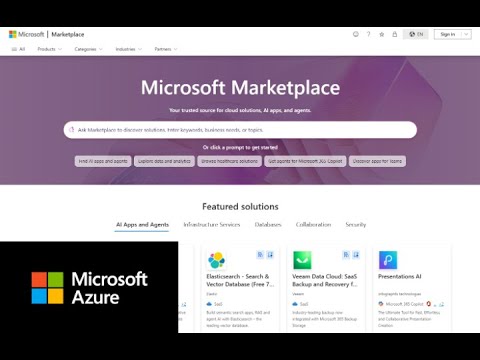
Microsoft Marketplace: Smart Discovery
Microsoft Marketplace demo: AI-powered discovery to find, compare and pick cloud solutions, AI apps and agents
Key insights
- Intelligent discovery: A new AI feature in Microsoft Marketplace that helps users find, compare, and decide on cloud solutions more quickly.
- Microsoft Marketplace: The platform for business-ready cloud solutions, including AI apps and agents, where the new discovery experience is available.
- Core actions: The demo shows how the tool helps you find relevant offers, compare options side-by-side, and decide which solution fits your needs.
- Preview timing: Microsoft begins a limited preview in June 2026 for a subset of U.S. Marketplace customers and will expand to more regions over time.
- Guided walkthrough: The video demonstrates the user flow and highlights how AI surfaces relevant results and comparisons in real scenarios.
- Expected value: The feature should reduce time spent searching and evaluating options, helping teams make faster, more informed buying choices.
Video overview: a guided demo of intelligent discovery
The YouTube video from Microsoft Azure presents a guided walkthrough of intelligent discovery in the Microsoft Marketplace, showing how the new tool helps customers find, compare, and decide on cloud solutions. The short demo focuses on an AI-powered experience that surfaces relevant cloud offers, AI apps, and agents based on business needs. In addition, the narrator highlights practical scenarios and user flows to illustrate the product in action.
According to the video, the feature enters preview starting June 2026 for a subset of U.S. Marketplace customers, and it will expand to more regions over time. Furthermore, the walkthrough emphasizes search and comparison capabilities designed to reduce the time customers spend evaluating options. As a result, buyers can move from discovery to decision more quickly than with traditional browsing.
How intelligent discovery works in practice
The demo shows a conversational and recommendation-driven interface that blends search with contextual prompts and filters. For example, users can enter high-level goals or upload brief requirements, and the system responds with curated matches that include relevant technical details and price signals. Additionally, the tool highlights key differentiators among products, which helps teams prioritize solutions without reading every product page.
Behind the scenes, the video claims the system draws on Marketplace metadata, product descriptions, user ratings, and telemetry to generate its suggestions. Moreover, it can surface vendor-provided demos, documentation, and deployment options to reduce friction during evaluation. Consequently, this layered approach aims to combine automated intelligence with human judgment for better outcomes.
Rollout, availability, and adoption implications
Microsoft states the preview will begin in June 2026 for a limited set of U.S. customers and will expand geographically over time, which suggests a phased approach to testing and feedback. Early access customers will likely shape feature priorities and help Microsoft tune model behavior based on real-world queries. Therefore, organizations that join the preview can influence how results are ranked and how the experience surfaces compliance or cost details.
At the same time, phased rollouts create tradeoffs between speed and stability: a narrow preview lets Microsoft iterate quickly while limiting exposure, but it also delays broader benefits for global customers. Meanwhile, partners and independent software vendors on the Marketplace will need to adapt listings and metadata to ensure their offers appear accurately in the new experience. Thus, success depends on coordination among Microsoft, buyers, and vendors.
Tradeoffs and technical challenges
Introducing AI-driven recommendations into a commercial marketplace raises several tradeoffs, particularly between convenience and control. On the one hand, automated matching speeds procurement and helps smaller teams discover relevant tools without deep technical expertise. On the other hand, over-reliance on recommendations can obscure niche solutions or novel technologies that require manual discovery, which means teams must still validate shortlisted options carefully.
Moreover, the system faces technical challenges such as ensuring model accuracy, avoiding vendor bias, and handling incomplete or inconsistent metadata. For instance, if product descriptions are sparse or inaccurate, recommendations may misrepresent capabilities or costs, which could lead to poor procurement choices. Therefore, maintaining high-quality catalog data and transparent ranking signals will be critical to trustworthy results.
Privacy, compliance, and governance considerations
Privacy and compliance also appear as key concerns in the video, since AI-driven suggestions often rely on customer context and usage data. Consequently, Microsoft must balance personalization with strict data controls so organizations can trust that sensitive information does not leak or influence unfairly ranked outcomes. In regulated industries, buyers will need clarity on what signals the system uses and how it handles protected data.
Furthermore, governance mechanisms such as audit logs and explainability tools will help customers understand why a specific solution was recommended. As a result, enterprises can meet internal procurement standards and demonstrate due diligence when selecting third-party services. Ultimately, a strong governance layer will be essential to broader enterprise adoption.
What customers and partners should do next
For customers, the immediate opportunity is to monitor the preview and, where possible, participate to shape the feature set and ranking behavior. By contrast, organizations that cannot join the initial preview should prepare by ensuring their Marketplace metadata and pricing are accurate to avoid missed opportunities when intelligent discovery expands. In other words, readiness will pay off once the experience reaches more regions.
Partners and vendors should likewise review their listings and consider how to present clearer value propositions, since the discovery tool emphasizes key differentiators and quick comparisons. Meanwhile, feedback during the preview will be valuable to improve result relevance and transparency. Ultimately, the video suggests that intelligent discovery could streamline cloud purchasing, but realizing that promise will require careful data hygiene, governance, and ongoing collaboration among Microsoft, customers, and partners.

Keywords
Microsoft Marketplace intelligent discovery, intelligent discovery demo walkthrough, Microsoft Marketplace demo, AI-powered marketplace search, Azure Marketplace intelligent discovery, app discovery Microsoft Marketplace, marketplace discovery features, intelligent app recommendation Microsoft