- All of Microsoft
Power BI Report Authoring: Top Skills
Founder | CEO @ RADACAD | Coach | Power BI Consultant | Author | Speaker | Regional Director | MVP
Microsoft expert unveils AI report authoring in Power BI and Fabric with Skills MCP Server GitHub Copilot and agents
Key insights
- Skills for Power BI Report Authoring is an AI-agent skill in the Skills for Fabric catalog that creates and edits Power BI reports using natural language prompts.
It generates and validates report files in PBIR format inside PBIP projects to keep outputs aligned with Power BI file rules. - The skill fits into an agentic workflow where an AI agent helps plan, build, validate, and publish reports instead of only giving Copilot-style suggestions.
This reduces repetitive clicks and moves report creation from manual to agent-assisted steps. - Core capabilities include planning, designing, building the semantic model, creating pages and visuals, validating by reloading Desktop, and publishing to Fabric workspaces.
The tool supports iterative prompt → review → validate cycles for quick refinements. - The system uses a plugin-based skill architecture split into components such as report authoring (PBIR content) and report management (upload/download via Fabric APIs).
It also works with the Power BI Desktop Bridge and integrates with tools like GitHub Copilot and other LLMs. - Main practical gains are speed and consistency: skills produce schema-correct PBIR files, enforce structure, and standardize report output across teams.
This helps teams deliver reports faster with fewer formatting errors. - The feature is currently in preview and already appears in public demos and early releases (example: v0.3.7 dated July 9, 2026).
Expect continued updates as Microsoft expands the Fabric Skills ecosystem and agent integrations.
Introduction: A New Agentic Approach to Power BI
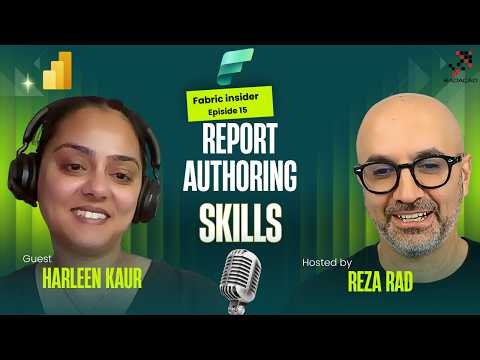
This article summarizes a recent blog-style video by Reza Rad (RADACAD) [MVP] that features an interview with Harleen Kaur from the Power BI team. In the episode, they explore the new Skills for Power BI Report Authoring capability in the Skills for Fabric ecosystem, showing how an AI agent can build and validate reports from natural-language prompts. The conversation frames this feature as a shift from manual canvas work in Power BI Desktop toward an agentic workflow that automates many routine steps. Consequently, the episode is useful for people experimenting with AI-driven report production and for teams deciding how to adopt these tools.
What the Skill Does
According to the video, the core authoring capability focuses on producing and validating PBIR report files within PBIP project containers. The skill helps with planning the report, designing visuals, creating pages and filters, enforcing themes, and even running Desktop validation checks. Moreover, the authoring capability integrates with a broader set of skills for planning, design, and management to cover the report lifecycle. As a result, teams can iterate by prompting the agent, reviewing generated artifacts, and refining outputs in a prompt-review-validate loop.
How It Works and the Live Demonstration
In the live demo shown by Reza Rad, Harleen Kaur demonstrates how a GitHub Copilot–style agent generates a PBIR file, reloads Power BI Desktop Bridge, and captures validation screenshots. The demo also highlights compatibility with other tools and models, since Microsoft designed the skill to work with GitHub Copilot CLI, VS Code Copilot, and other LLM integrations such as Claude. Therefore, the workflow supports multiple developer preferences and allows teams to adopt the tooling that best fits their stack. The episode further clarifies that the authoring skill is part of a plugin-based architecture rather than a single monolithic generator.
Tradeoffs: Speed Versus Control
While the skill offers speed and standardization, the episode carefully notes tradeoffs between automation and human control. On one hand, organizations gain consistency, faster initial drafts, and reduced repetitive formatting; on the other hand, complex business logic, nuanced visual design, and advanced DAX calculations may still need manual intervention. Consequently, teams must balance productivity gains against the potential for overlooked model assumptions or layout details. In practice, the best approach appears to be a hybrid one where AI accelerates routine work while analysts retain final approval and refinement responsibilities.
Challenges: Accuracy, Governance, and Integration
Reza Rad and Harleen Kaur address several challenges that teams will face when adopting agentic report authoring. First, the system depends on accurate semantic models and clean source data; otherwise, generated artifacts can reflect incorrect assumptions or incomplete measures. Second, governance and security matter because automated publishing and API-driven updates must conform to organizational policies and workspace controls. Therefore, teams should plan validation steps, access controls, and audit trails to reduce risk.
Practical Considerations and Next Steps
The video also discusses practical considerations such as preview status, release cadence, and integration with management skills that handle upload and Fabric REST API operations. Since the skills are currently in preview, organizations should pilot them in controlled environments and measure outcomes like time saved, error rates, and user satisfaction. Moreover, the episode suggests future improvements around deeper modeling skills, richer visual design options, and broader LLM support. Ultimately, the recommendation is to experiment early but keep human review as a central part of the workflow.
Conclusion: A Useful Shift, Not a Replacement
In summary, this Fabric Insider episode by Reza Rad with Harleen Kaur explains a meaningful change in how Power BI reports can be produced. The Skills for Power BI Report Authoring introduce an agentic, end-to-end flow that speeds up many authoring tasks, yet they require careful governance and human oversight. For teams, the clear takeaway is that these skills can increase productivity and standardization, but they should be adopted with checks for semantic quality, security, and design intent. Therefore, the technology looks promising as a productivity multiplier rather than a full replacement for experienced report authors.

Keywords
Power BI report authoring, Power BI skills, Fabric Insider episode, Harleen Kaur Power BI, Power BI report design, Power BI tips and tricks, Power BI best practices, Power BI data modeling