Microsoft Fabric IQ connects data to business meaning
Technical Lead - Business Intelligence • Microsoft Certified PL-300 • Data Analyst • Power BI Youtube
Fabric IQ connects governed Fabric data with business definitions and relationships so teams and AI agents can work from shared context.
Key insights
- Fabric IQ adds business context to data in OneLake; it does not replace the underlying Fabric data platform.
- Its ontology can describe entity types, properties, relationships, business rules and metrics.
- Power BI semantic models provide trusted measures and definitions that can support analytics and AI agents.
- The Fabric IQ ontology is in preview, so evaluate its capabilities before relying on it for critical production workloads.
- Fabric data agents use governed Fabric data and business context to answer questions in natural language.
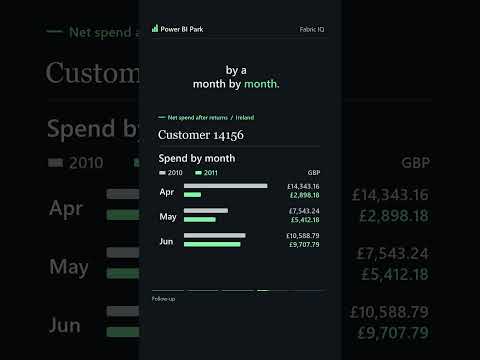
Microsoft Fabric IQ connects governed data with business definitions, relationships and rules, helping people and AI agents interpret information in business terms. It matters to Fabric and BI teams building consistent analytics or AI experiences from organizational data. Injae Park introduces Fabric IQ in a YouTube Short.
What it does
Fabric IQ adds a business-context layer to Fabric rather than replacing its data foundation. OneLake remains the central place for analytical, real-time and operational data, while Fabric IQ helps describe what that data represents. The goal is to connect records and measures to concepts such as customers, products, orders and operational events.
Its ontology is a machine-readable model of the business. It can define entity types, their properties, relationships, business rules and metrics, and connect those concepts to live enterprise data. For example, a model could express how customers place orders and how the organization calculates revenue.
Power BI semantic models contribute trusted measures, dimensions and calculations. Graph capabilities represent relationships between business entities, while Fabric data agents can use governed data and business context to answer natural-language questions. Together, these capabilities are intended to make the same business definitions useful across analytics, applications and AI.
Who it is for and what you need
Fabric IQ is relevant to BI and data teams that need shared definitions across departments, as well as organizations building agents or applications on Fabric data. It can build on investments in OneLake and Power BI semantic models, rather than requiring every AI experience to interpret raw tables independently.
The ontology is in preview. Treat it as something to evaluate before making it a dependency for critical production workloads. The capabilities described also include planning scenarios such as budgets and forecasts, extending the idea beyond reporting and question answering.
How it works
- Bring governed analytical, real-time or operational data into the Fabric data foundation in OneLake.
- Represent business entities, properties and their relationships in an ontology, and associate business rules and metrics with those concepts.
- Use Power BI semantic models for trusted measures and dimensions, and connect relevant business context to Fabric experiences.
- Use that context in analytics, applications or Fabric data agents so questions can be interpreted using organizational definitions.
Limitations and alternatives
The ontology's preview status means teams should test how well its model fits their business concepts and workflows before relying on it for critical production use. Fabric IQ adds context; it does not replace OneLake or the underlying Fabric data platform.
Organizations can also use Power BI semantic models as a source of established definitions. Those models help standardize measures, while the ontology is intended to add a broader structure for entities, relationships and rules. Injae Park's overview is available as a YouTube Short about Fabric IQ.
Sources
Frequently asked questions
What is Microsoft Fabric IQ?
Fabric IQ connects data in the Fabric environment with business definitions, relationships, metrics and rules. It adds context to the data platform rather than replacing it.
What is the Fabric IQ ontology?
It is a machine-readable business model that can define entity types, properties, relationships, rules and metrics, and connect them to live enterprise data.
Is the Fabric IQ ontology generally available?
The ontology is in preview. Organizations should evaluate its capabilities before depending on it for critical production workloads.
How do Power BI semantic models fit into Fabric IQ?
Semantic models provide trusted measures, dimensions and calculations. Fabric IQ can use those definitions as part of a broader context for analytics and AI agents.