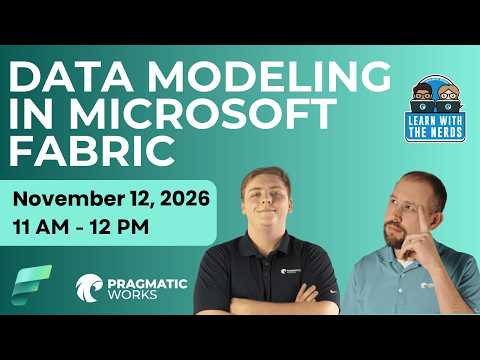
Microsoft Fabric Data Modeling in a free live course
Pragmatic Works showed a free live course on data modeling in Fabric, focused on semantic models and scalable analytics design.
Key insights
- Pragmatic Works published a video about a free live course on data modeling in Fabric.
- The course covers core modeling concepts and semantic model design.
- It also looks at Fabric capabilities that differ from traditional Power BI environments.
- The goal is to simplify architecture and improve performance.
- The source material points to scalable analytics solutions, not a full product tutorial.
Pragmatic Works recently published a YouTube video titled Free Live Course: Data Modeling in Fabric. The video presents a free live course focused on core modeling concepts, semantic model design, and practical guidance for building scalable analytics solutions. Its main takeaway is straightforward: if you work with Microsoft Fabric analytics, the way you design the model affects both architecture and performance.
The description says the course also explores Fabric capabilities that make it different from traditional Power BI environments. Pragmatic Works frames those differences as practical, not theoretical, because they can help simplify the way analytics solutions are built and maintained. That makes the video relevant to anyone deciding whether Fabric’s modeling approach matters for reporting, analytics, or broader data platform work.
What's new
The new element in this video is not a feature announcement from Microsoft, but a training session centered on Fabric data modeling. The course is built around semantic models, which are the business-facing layer that turns technical tables into terms people can use for analysis. The material also points to core modeling concepts rather than a single walkthrough of one tool or one report.
According to the source material, the course discusses how Fabric differs from traditional Power BI environments. That matters because many people already know Power BI modeling patterns, but Fabric adds a broader analytics context. In other words, the conversation is not just about reports; it is about how the model fits into a larger analytics solution.
The published description emphasizes scalable analytics solutions. That suggests the course is aimed at models that need to hold up as usage grows, rather than at quick one-off demos. The source material does not provide a full syllabus, but it does identify semantic model design and performance as the central themes.
Why it matters
For admins and data platform teams, the reason to care is that model design affects maintainability and performance. A good model can reduce complexity and help analytics solutions run more efficiently. The material explicitly says Fabric features can help simplify architecture and improve performance.
For makers and analysts, semantic models matter because they present data through business concepts instead of raw technical structures. That makes it easier to work with customers, products, dates, revenue, or similar concepts without rebuilding the logic in every report. The research notes also connect semantic models to Power BI reports, dashboards, analysts, applications, and AI agents, but the video description itself stays focused on modeling and scalability.
For organizations already using Power BI, the video is useful because it highlights that Fabric is not just a rebrand of the same experience. The source says the course will explore capabilities that make Fabric different from traditional Power BI environments. If your team is planning a Fabric-based analytics approach, this is the kind of material that helps frame the move from report-centric thinking to platform-level modeling.
The source material does not mention licensing, availability, or rollout stage. It also does not say which Fabric workloads are included in the course. So readers should treat it as a learning resource about modeling in Fabric, not as a product update with deployment details.
How it works
The published description gives a high-level view of the course rather than a step-by-step lab. Based on that description, the learning flow appears to be:
- Start with core modeling concepts.
- Design a semantic model for analytics use.
- Explore Fabric capabilities that differ from traditional Power BI setups.
- Use those capabilities to simplify architecture.
- Apply the model with the aim of improving performance.
The research notes add more detail about the kinds of topics typically covered in Fabric modeling training, including fact and dimension tables, star-schema principles, table relationships, storage modes, DAX calculations, and optimization. Those topics are consistent with the course title and description, but they are not listed directly in the video text, so they should be treated as context rather than confirmed course modules.
For readers new to the term, a semantic model is the layer that gives technical data business meaning. Instead of asking users to query raw tables, it organizes data so reports and analysis can work with familiar concepts. In a Fabric setting, that model is part of the broader analytics platform, which is why the design choices can affect more than just one report.
The source also includes a sign-up link in the video description. We are not repeating that promotional call here, but it confirms that Pragmatic Works is presenting the material as a free live course rather than a recorded explainer alone.
Limitations and open questions
The source material is brief, so it does not tell us exactly which demos, exercises, or case studies are included. It also does not specify who the intended audience is, beyond the general usefulness for analytics professionals. We cannot verify whether the course covers lakehouses, warehouses, eventhouses, or any specific Fabric workload from the published description alone.
There is also no information on the video’s length, date, or whether the course is still open for registration. The material mentions a free sign-up link, but it does not say anything about region, license requirements, or tenant eligibility. Because of that, readers should not assume access rules beyond what is written in the description.
Finally, the research notes provide broader Fabric context, but the published source does not confirm every one of those details. This article therefore stays close to what Pragmatic Works explicitly said: the course covers core modeling concepts, semantic model design, and Fabric capabilities that can support scalable analytics.
Sources
Frequently asked questions
What does the Pragmatic Works video focus on?
It focuses on core modeling concepts, semantic model design, and guidance for scalable analytics solutions in Fabric.
Does the source explain what makes Fabric different from Power BI?
Yes, but only at a high level. It says the course will explore Fabric capabilities that differ from traditional Power BI environments and may simplify architecture and improve performance.
Does the material list the full course outline?
No. The source gives a short description, but it does not provide a full agenda or step-by-step lesson plan.
Is there information about licensing or availability?
No. The source does not mention licensing, regions, or tenant availability.