- All of Microsoft
Fabric: OneLake Updates & Future Vision
Founder | CEO @ RADACAD | Coach | Power BI Consultant | Author | Speaker | Regional Director | MVP
Explore OneLake fundamentals, security, shortcuts, storage tiers, catalog and AI in Microsoft Fabric with Power BI and MCP
Key insights
- OneLake as the unified data lake: OneLake is the central storage layer for Microsoft Fabric that keeps data accessible for analytics, engineering, and AI.
It favors shared, low-copy access so teams avoid unnecessary duplication and simplify data flows. - OneLake Security and access controls: Microsoft builds governance into the lake with Entra ID integration and policy controls.
Expanded Outbound Access Protection now covers shortcuts, dataflows, and pipelines to limit unwanted data movement. - Storage Tiers and cost optimization: OneLake supports Hot, Cool, and Cold tiers plus automated lifecycle management to move older data to lower-cost layers.
The new storage reporting shows what consumes space so teams can cut costs responsibly. - Shortcuts and mirroring for low-copy access: Shortcuts (including SharePoint/OneDrive shortcuts) let users access external data without full ETL.
Mirroring and connectors improve interoperability with platforms like Databricks and Snowflake while reducing duplication. - OneLake Catalog and data discovery: The catalog centralizes metadata to support search, lineage, and governance.
Combined with item-size reporting, it helps teams find data, track usage, and enforce rules. - MCP, AI agents, and the roadmap: OneLake integrates with MCP servers and AI agents to enable programmatic access and intelligent workflows.
Planned features include improved Excel-to-Delta flows, dynamic columns, nested folder support, and richer transformation options.
Overview of the episode
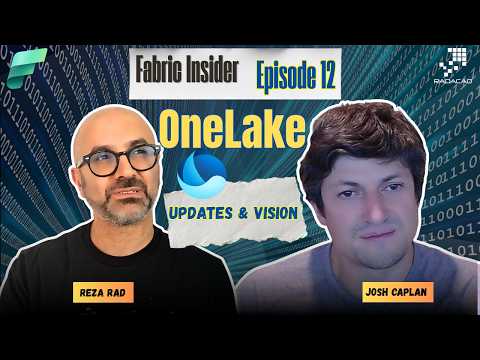
In a recent blog post, Reza Rad (RADACAD) [MVP] summarizes Fabric Insider Episode 12, which features a detailed conversation with Josh Caplan, a product manager for OneLake at Microsoft. The video focuses on recent updates and the strategic direction of OneLake inside Fabric, and the blog frames those points for readers who prefer a written summary. Consequently, the post aims to help both newcomers and experienced data engineers understand where data should live and how the platform is evolving.
The conversation covers foundational topics such as the purpose of OneLake, security, storage tiers, shortcut transformations, and the OneLake Catalog. Moreover, the episode explores how these features fit into AI use cases and what the future roadmap might look like. As Reza notes, the goal is to explain technical concepts clearly while noting practical implications for real-world teams.
What OneLake is and why it matters
OneLake is described as the unified storage layer for Fabric, intended to act as a shared, governed data foundation across analytics, data engineering, and AI. By centralizing data access, Microsoft aims to reduce unnecessary duplication and simplify governance, which can speed up development and reduce risk. For organizations, this means rethinking classic patterns where data was copied into many separate silos.
However, centralization brings tradeoffs. While a single logical lake simplifies discovery and governance, it also shifts responsibility for access control, performance management, and lifecycle policies to a central team. Therefore, the benefits of easier sharing and consistent policy enforcement must be balanced against the need for robust operational processes and clear ownership inside the organization.
Security and governance changes
Reza highlights that the episode emphasizes improvements in governance and security, including tighter integrations with enterprise identity and expanded protections for outbound access. These controls help organizations limit data exfiltration and enforce policies consistently across Fabric services, which is especially important in regulated environments. As a result, teams gain more visibility and control over where data can move and who can access it.
At the same time, Reza points out that deciding where to enforce security—at the lake level or in semantic models—remains a key design choice. Lake-level security centralizes rules and can reduce duplication of effort, but model-level security allows fine-grained permissions that follow business logic. Thus, teams must weigh the benefits of central control against the agility that localized protections can provide.
Storage tiers, shortcuts and integration choices
The blog explains that OneLake now supports hot, cool, and cold storage tiers, plus lifecycle rules and an item-size reporting feature to help manage costs. These capabilities let organizations automatically move older data to lower-cost tiers while keeping datasets accessible for analytics, and they reduce surprise bills. Consequently, cost-conscious teams can tune performance and expense, though they must monitor access patterns to avoid latency surprises.
Another major theme is the expanded use of shortcuts and mirroring to enable low-copy access to external sources such as SharePoint and other platforms. Reza clarifies that shortcuts can replace traditional ETL in many cases because they provide direct access without duplicating data, and that shortcut transformations can apply lightweight changes on read. However, this approach trades copy overhead for potential runtime complexity, since query performance and transformation costs may shift to the read path.
Deciding between shortcuts, dataflows, and pipelines depends on use case. For example, shortcuts excel when data already lives in a managed source and needs governed discovery, while pipelines and dataflows are better when heavy transformations, lineage, or batch control are required. Therefore, architects should evaluate latency, governance, transform complexity, and cost when choosing a pattern.
MCP, catalog, AI agents and roadmap
Reza also covers Microsoft’s work on the MCP server, agentic AI use cases, and the OneLake Catalog, which together aim to make data discovery and automated workflows easier. The catalog improves findability and governance by tagging and tracing items across the lake, while AI agents and MCP use those services to automate routine tasks and surface insights. Consequently, these features promise to accelerate data workflows but will require careful governance and controls to avoid unintended actions.
Looking ahead, the roadmap described in the post points to broader interoperability and richer transformations, coupled with enhanced governance and performance tooling. That direction supports enterprises seeking to combine multiple platforms while retaining a single place for policies and storage management. Nevertheless, integrating across platforms introduces complexity in identity mapping, latency management, and cost allocation that teams must plan for.
Tradeoffs, practical challenges and recommendations
Reza concludes by weighing tradeoffs and offering practical advice for teams adopting OneLake. He recommends starting with clear ownership and governance processes, using tiering to control cost, and choosing shortcuts for low-copy use cases while reserving pipelines for heavy transforms. Consequently, teams should pilot patterns to measure performance and cost before committing broadly.
Finally, the blog emphasizes that the platform is evolving rapidly and that organizations must balance innovation with operational readiness. While OneLake can reduce duplication and improve discovery, it also demands stronger governance, monitoring, and skills. Therefore, teams that combine clear policies with measured pilots will find it easier to capture the benefits while managing the risks.

Keywords
Microsoft Fabric OneLake, OneLake updates, Microsoft Fabric roadmap, Josh Caplan interview, Fabric Insider podcast, OneLake vision, Microsoft data lakehouse, Fabric OneLake integration