- All of Microsoft
Fabric: Polaris GPU Warehouse Deep Dive
Founder | CEO @ RADACAD | Coach | Power BI Consultant | Author | Speaker | Regional Director | MVP
Microsoft Fabric Data Warehouse, Polaris query engine, GPU queries, Power BI expert insights on clustering and autoscale
Key insights
- Fabric Data Warehouse: A fully managed, lake-centric relational warehouse built for SQL-first analytics and Power BI workloads.
It stores curated, structured data on OneLake and removes the need to copy data into separate warehouse storage. - Polaris: The distributed SQL query engine that powers Fabric Warehouse with a stateless design and optimized distributed execution.
Polaris focuses on high-scale SQL analytics and differs from Synapse’s engine in how it schedules and runs queries. - OneLake & Delta: OneLake is the open storage layer where data is kept as Delta tables, enabling zero-copy access across Fabric services.
This open format reduces data duplication and simplifies cross-workload queries and governance. - GPU acceleration: GPUs speed up complex, parallelizable query operations and heavy analytics workloads.
Using GPU-accelerated execution can cut query time for compute-intensive tasks and change how queries are planned. - Custom SQL Pools: Pools let you break the fixed 50/50 SELECT vs. non-SELECT resource split and assign resources to match real workloads.
They improve mixed-workload performance and work with autoscale to better match compute to demand. - Data clustering, retention & monitoring: Clustering helps performance when applied to the right tables, and configurable retention plus clones addresses recovery needs.
Admins should track the new stored procedure for Lakehouse SQL, workload controls, and common query-optimization mistakes to avoid performance issues.
Video snapshot and why it matters
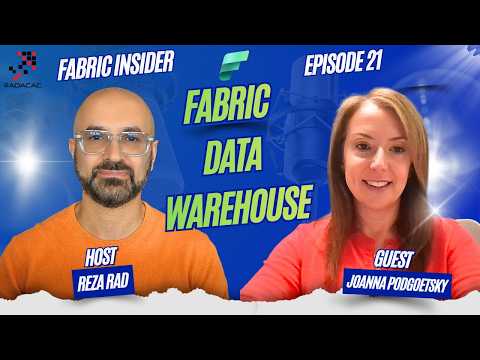
In a recent episode of the Fabric Insider series, host Reza Rad (RADACAD) [MVP] sits down with Joanna Podgoetsky, Principal PM Manager for Microsoft Fabric Warehouse, to unpack the architecture and future of the platform. The conversation moves from basics for newcomers to detailed engine internals, making it relevant to both business analysts and platform engineers. Moreover, the episode highlights practical changes such as GPU acceleration, configurable retention, and data clustering that signal a shift from traditional warehouse designs. Consequently, the video serves as a timely briefing for teams evaluating modern analytics stacks.
What Fabric Data Warehouse is and how it differs
At its core, the platform emphasizes a lake-centric approach by storing data in open formats rather than copying into isolated silos. For example, data lives in a shared layer called OneLake using Delta-style tables, which reduces duplication and simplifies governance across tools. This design supports common analytics patterns like star schemas and governed semantic models, and therefore aims to be familiar to Power BI users while offering cloud-scale capabilities. However, this openness changes some integration assumptions teams have with older, tightly coupled warehouses.
Furthermore, the video explains that the warehouse separates compute from storage so teams can scale each independently. As a result, you can increase query throughput without moving or duplicating data, which improves agility for mixed workloads. At the same time, this separation introduces operational tradeoffs: you gain flexibility but must plan compute sizing and autoscaling strategies to control cost. Thus, organizations must balance performance needs against budget and complexity when adopting the model.
Polaris and the distributed execution story
One of the episode’s central technical topics is Polaris, Microsoft’s distributed SQL query engine that powers the warehouse. Joanna describes Polaris as stateless and designed for SQL analytics at scale, and she contrasts it with older engines to show where it provides performance or behavioral differences. Consequently, Polaris aims to deliver faster query plans and better use of parallel resources, which helps with large structured workloads. Nevertheless, the video also emphasizes that not every workload benefits equally, so workload profiling remains important.
Moreover, the episode highlights how Polaris interacts with storage and compute resources, including how autoscale works from a resourcing perspective. This interaction reduces the need for manual tuning in many scenarios, but it also means that teams should monitor scaling events and resource contention closely. For instance, mixing heavy ETL and ad hoc analytics can lead to resource contention unless resource controls are applied. Therefore, while Polaris increases throughput, it also brings new operational patterns to manage.
Performance gains, GPU acceleration and tradeoffs
The hosts discuss recent performance improvements and the introduction of GPU acceleration for certain query types, which can dramatically speed up analytic workloads. In particular, GPU acceleration benefits highly parallel operations and can shorten processing windows for complex aggregations or model scoring. Yet, Joanna notes that GPUs are not a universal cure; they work best for particular query patterns and can increase costs if applied indiscriminately. Consequently, teams must weigh performance gains against higher compute expense and evaluate queries to identify clear candidates for GPU execution.
Additionally, the episode covers changes like Custom SQL Pools that remove rigid resource splits between SELECT and other workloads. This flexibility helps match resources to actual usage, but it also increases the need for governance so one workload does not starve another. As a result, administrators should deploy workload controls and monitoring to balance priorities effectively. Overall, the message is that performance features are powerful but require thoughtful policies to avoid unintended consequences.
Operational features, optimization and common pitfalls
Beyond raw speed, the video highlights operational capabilities such as configurable retention, clones, and a new stored procedure that optimizes SQL over the Lakehouse. These features help with data recovery, rapid testing, and querying performance, which together simplify many day-to-day tasks for data teams. However, Joanna warns that improper clustering or ill-advised optimization steps can harm rather than help performance, so diagnostics and health checks remain critical. Consequently, the episode stresses that the biggest mistake teams make is optimizing blindly without understanding table health and query patterns.
The conversation concludes with practical monitoring advice and roadmap notes, pointing out metrics and alerts Fabric admins often overlook. For example, query plan characteristics, resource contention events, and cache behavior deserve close attention to prevent slowdowns. Looking ahead, Joanna teases workload controls and other improvements that aim to give administrators more fine-grained levers. Meanwhile, teams adopting the platform must balance agility, governance, and cost to fully realize the benefits.
Implications for adopters and next steps
In summary, the episode by Reza Rad (RADACAD) [MVP] with Joanna Podgoetsky positions Fabric Data Warehouse as a modern, SQL-first option built on open storage principles. Therefore, it appeals to organizations that want tight Power BI integration, reduced data duplication, and cloud-scale query performance. Yet, the episode makes clear that these advantages come with tradeoffs in operational complexity and cost management, so teams must plan monitoring, workload controls, and targeted use of accelerators like GPU. Ultimately, the video offers a practical guide for decision makers weighing modernization against the realities of running large analytic platforms.

Keywords
Fabric Data Warehouse,Polaris GPU,Microsoft Fabric,Fabric Insider Ep 21,Joanna Podgoetsky,Polaris architecture,GPU acceleration for data warehouses,Fabric performance tuning