- All of Microsoft
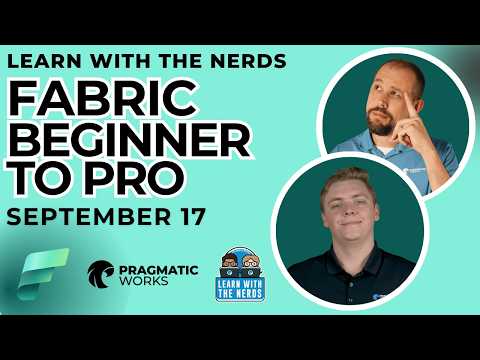
Fabric: Free Live Course for Beginners
Microsoft Fabric primer build a Lakehouse, craft semantic models, deploy Data Agents and Ontology to prepare data for AI
Key insights
- Microsoft Fabric
Microsoft Fabric is a unified, end-to-end analytics platform that combines data ingestion, storage, processing, transformation, and reporting in one SaaS environment.
It helps teams work together on analytics and prepares data for AI-ready scenarios. - Free Live Course
The video session walks viewers from basics to advanced Fabric tasks, led by Zane Goodman and Mitchell Pearson.
Note: Microsoft offers official Fabric training on Microsoft Learn, while this particular "Beginner To Pro" event appears to be a third-party, instructor-led offering. - Lakehouse
The course shows how to build and structure a Lakehouse for analytics, including where to store raw and curated data.
Organizing data in a Lakehouse makes downstream reporting and AI prep simpler. - Semantic model
It demonstrates creating a semantic model on top of your data to define consistent measures and business logic.
Semantic models let business users query reliable metrics without complex SQL. - Data Agent
The instructors show how to set up a Data Agent that answers questions in natural language by querying your data directly.
Data Agents speed ad‑hoc exploration and let nontechnical users access insights more easily. - Ontology
Fabric's Ontology feature maps business terms to underlying tables and columns to create a shared vocabulary.
Using Ontology improves clarity across teams and helps standardize reporting and AI inputs.
Video at a glance
The YouTube session released by Pragmatic Works presents a free live course titled Fabric Beginner To Pro, led by Zane Goodman and Mitchell Pearson. In the video, the hosts guide viewers through a practical sequence that begins with building a Lakehouse and moves toward creating semantic models and setting up Data Agents. Moreover, the presenters introduce Fabric’s new Ontology feature and explain how it helps standardize business vocabulary across teams. As a result, the recording aims to take learners from basic concepts to more advanced, AI-ready data workflows.
The format blends demonstration with explanation, and the hosts emphasize hands-on steps that viewers can reproduce in their own Fabric tenant. At the same time, the video positions itself for both newcomers and those who want to extend existing skills toward production scenarios. Consequently, it acts as a roadmap for practitioners who need to see the full lifecycle from ingestion to natural language querying. Overall, the session promises a compact but practical introduction to core Fabric capabilities.
What the course covers
First, the presenters show how to build and structure a Lakehouse for analytics, highlighting best practices for file layout and partitioning. Then, they demonstrate creating a semantic model that sits on top of raw and transformed data to support consistent reporting and analysis. Next, the video walks through configuring Data Agents so users can query enterprise data using natural language, which speeds exploratory workflows. Finally, the hosts explore Ontology to map business terms to data structures and reduce ambiguity across teams.
Throughout these sections, the instructors balance conceptual framing with concrete steps and screenshots that clarify the flow inside the Fabric studio. They also show practical considerations like data types, permissions, and how semantic models support governance. Consequently, viewers gain both the “how” and the “why” behind each task, which helps bridge learning from lab experiments to real-world projects. Moreover, the presenters note common pitfalls and how to avoid them during implementation.
How this fits into Microsoft’s learning landscape
The video complements official Microsoft learning options that cover Microsoft Fabric, but it is a third-party session produced by Pragmatic Works rather than an official Microsoft course. Notably, Microsoft offers a beginner path on Microsoft Learn with multiple modules that introduce Fabric’s capabilities, while vendors and community trainers provide instructor-led and live sessions for deeper or more applied topics. Therefore, this recording fills a niche for users who prefer live demonstrations with a practical orientation. At the same time, learners should treat it as part of a broader study plan.
In addition, the video helps viewers see how Fabric’s unified SaaS approach compares to traditional toolchains where warehousing, engineering, and BI sit in separate products. By presenting an end-to-end workflow, the session highlights Fabric’s promise of simplified integration across ingestion, storage, transformation, and analytics. Nevertheless, viewers should weigh vendor-neutral fundamentals alongside Fabric-specific techniques to remain adaptable. Consequently, combining multiple learning sources tends to produce stronger, long-term skills.
Tradeoffs and implementation challenges
Adopting Microsoft Fabric and following a guided course involves tradeoffs between simplicity and control, because a unified SaaS platform streamlines many tasks but can hide low-level configuration details. For example, Fabric’s integrated tools speed onboarding, yet teams that require fine-grained control over infrastructure may find some limits. Moreover, implementing semantic models and Ontology demands careful governance and stakeholder alignment, since inconsistent definitions undermine the very benefits these features aim to deliver. Therefore, organizations should balance rapid adoption with a plan for metadata management and review.
Another challenge involves natural language querying through Data Agents, which improves accessibility but still depends on clean, well-modeled data and robust permissions. In practice, teams must invest in quality data pipelines and testing to ensure reliable answers from natural language queries. Meanwhile, scaling lakehouse performance for mixed workloads requires tuning, which can be more visible in production than in a demo environment. In short, the video shows what is possible and indicates the operational work needed to sustain those capabilities.
Who benefits and next steps
Practitioners new to cloud analytics, data engineers, and analysts who want a single environment for end-to-end workflows will find this video particularly useful. Furthermore, technical leads can use the session to evaluate whether Fabric aligns with their organization’s goals for collaboration and AI readiness. For those interested in formal certification or deep specialization, the video pairs well with official modules on Microsoft Learn and targeted instructor-led training. Consequently, viewers should treat this recording as a practical orientation rather than a complete curriculum.
In closing, the Pragmatic Works session provides a clear, applied tour of Fabric’s lakehouse, semantic modeling, Data Agents, and Ontology features, while also making tradeoffs and challenges visible. Therefore, it serves as a helpful next step for teams evaluating Fabric for analytics and AI workflows, and it encourages learners to follow up with hands-on labs and governance planning. Ultimately, the video will accelerate practical experimentation but requires complementary resources and operational discipline to succeed in production.

Keywords
free live fabric course, fabric beginner to pro course, free live sewing course, learn fabric sewing online, fabric design course free, live fabric workshop, fabric sewing for beginners, advanced fabric techniques course