- All of Microsoft
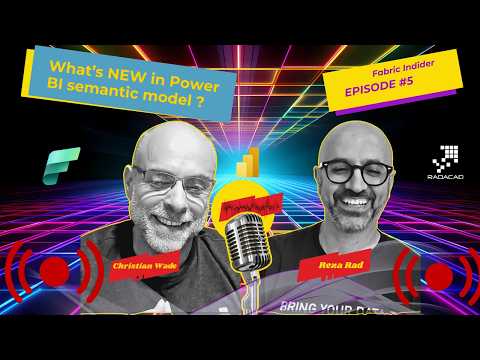
Power BI: 2026 Semantic Models Updates
Founder | CEO @ RADACAD | Coach | Power BI Consultant | Author | Speaker | Regional Director | MVP
Microsoft expert: Power BI semantic models in Microsoft Fabric with OneLake security, Direct Lake, TMDL and AI agents
Key insights
-
In this episode of Fabric Insider I summarize a conversation with Christian Wade about what's new for Power BI semantic models in Microsoft Fabric.
The show features several live demos, including an AI agent that builds a semantic model from scratch. -
The host demos OneLake Security and contrasts Direct Lake on OneLake versus SQL-based Direct Lake.
New capabilities now let Direct Lake support calculated columns and tables without materializing data. -
The episode covers Composite models that mix Direct Lake and import tables, showing both opportunities and current limitations.
The demos highlight where hybrid storage works well and where authors still must plan around constraints. -
Christian explains user-context-aware calculated columns using fields like UserPrincipalName, UserCulture, and CustomData.
The discussion shows how these values affect calculation timing and query behavior in the semantic layer. -
The show emphasizes the value of TMDL on the web and a stronger browser-based modeling experience in Fabric.
Developers can now add, transform, and edit models in the service, reducing switch-over to Power BI Desktop. -
AI and automation feature prominently: AI Auto-Description, Copilot assistance, and programmatic tools like Semantic Link / SemPy improve model documentation, deployment, and governance.
These advances make semantic models easier to build, reuse, and manage at scale.
Video Snapshot: What Reza Rad Presents
In a recent YouTube episode led by Reza Rad (RADACAD) [MVP], Christian Wade, Principal Program Manager for Power BI Semantic Models at Microsoft, outlines the major advances for semantic modeling in 2026. The conversation centers on practical demos and product direction, making the video a concise briefing for data professionals who build and govern analytical models. Moreover, the episode emphasizes live demonstrations of several features, which clarify how these updates behave in real scenarios.
Notably, the episode covers OneLake Security, Direct Lake composite models, user-context-aware calculated columns, TMDL on the web, and an AI agent constructing a semantic model from scratch. Consequently, viewers can see both capabilities and limitations in action rather than only theoretical claims. Altogether, the video serves as a practical tour of Microsoft Fabric's evolving semantic layer for Power BI.
Key Features Demonstrated
First, the demo of OneLake Security highlights how access controls and data protection tie back to the storage layer. Christian shows how governance flows from OneLake into semantic models, which helps administrators maintain consistent security policies across datasets. At the same time, he stresses that policy design still requires careful planning to avoid overpermissive access.
Second, the episode differentiates Direct Lake on OneLake versus Direct Lake on SQL and demonstrates composite models that combine Direct Lake and import tables. The demos make clear where calculated columns run on-the-fly versus when materialization is required, which affects performance and storage needs. Therefore, developers must choose approaches that match query patterns and latency expectations.
Third, the show introduces user-context-aware calculated columns—such as UserPrincipalName, UserCulture, and CustomData—and explains whether these values compute on demand or are pre-calculated. In addition, viewers see how TMDL views on the web streamline developer workflows and why many developers may prefer modeling in the browser. Finally, the AI agent demo underlines how automation can accelerate model creation, while also raising questions about validation and quality control.
Benefits and Trade-offs
On the positive side, browser-based modeling reduces friction because teams no longer must alternate constantly between Desktop and the service. This change speeds up collaboration and supports continuous deployment across Fabric workspaces, thereby improving governance and reusability. Moreover, AI-powered features such as auto-descriptions can boost productivity and make models easier to understand for non-experts.
Nevertheless, trade-offs remain. For example, enabling calculated columns in Direct Lake increases flexibility but may impact runtime performance compared with pre-materialized import tables. Likewise, AI automation can generate useful scaffolding quickly, but it can also introduce logic that requires human review and testing before production deployment. Thus, organizations must balance speed with control and observability.
Additionally, choosing between Direct Lake and import modes often involves a trade-off between storage costs and query speed. Direct Lake reduces duplication by reading data in place, yet complex transformations or high-concurrency scenarios may still benefit from import and materialization. Therefore, architects should test representative workloads to identify the best compromise for their environment.
Technical Challenges and Limitations
Christian Wade acknowledges that some gaps remain between Desktop and the web modeling experience, such as changing a table’s storage mode from the service and certain dialog features. Also, when authors import data using Power Query in the Fabric service, relationships from source systems may not auto-populate, which forces manual relationship maintenance. These limitations can extend authoring time and increase the risk of modeling inconsistencies.
Furthermore, governance and deployment scenarios still require careful automation and monitoring. While programmatic support through Semantic Link and admin APIs has improved, teams must still manage workspace deployments, remapping, and versioning with discipline. In addition, AI-generated models need validation pipelines so that unexpected semantics or security gaps do not slip into production.
Lastly, debugging performance in hybrid scenarios—where Direct Lake and import tables coexist—can be complex. Tooling is improving for traceability and query diagnostics, but architects should expect an initial learning curve. Consequently, adequate testing, observability, and rollback plans are essential when adopting these new capabilities.
Outlook: Practical Steps and Next Moves
For practitioners, the video suggests starting with small experiments that combine Direct Lake and import approaches to measure performance and cost impacts. In addition, teams should treat AI outputs as accelerators rather than finalized assets and implement review gates and unit tests for critical measures and calculations. This approach reduces risk while harnessing the productivity gains shown in the demo.
Moreover, IT and data governance groups should integrate OneLake Security controls into their model design and deploy programmatic checks that verify role definitions and access rules. Such practices will help maintain compliance and prevent privilege creep as modeling shifts to the browser. Finally, staying current with Fabric service updates will be important because Microsoft continues to close feature gaps and extend automation capabilities.
In summary, Reza Rad’s episode with Christian Wade offers a practical and timely overview of semantic modeling improvements in 2026. While the new features promise faster authoring and tighter integration, they also require thoughtful trade-offs around performance, governance, and AI validation. Consequently, organizations that plan carefully can gain significant value from these advances while managing the associated risks.

Keywords
Power BI semantic models 2026, Microsoft Fabric semantic model updates, Power BI semantic modeling, Power BI modeling best practices 2026, Fabric Insider podcast Christian Wade, Power BI semantic layer tips, Power BI Fabric new features 2026, Christian Wade Power BI insights