- All of Microsoft
Copilot Studio: Build Smarter Agents
Software Development Redmond, Washington
Microsoft Copilot Studio Agent Academy builds multiagent apps with child/connected agents for hire prep on PowerPlatform
Key insights
- Copilot Studio Agent Academy: a free, self-paced, role-based curriculum that teaches how to build production-ready AI agents.
It uses mission ranks—Recruit, Operative, and Commander—with the Operative level previewed for real multi-agent business scenarios like hiring and interview preparation. - Hands-on labs: guided, project-based exercises walk you through building, testing, and publishing agents end-to-end.
These labs focus on real tools and real use cases so you learn by doing, not by reading theory. - No-code/low-code: Copilot Studio makes agent building accessible to makers and business users while letting developers extend functionality with code and Azure integrations.
This lowers the barrier for teams to automate processes and create useful copilots quickly. - Agent components: create agents using topics, knowledge, logic, and flows, combined with grounded prompts and knowledge sources to produce reliable assistive or autonomous behavior.
Multi-agent patterns (child and connected agents) let you orchestrate complex workflows across roles and steps. - Microsoft integration: agents can use Microsoft 365 data (like SharePoint and OneDrive), publish into Microsoft Teams and M365 Copilot, and connect to the Power Platform and Azure for enterprise scenarios.
This makes agents practical for organizations already using Microsoft services. - Career and business impact: completing the academy builds in-demand skills to design, deploy, and manage production-ready agents that solve real business problems.
Advancing through Operative and Commander prepares you for multi-agent orchestration and enterprise-grade deployments.
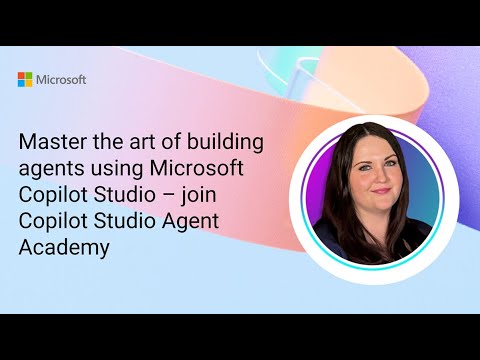
The newsroom reviewed a recent YouTube video published by Microsoft that introduces the Copilot Studio Agent Academy, and the presentation offers a practical look at how to build AI agents with Copilot Studio. The demo, presented by April Dunnam during a Microsoft 365 & Power Platform community call on November 4, walks viewers through an Operative-level curriculum and real-world agent scenarios. As reporters, we summarize the video to highlight what the training covers, how agents are structured, and what organizations should consider when adopting these tools. Overall, the video serves as both an instructional demo and a preview of more advanced content coming to the academy.
Video overview and format
The recording begins with a clear statement of purpose: to teach makers and developers how to build and deploy agents using Copilot Studio. The presenter demonstrates a step-by-step workflow while explaining the role-based curriculum that structures the learning path into ranks. Furthermore, the session mixes live demos with explanatory commentary so viewers can see each feature in context rather than only reading theory. This format makes the material accessible to viewers with varying technical backgrounds.
What the Academy teaches
The academy is framed as a self-paced, role-based learning path aimed at moving learners from basic concepts to production-ready agents. For example, the curriculum uses the ranks Recruit, Operative, and Commander to signal progression from foundations to advanced, enterprise-scale scenarios, including deeper Azure integration. In the video, the Operative content focuses on multi-agent orchestration and real business scenarios, showing how child and connected agents collaborate to complete complex tasks. Thus, learners can expect labs that emphasize hands-on building, testing, and publishing.
Additionally, the training aims to be inclusive of both no-code users and professional developers by showing how low-code tools and developer extensions coexist within the same platform. The demo highlights practical modules such as adding topics, linking knowledge sources, and designing flows that reflect business processes like hiring and interview prep. Therefore, the academy positions itself as useful for makers automating workflows and for developers building extensible, integrated solutions. As a result, teams can adopt a common platform while allowing specialists to add custom integrations when needed.
How agents function in the demo
During the demonstration, the presenter builds sample agents that combine large language model capabilities with organizational data and logic. Viewers observe how child agents handle focused tasks while a coordinating agent orchestrates the overall workflow, enabling multi-step scenarios without manual handoffs. Furthermore, the demo shows how agents use structured topics, knowledge connections, and decision logic to move from conversation to concrete actions like scheduling or document retrieval. This layered approach makes it easier to design agents that remain predictable and auditable.
Integration with the Microsoft ecosystem
The video emphasizes seamless ties to Microsoft services as a core benefit of Copilot Studio, showing how agents can use content from Microsoft 365 and publish into Teams. In addition, the presenter touches on connections to Power Platform and hints at deeper Azure integrations planned for advanced ranks. Consequently, organizations already invested in Microsoft tools can more easily adopt agents that surface inside familiar apps and workflows. This ease of integration lowers friction but also raises questions about governance and data handling inside enterprise systems.
Tradeoffs and practical challenges
Adopting Copilot Studio presents tradeoffs between speed of delivery and long-term control. On one hand, the no-code/low-code model speeds up prototyping and lets business users build useful agents quickly; on the other hand, teams must balance that speed against requirements for security, compliance, and lifecycle management. Additionally, the multi-agent approach simplifies complex scenarios but increases testing and monitoring needs, since more moving parts mean more potential failure points and harder-to-diagnose issues.
Moreover, the academy addresses skills gaps but cannot eliminate them; organizations still need people who understand prompt design, data mapping, and governance to ensure agents behave reliably. Finally, scaling agent deployments introduces additional costs and architectural choices, particularly when linking to sensitive data or external services. Therefore, teams must weigh the benefits of rapid capability delivery against the investments required for robust operations, oversight, and staff training.
Implications and next steps
The YouTube demo signals that Microsoft aims to make agent-building accessible and aligned with existing enterprise systems, and the academy offers a clear path for teams to gain hands-on experience. For readers interested in experimenting, the video suggests participating in community calls and following the academy curriculum to progress from Recruit to Operative and eventually to Commander-level scenarios. In addition, organizations should plan governance and testing strategies as they pilot agents so that quick wins do not create long-term risks. Finally, viewers who want to adopt these tools should combine practical labs with policies and monitoring to get the most value while controlling downside risks.
Keywords
Copilot Studio agents, Microsoft Copilot Studio tutorial, build AI agents Copilot Studio, Copilot Studio Agent Academy, create autonomous agents Microsoft, Copilot Studio guide for developers, AI agent development with Copilot, Copilot Studio training course