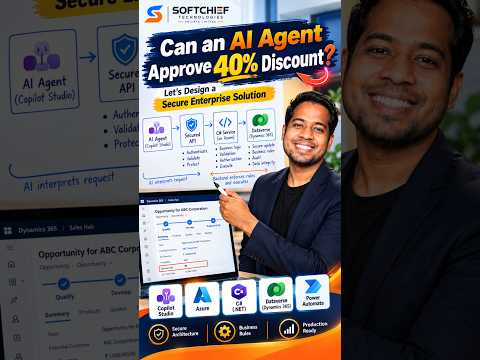
Dataverse: design secure AI solutions with C# and Azure
Learn how to take advantage of your business data with Microsoft Dynamics 365 & Power Platform & Cross Technologies. My name is Sanjaya Prakash Pradhan and I am a Microsoft Certified Trainer (MCT) and
Teams building business AI can combine Dataverse data with C# application logic and Azure services, while keeping access controls in the design.
Key insights
- The architecture pairs Dataverse business data with C# application logic and Azure services.
- The research notes describe checking identity and permissions before retrieving data for an AI request.
- Dataverse supports structured business data, relationships, roles and access controls.
- The Short’s transcript is unavailable, so its specific steps and implementation details cannot be verified.
Microsoft Dataverse can serve as the business-data layer in an AI solution that uses C# for application logic and Azure for services and infrastructure. This approach is relevant to developers and solution architects connecting AI features to business processes and governed data. Softchief Learn’s Short is titled around this architecture, but no transcript or detailed demonstration is available to verify its specific implementation.
What it does
The proposed design combines four parts: an AI capability, C# and .NET application code, Azure services, and Dataverse. Dataverse provides structured business data, including tables and relationships, alongside features such as role-based access controls and business rules. C# can implement application logic and coordinate calls to Dataverse and Azure services.
The research describes a controlled flow in which an application checks a user’s identity and permissions, retrieves authorized information, sends relevant context to an AI service, and limits actions to permitted functions. This makes access decisions part of the application design rather than assuming an AI model should have unrestricted access to business data.
Who it is for and what you need
This pattern is aimed at teams building business applications or AI workflows that use Dataverse data. It assumes familiarity with C# or .NET, Azure, and Dataverse. The material does not specify required product licenses, Azure services, minimum versions, tenant settings, or prerequisites for a particular implementation.
The research also discusses identity, permissions, secret management, monitoring, and API-based business logic as security considerations. These are architectural considerations, not evidence that the Short demonstrates a finished or deployable solution. No rollout stage or preview status is stated.
How it works
- Receive a user request or business-process event in the application.
- Authenticate the user and check which data and actions they are authorized to access.
- Use C# application logic to retrieve permitted data from Dataverse and call the relevant Azure AI service.
- Validate the response, allow only approved actions, and record relevant activity.
The research describes these as elements of a typical solution, not verified steps from the Short. It does not provide a menu path, code sample, deployment procedure, or specific Azure service names to follow.
Limitations and open questions
The available Short transcript contains no spoken or demonstrated content, and its description provides no technical detail. As a result, the exact architecture, security configuration, and implementation shown cannot be confirmed. The source material also does not establish licensing, availability, or a specific configuration path.
Before implementing the pattern, teams would need to determine which Azure and Dataverse services fit their requirements and define their own authorization, data-handling, and monitoring controls. The material does not compare this design with a previous method or provide a complete production checklist.
Sources
Frequently asked questions
How can Dataverse fit into an AI application built with C#?
The described pattern uses Dataverse for structured business data and access controls, while C# implements application logic and coordinates service calls.
Does this architecture require a particular Dataverse or Azure license?
The available material does not specify required licenses or plans.
Does the source provide a working code sample or setup steps?
No. The Short has no available transcript, and the material does not include a code sample, menu path, or deployment procedure.