- All of Microsoft
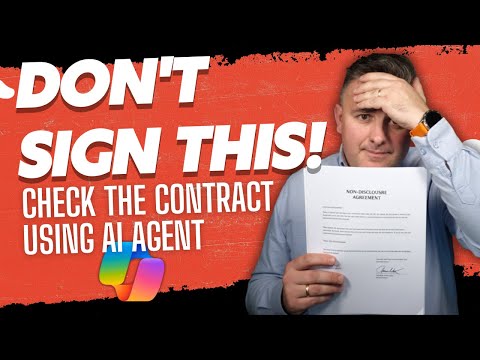
Copilot: Let AI Review Contracts First
Microsoft 365 atWork; Senior Digital Advisor at Predica Group
Microsoft pro: Copilot AI Agents for NDA review with GPT Five to spot legal risks and boost Microsoft cloud efficiency
Key insights
- AI Agent and Copilot Chat: The video demonstrates building a Copilot Chat AI Agent that reviews NDAs and contracts, flags risks, and summarizes issues for legal review.
It shows a practical demo of the agent working on real contract text. - Speed and cost savings and consistency: Agents speed up routine reviews, cut per‑review cost, and apply consistent playbook checks to reduce human errors across teams.
They also help triage high‑risk agreements so lawyers focus on complex cases. - Document ingestion and clause extraction: The agent converts PDFs, Word files, and scans into text, then finds clauses like indemnities, termination, dates, and payment terms for analysis.
This structured extraction makes key terms easy to review and report. - Playbook comparison and automated redlining: The system compares clauses to organizational playbooks, scores deviations, and proposes edits or redlines that lawyers can accept or modify.
It prioritizes issues by severity to speed decision making. - Integration with Microsoft 365 and lifecycle tracking: The demo shows how agents surface suggestions inside Word and Microsoft 365 workflows and track milestones like renewals and expirations for reminders.
That keeps contract metadata connected to existing systems and audits. - GPT‑5 and lawyer oversight: The presenter uses GPT‑5 to craft better instructions for the agent and highlights low‑code agent creation tools, while stressing that lawyers must validate edits and manage legal risk.
AI accelerates work but does not replace human review.
Szymon Bochniak (365 atWork) released a practical YouTube walkthrough that shows how to build a Copilot Chat AI Agent to review non‑disclosure agreements before signing or sharing them with legal teams. In the video, Bochniak demonstrates a live NDA agent and explains how to use GPT‑5 to craft better instructions for the agent. Consequently, the session aims to help professionals set up a tool that speeds contract checks while keeping lawyers in the loop.
Overview of the video
The video opens with a short demo, then moves into step‑by‑step assembly of an NDA review agent inside the Microsoft 365 and Copilot context. Bochniak frames the agent as a safety net: it flags risky language, extracts key terms and suggests remedial edits that a human reviewer can accept or refine. Moreover, timestamps in the presentation make it easy for viewers to jump to the demo, the GPT‑5 instruction segment, or the technical build details.
Demo and workflow
In the demo, the NDA agent ingests a contract, identifies critical clauses and highlights potential risks while proposing redlines that preserve legal intent. Then Bochniak shows how a reviewer can accept suggested edits directly or use them as a starting point for negotiation with counter‑parties. In addition, he emphasizes how the agent fits into a broader Microsoft 365 workflow so teams see suggestions where they already work, such as in documents and chats.
How the AI Agent works
Bochniak explains core components clearly: document ingestion and OCR for scanned files, clause detection with natural language processing, comparison against an organizational playbook, and automated redline generation for Microsoft Word. He also demonstrates how metadata extraction—dates, parties, payment terms—feeds reports and reminders so the legal lifecycle does not slip. Together these elements allow the agent to triage contracts and surface the highest risks first.
Importantly, the video highlights the use of GPT‑5 to craft the agent's instruction set, which improves how the agent interprets ambiguous clauses and formulates suggested language. Bochniak argues that a well‑designed instruction layer reduces false positives and makes remediation recommendations more practical. However, he notes that the underlying models still require human review for final decisions, particularly for complex or novel legal issues.
Benefits, tradeoffs and risks
The primary advantages are speed and consistency: automated checks can reduce review time and apply the same playbook across many documents, which reduces human error and improves compliance. Moreover, integration with Microsoft tools means suggested redlines and summaries appear in familiar interfaces, which helps adoption across teams. At the same time, there are tradeoffs: automation can miss rare but critical edge cases, and overly aggressive redlining might erode negotiating leverage if applied without legal context.
There are also risk considerations around model reliability, privacy and governance. For instance, extracting sensitive contract data raises data handling questions, so organizations must control where documents and model outputs reside. Finally, legal liability remains a concern: the agent can recommend edits, but lawyers must retain oversight, approve final language and accept responsibility for legal outcomes.
Challenges and practical recommendations
Bochniak outlines practical steps to mitigate common challenges, such as building a robust playbook, testing the agent against real contract samples and calibrating severity scores for flagged clauses. In addition, he recommends iterative tuning using feedback from legal teams and version control for playbook changes so the system evolves without breaking expectations. He also warns that prompt and instruction engineering—especially when using GPT‑5—requires care to avoid hallucinations and maintain consistent outputs.
Operationally, teams must plan for integration complexity and maintenance costs, such as updating clause libraries when regulations or corporate policy change. Therefore, organizations should treat the agent as a complement to human expertise rather than a replacement, and set clear escalation paths for ambiguous or high‑risk items. Meanwhile, pilot programs with a mix of routine and complex contracts help validate ROI and safety before broad deployment.
Conclusion
Szymon Bochniak’s video offers a compact, actionable guide for building a Copilot Chat AI Agent to review NDA contracts using modern models and Microsoft integrations. The presentation balances practical how‑to steps with honest discussion of tradeoffs, urging teams to combine automation with legal oversight for safe outcomes. Ultimately, the agent approach promises faster, more consistent reviews, but success depends on careful tuning, governance and ongoing collaboration between legal and technical teams.

Keywords
AI contract review, automated contract review tool, build AI contract reviewer, AI legal contract assistant, contract analysis with AI, AI agent contract review, how to create AI contract reviewer, contract review automation