- All of Microsoft
Microsoft Agent Framework: Orchestrate
Microsoft Agent Framework: orchestrate multi-agent AI workflows with Python and .NET, streaming and human-in-the-loop
Key insights
- Microsoft Agent Framework: A multi-language SDK for Python and .NET that lets teams build, orchestrate, and deploy AI agents using graph-based workflows.
It supports streaming, checkpointing, and human-in-the-loop interactions to automate complex tasks. - Memory Persistence: Built-in context management keeps multi-turn conversations intact across sessions.
Agents remain stateless while conversation state can be serialized and resumed for consistent, context-aware interactions. - Orchestration Patterns: Supports multiple workflow styles to match business needs:
• Concurrent — run tasks in parallel and collect independent results.
• Sequential — pass output from one agent to the next for staged processing.
• Group Chat — multiple agents collaborate with a manager controlling turns.
• Handoff — switch control between agents based on rules or context.
• Magentic — enable complex, generalist multi-agent collaboration. - Tool Integration: Connect agents to any API using OpenAPI specs and enable agent-to-agent (A2A) communication.
The framework uses a Model Context Protocol to let agents call tools and integrate with existing DevOps and enterprise systems. - Governance & Security: Includes policy enforcement, permissions, and auditable agent actions for regulated environments.
It integrates with enterprise identity and access controls to maintain compliance and traceability. - Demo Highlights: Elijah Straight demos a PowerPoint synthesis and a multi-agent workflow, showing visualization and a live demo.
Key timestamps: visualization early, demo start around 05:03, and code/GitHub references near the end; the video points viewers to docs and a GitHub repo for samples and code.
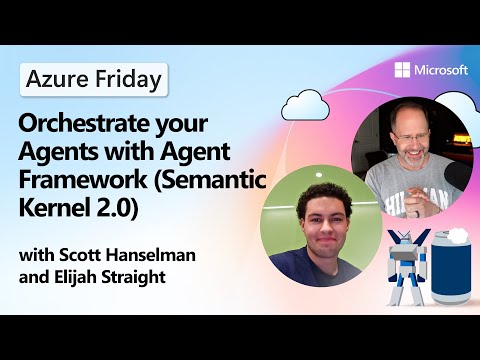
The recent YouTube video from Microsoft Azure Developers showcases a practical walkthrough of the Microsoft Agent Framework, and it explains how to design and run multi-agent workflows using graph-based orchestration. In the video, product manager Elijah Straight demonstrates a live demo that synthesizes a PowerPoint and then shows code and repository references, helping viewers see the framework in action. As a result, the presentation balances conceptual overview with hands-on examples, making the technology accessible to developers and technical leaders alike.
Overview of the Framework
First, the video frames Microsoft Agent Framework as a multi-language SDK that supports both Python and .NET, and it emphasizes features like streaming, checkpointing, and human-in-the-loop capabilities. Moreover, the presenter positions the framework as a unifying layer that links local development to enterprise deployments, including observability and compliance features that enterprises expect. Consequently, viewers learn that the framework targets scenarios where multiple agents must cooperate while preserving context and security boundaries.
Demo Walkthrough and Visualization
During the demo, Elijah Straight visualizes a multi-agent workflow and walks viewers through how a PowerPoint file is synthesized and processed by coordinated agents, which clarifies the orchestration model. Then, the demonstration switches to code and a GitHub repository where the project structure, graph definitions, and runtime behaviors are visible, helping developers map theory to implementation. Therefore, the demo serves as a concrete reference point for teams who want to replicate or adapt the flow for their own use cases.
Core Capabilities Highlighted
The video highlights several core capabilities, including context management for multi-turn interactions and a persistence model that lets agents serialize and resume conversations reliably. In addition, it shows how the framework supports tool integration through OpenAPI-style connectors and enables agent-to-agent communications via Agent2Agent (A2A) patterns, which expands interoperability across runtimes. As a result, developers can combine specialized agents, let them call external APIs, and coordinate actions while maintaining a coherent conversation state.
Orchestration Patterns and Design Choices
Importantly, the presenter outlines multiple orchestration patterns such as concurrent broadcasts, sequential pipelines, group chat coordination, and dynamic handoff between agents, and he explains when each approach fits typical business problems. For instance, a concurrent pattern speeds analysis but increases the need for result reconciliation, whereas a sequential pipeline simplifies state transfer but can introduce latency. Therefore, teams need to weigh tradeoffs between responsiveness, reliability, and complexity when they pick an orchestration strategy.
Tradeoffs and Operational Challenges
While the framework offers many benefits, the video does not shy away from challenges that teams will face when adopting multi-agent systems, such as ensuring robust governance, handling failure modes, and managing costs associated with parallel processing. Moreover, integrating agents with enterprise identity and permissions requires careful policy design to avoid privilege escalation and maintain auditability under regulatory constraints. Consequently, organizations should plan for observability and testing infrastructure up front, because operational visibility becomes critical as agent count and workflow complexity grow.
Adoption Path and Resources
The presenter points viewers to documentation and a GitHub repository for getting started, which supports both experimental prototyping and later production hardening. Additionally, the video suggests that teams begin with small, well-bounded workflows to build confidence, and then expand patterns once they validate correctness and cost-effectiveness. Thus, a staged adoption reduces risk and makes it easier to measure benefits before investing in broader deployments.
Conclusion and Practical Takeaways
In summary, the YouTube presentation from Microsoft Azure Developers offers a clear, practical introduction to orchestrating agent-based automation using the Microsoft Agent Framework, and it combines live demo material with architectural guidance. Moving forward, teams should balance rapid experimentation with careful governance and observability, because the most powerful multi-agent systems also demand disciplined operational practices. Finally, the recorded demo and associated repository provide a useful blueprint for developers who want to prototype orchestrated AI workflows and evaluate tradeoffs in real projects.
Keywords
microsoft agent framework, agent orchestration, orchestrate agents with microsoft, microsoft ai agents, multi-agent orchestration, agent framework tutorial, azure agent orchestration, conversational ai orchestration