- All of Microsoft
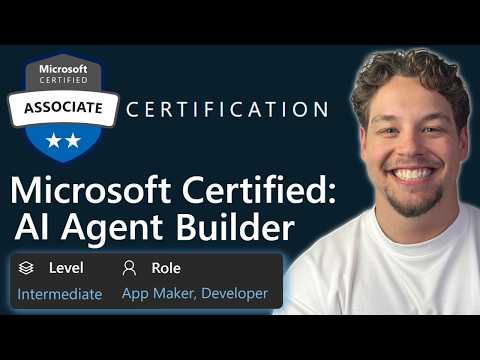
AB-620 Course: Pass the Exam Fast
Certified Power Apps Consultant & Host of CitizenDeveloper365
Pass AI Agent Builder exam mastering Copilot Studio agent orchestration, Power Platform, Dataverse and Azure AI Search
Key insights
- AB-620 is the exam code for the Microsoft Certified: AI Agent Builder Associate credential; the aligned course AB-620T00-A is a 3-day instructor-led offering that became available on 2026-06-19 and some Learn pages still show beta status.
- Key platforms and concepts include Copilot Studio, Power Platform, Dataverse, and Azure AI Search, plus agent patterns like Retrieval-Augmented Generation (RAG), Model Context Protocol (MCP), Agent2Agent (A2A), and adaptive cards for user interactions.
- The certification stresses building production-ready agents that support enterprise integration, operate at scale, and follow governance, security, and lifecycle management practices.
- Exam logistics to note: a common passing score reference is 700/1000, typical exam time is around 100–120 minutes, and candidates can usually retake after 24 hours if needed.
- Prepare by practicing practical skills: design agent orchestration, create custom connectors and use REST APIs, test agent evaluations and performance, and build human-in-the-loop flows in labs or projects.
- Study smart: focus on how components work together, build a small multi-agent solution, verify knowledge grounding and content moderation, and follow a step-by-step study guide or roadmap to fill gaps quickly.
Introduction: A comprehensive walkthrough of the AB-620 video
In a recent YouTube presentation, Griffin Lickfeldt (Citizen Developer) offers a full-course walkthrough aimed at helping candidates pass the Microsoft AI Agent Builder Associate exam (AB-620). The video combines a study guide with practical explanations of the tools and patterns used to build production-ready agents in Copilot Studio and the broader Microsoft stack. Moreover, Griffin emphasizes real-world examples and reasoning rather than rote memorization, which helps viewers understand how technologies combine in enterprise scenarios.
Course scope and structure covered in the video
The video outlines an extensive set of topics that map to the AB-620 objectives, including agent orchestration, multi-agent architectures, and integrations with business systems. In addition, Griffin walks through core components such as Microsoft Dataverse, Power Platform, Power Fx, adaptive cards, and connectors, and he highlights how these pieces fit together to deliver practical solutions. He also provides chaptered timestamps and a downloadable slide deck for learners who want a structured study path.
Griffin spends substantial time on advanced agent features like the Model Context Protocol (MCP), Agent2Agent (A2A) collaboration, and Retrieval-Augmented Generation (RAG). Furthermore, the course touches on security, authentication, content moderation, and application lifecycle topics to reflect enterprise priorities. Consequently, the content aims to prepare developers and architects for both conceptual exam questions and implementation-focused challenges.
Key technical themes and how they interact
One major theme is grounding agent responses in enterprise data sources to reduce hallucinations, for which Griffin explains the role of Azure AI Search and RAG patterns. He also discusses when to use out-of-the-box Copilot connectors versus custom connectors or REST APIs, noting that each choice affects maintainability and scope of integration. In addition, adaptive cards and agent tools receive attention as primary user interaction mechanisms, with examples showing how agents collect inputs and return structured outputs.
Another core focus is agent orchestration and multi-agent architectures, where Griffin explains tradeoffs between centralized control and distributed autonomy. For instance, using child agents can simplify responsibilities, but it increases coordination complexity and state management needs. Therefore, he recommends designing clear agent roles and robust evaluation practices to measure performance and reliability during both testing and production phases.
Tradeoffs and practical challenges highlighted
Griffin frames many design choices in terms of tradeoffs, especially when balancing speed of delivery against long-term reliability. For example, rapid prototyping with generative answers speeds validation, but it requires stronger grounding and moderation to meet enterprise governance standards. Similarly, connecting agents to multiple enterprise systems improves value, but it increases surface area for security and failure modes that teams must manage.
The video also discusses cost and operational tradeoffs, noting that multi-agent approaches and heavy retrieval strategies can raise both compute and management overhead. Moreover, teams face a challenge in testing agent behaviors across varied data sources and conversational flows, so Griffin urges rigorous evaluations and human-in-the-loop scenarios to catch edge cases. Ultimately, these tradeoffs require cross-functional planning between developers, security, and business owners.
Exam preparation and study strategy suggested in the video
Griffin recommends a hands-on study approach that pairs the slide-based guide with practical labs in Copilot Studio and related services. He advises candidates to practice building simple agents, then progressively add connectors, knowledge sources, and evaluation tests to gain a complete view of the lifecycle. In addition, Griffin points out the value of reviewing Microsoft’s official course description and combining it with scenario-based exercises to bridge theory and practice.
For time management, Griffin suggests allocating study time across the major domains—architecture, integrations, security, and ALM—rather than focusing narrowly on one area. Moreover, he notes that the exam may require understanding both conceptual patterns and implementation details, so balanced preparation helps. Finally, he offers optional next steps, such as turning the material into a targeted study plan or seeking one-on-one coaching for specific gaps.
Implications for practitioners and final notes
The video positions the AB-620 credential as a pathway for developers and architects who will build enterprise-grade agents, and it highlights the growing emphasis on agentic solutions across organizations. However, Griffin also clarifies that titles like “full course” often come from community creators, while Microsoft’s official offering is the AB-620T00-A training; therefore, viewers should consult official materials for exact exam logistics. In addition, the certification’s beta status in some locales suggests the syllabus may evolve as the field and tools mature.
Overall, Griffin Lickfeldt’s presentation offers a practical and structured overview for candidates preparing for AB-620, emphasizing hands-on practice and thoughtful system design. Consequently, teams adopting agentic AI should weigh the tradeoffs between rapid innovation and enterprise governance, and they should plan for testing, evaluation, and lifecycle management from the start. For readers, the video can serve as a useful roadmap for both exam preparation and real-world implementation of Microsoft-based AI agents.

Keywords
AI Agent Builder Associate AB-620, AB-620 exam preparation, AI Agent Builder certification, Pass AB-620 exam, AB-620 practice tests, Microsoft AI Agent Builder course, AB-620 study guide, AI Agent Builder full course