- All of Microsoft
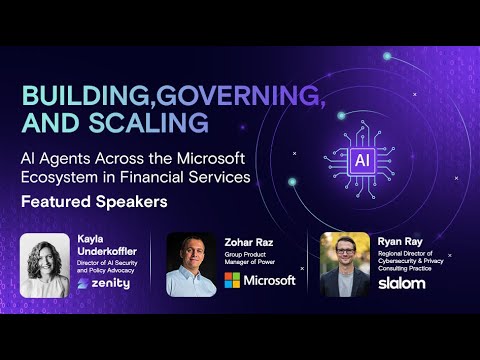
Microsoft AI Agents in Finance
Build govern scale secure AI agents in finance with Microsoft three-sixty-five Copilot, CopilotStudio & Azure AI Foundry
Key insights
- Frontier Firms and the goal: financial firms use AI agents across the Microsoft stack to automate workflows and improve customer service.
Session experts show how Microsoft 365 Copilot, Copilot Studio, and Azure AI Foundry fit into that strategy. - Operational Efficiency and productivity: agents speed tasks like document checks, income validation, and report drafting while Copilot in Word and Excel helps staff work faster.
These tools support large-scale automation without manual constant oversight. - Agent 365 and governance: Microsoft’s control plane centralizes registration, telemetry, and monitoring of agents to meet regulatory needs.
Organizations should treat agents as identities and apply defense-in-depth controls for visibility and compliance. - Copilot Studio and deployment patterns: teams can build custom agents and deploy them with tested, secure templates.
Follow proven patterns for environment segmentation, logging, and real-time protection to operationalize safely within existing risk frameworks. - Multi-agent ecosystems and autonomy: agents can collaborate to plan, decide, and act across processes, for example in sales qualification or workforce analytics.
Design workflows so human teams supervise critical decisions and auditors can trace actions. - Practical blueprint to scale: start with focused pilots, enforce governance rules, use telemetry to monitor risk, and lean on the partner ecosystem for domain expertise.
This approach helps accelerate adoption while keeping regulators and risk officers aligned.
Zenity published a YouTube video that examines how financial services firms can build, govern, and scale AI agents across the Microsoft 365 ecosystem. In the session, Kayla Underkoffler of Zenity joins Zohar Raz from Microsoft and Ryan Ray of Slalom to explain practical approaches and governance patterns. The conversation centers on tools such as Microsoft 365 Copilot, Copilot Studio, Azure AI Foundry, and the newly highlighted Agent 365 control plane. As regulators press for stronger controls, the panel offers a blueprint for adopting agents without sacrificing compliance or security.
What the Video Covers
The video begins by framing Microsoft's vision for organizations that embed AI deeply into operations, referred to as Frontier Firms, and explains why financial services are a natural fit. Panelists outline how agents can automate tasks, improve customer engagement, and free staff from routine work. They also emphasize the need to align agent design with existing risk and compliance frameworks to meet regulatory expectations. Overall, the session balances ambition with cautious planning to drive confident adoption.
Next, the speakers demonstrate real deployment patterns and give examples from banking workflows like document verification and regulatory checks. They walk through the lifecycle of agents from design and testing to registration and monitoring, stressing telemetry and audits. The session highlights how enterprises can use Copilot Studio to build tailored agents without deep engineering resources. In doing so, the presenters show practical paths that mix low-code tooling with robust governance.
How Financial Firms Are Using Agents
Panelists describe agents operating both autonomously and in assistant roles across productivity and back-office systems, which increases throughput and reduces manual error. For example, copilots in productivity apps help employees draft documents and analyze data, while specialized agents manage compliance tasks and customer responses. These use cases demonstrate how firms can scale repeatable processes and maintain human oversight where decisions carry risk. Consequently, institutions can achieve efficiency gains while keeping experts in the loop for complex scenarios.
Additionally, the speakers note that partners in the Microsoft ecosystem build domain-specific copilots for functions like ESG reporting and customer engagement. These partner solutions accelerate time to value by combining financial-domain knowledge with Microsoft platform services. However, integrating partner agents requires disciplined vetting and clear contract terms to maintain data protection and governance. Therefore, institutions must treat partner-built agents as extensions of their own control environment.
Security, Identity, and Governance
Security and compliance form a central theme, with the panel explaining how agents become first-class identities that require tailored access controls. The Agent 365 control plane plays a key role by providing registration, telemetry, and enforcement hooks across services like Defender, Entra, and Microsoft Purview. This layered approach enables visibility at each stage of the agent lifecycle and supports real-time protection against misuse and drift. As a result, firms can detect anomalies and apply policy consistently across many agents.
At the same time, the moderators acknowledge the complexity of enforcing governance across hybrid environments and third-party integrations. Firms must balance strict controls against the need for developer agility, or else they risk slowing innovation. Consequently, teams often adopt tiered trust levels that restrict high-risk agents while allowing experimentation in controlled sandboxes. This compromise preserves speed without compromising essential controls or auditability.
Operationalizing and Scaling Agents
Scaling agents introduces operational challenges such as orchestration, monitoring, and cost management, which the video addresses with practical recommendations. The panel recommends building observable pipelines that collect usage data, performance metrics, and compliance logs to feed governance dashboards. They also advise governance automation where policies enforce guardrails at deployment time, reducing the burden on central teams. This combination helps organizations expand agent use while maintaining consistent oversight.
Furthermore, the session highlights the need for clear runbooks and incident response plans that include agent-specific failure modes. Operators must prepare for scenarios like model drift, prompt injection, and unexpected data exposure, and they should automate mitigation where possible. The speakers stress training and cross-functional ownership to ensure teams can react quickly and trace decisions. By planning operations upfront, firms can scale agents with fewer surprises and faster recovery.
Tradeoffs and Key Challenges
The video presents tradeoffs between innovation and control, noting that too much restriction stifles value while too little invites risk. Firms face choices about centralizing governance versus empowering business units, and each approach affects speed, consistency, and accountability. There is also a technical tradeoff: tighter security and observability can increase latency or cost, which teams must weigh against business benefit. Hence, leadership should set clear priorities and metrics to guide these decisions.
Other challenges include managing multi-agent ecosystems where agents coordinate tasks and share data, which raises questions about data lineage and consent. Interoperability across legacy systems and cloud services also complicates deployment, requiring adapters and careful testing. Finally, talent and culture change are essential, since teams need new skills in AI risk management and operational analytics. Addressing these human and technical elements is crucial for lasting success.
Conclusion
Zenity’s video offers a practical, balanced view of adopting AI agents in financial services using Microsoft platforms, blending tool-level guidance with governance strategy. Panelists argue that firms can become true Frontier Firms if they pair agile development with strong identity, telemetry, and policy frameworks like Agent 365. Ultimately, the session shows that careful design, clear ownership, and staged scaling enable innovation without sacrificing security or compliance. Financial institutions that follow these principles can accelerate AI adoption while keeping regulators and risk officers aligned.

Keywords
AI agents Microsoft Financial Services, Governing AI agents in finance, Scaling AI agents on Azure, Responsible AI governance for banking, Azure AI deployment for finance, Microsoft ecosystem AI agents, Compliance and risk management AI finance, MLOps for financial services AI