- All of Microsoft
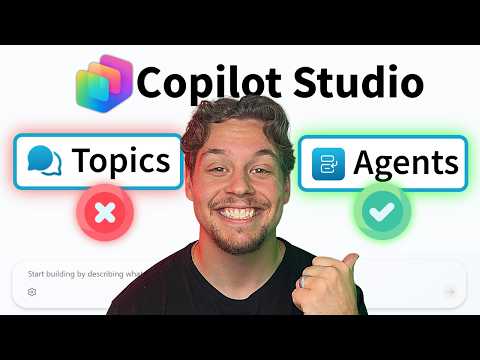
Microsoft Copilot: Topics vs Agents
Certified Power Apps Consultant & Host of CitizenDeveloper365
Microsoft Copilot Studio demystified: when to use Topics versus Child Agents for Power Platform chatbots with Dataverse.
Key insights
- Topics: Small, structured conversation maps inside an agent that handle predictable workflows like FAQs, guided forms, and simple validations.
They use deterministic flows so responses stay consistent and easy to maintain. - Child Agents: Standalone copilots designed for larger or more dynamic domains that need their own lifecycle, security, connectors, and publishing options.
They support non-deterministic, flexible conversations across multiple systems. - System topics: Built-in topics such as Conversation Start, End, and Escalate provide essential defaults for any agent.
These help standardize greetings, handoffs, and closures without starting from scratch. - When to use Topics: Choose topics for short, predictable interactions or single-system tasks where clear branching and repeatable logic are important.
They reduce complexity for guided processes like IT triage with strict protocols. - When to use Child Agents: Use child agents for broad, complex, or cross-domain scenarios that need separate ownership, versioning, and integration credentials.
They prevent “topic sprawl” and simplify governance for large teams or departments. - Triggers, actions, and modular design: Both approaches support triggers, actions, and conditional branching, but topics favor graph-based determinism while child agents enable flexible orchestration.
Combine topics inside agents to stay modular, maintainable, and scalable as solutions grow.
Overview
In a recent YouTube video, Griffin Lickfeldt (Citizen Developer) breaks down the practical differences between Topics and Child Agents in Copilot Studio. He aims to help builders decide when to use deterministic, structured conversation maps and when to rely on more flexible, non-deterministic agent flows. This report summarizes his key points, highlights tradeoffs, and flags technical and governance challenges for teams designing conversational AI.
Lickfeldt frames the discussion around common enterprise needs such as IT helpdesk triage and broad knowledge exploration, and he walks viewers through concrete timestamps and examples. He draws parallels to familiar tools like Power Automate and Power Virtual Agents to connect new patterns with existing skills. Consequently, the video addresses both citizen developers and technical leads who must balance speed with control.
What Are Topics?
According to the video, Topics act as focused conversation maps that guide predictable exchanges with users. They work well for single-purpose workflows such as FAQs, guided forms, or short validations where the path and outcomes remain clear. Lickfeldt notes that topics reduce dependence on generative responses and make testing, auditing, and compliance easier because flows follow set branches.
Authors can build topics from scratch, adapt prebuilt templates, or use natural language prompts to generate initial flows, which speeds development. However, teams must watch for "topic sprawl" where many small topics create hidden complexity and duplicated logic. Therefore, he recommends clear naming, version control, and reuse strategies to keep topics maintainable over time.
What Are Child Agents?
Child Agents represent independent copilots that handle broader domains and can run non-linear, flexible dialogs drawing on multiple data sources. In the video, Lickfeldt compares them to child flows in Power Automate, emphasizing that child agents can own credentials, connectors, and their own publishing lifecycle. This independence makes them useful for departmental solutions like HR, legal, or IT, where teams need separate governance and release schedules.
Child agents support dynamic responses and can adapt when user intent or context changes mid-conversation, but that flexibility can complicate testing and debugging. Lickfeldt warns that non-deterministic flows require stronger observability, robust fallbacks, and clear human handoff strategies to avoid poor user experiences. Thus, teams should treat child agents like small products that need monitoring, logging, and periodic tuning.
Choosing Between Topics and Agents
Choosing between a topic and a child agent depends on scale, ownership, and how predictable conversations must be. For quick, repeatable tasks, a Topic inside a parent agent reduces overhead and keeps behavior consistent across channels. Conversely, when a domain needs independent release cycles, distinct credentials, or separate governance, a Child Agent becomes the better option.
Lickfeldt suggests a hybrid approach where small workflows live as topics and larger domain workflows are extracted into child agents to avoid monolithic designs. This hybrid strategy balances reuse with control, but it requires clear boundaries and orchestration logic to route users between topics and agents smoothly. Teams should document triggers, actions, and conditional branching so integration points remain understandable and testable.
Tradeoffs and Implementation Challenges
The video emphasizes tradeoffs: topics favor predictability and easier compliance, while child agents prioritize flexibility and domain autonomy. Therefore, architects must weigh the cost of governance, the difficulty of debugging non-deterministic flows, and the risk of duplicated connectors or credentials across agents. Performance and budget also matter because more agents or additional calls to generative services can increase latency and operating costs.
To manage these challenges, Lickfeldt recommends investing early in monitoring, defining ownership, and creating test suites that cover both deterministic and generative paths. Additionally, implementing clear escalation points and simple fallback responses helps maintain user trust when the system cannot resolve queries automatically. Finally, he advises iterative design: start small, measure outcomes, and refactor agents and topics as usage patterns reveal the best structure.
Practical Next Steps for Teams
Practically, teams should begin by mapping common user intents and grouping them by predictability and domain ownership. Then, place highly repeatable, compliance-sensitive flows into Topics and consider extracting broader, evolving areas into Child Agents so teams can manage releases and credentials independently. This staged approach reduces risk while allowing teams to learn from real usage.
Finally, governance practices matter: assign clear owners, track versions, and monitor metrics like resolution rate and escalation frequency so you can prioritize refactors. With these controls in place, organizations can combine the predictability of topics with the agility of child agents to build conversational systems that scale and remain maintainable. Overall, Lickfeldt’s guidance offers a practical framework for balancing modularity, control, and user experience when working in Copilot Studio.
Keywords
Microsoft Copilot Studio, Copilot Studio topics, Copilot Studio agents, Topics vs Agents Copilot, Copilot agent vs topic, Copilot Studio tutorial, Copilot Studio best practices, building agents in Copilot Studio