- All of Microsoft
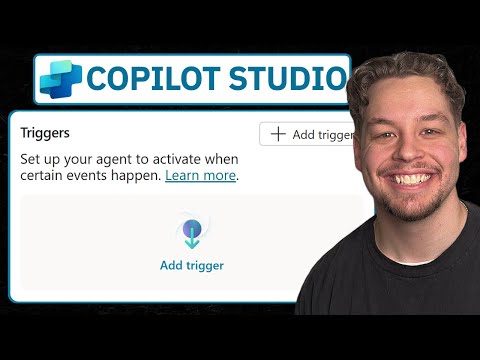
Microsoft Copilot Studio: Agent Triggers
Certified Power Apps Consultant & Host of CitizenDeveloper365
Master Agent Triggers in Microsoft Copilot Studio to automate Dataverse events with Power Automate and Power Platform
Key insights
- Agent Triggers — Predefined events that start a Copilot agent automatically.
They let agents run tasks without a user typing commands. - Trigger Types — Generative orchestration activates when a message matches the topic, while Classic orchestration uses trigger phrases.
Choose the type that fits your flow and messaging style. - Setup Steps — Create an agent, open its Topics, select the Trigger node, and choose the trigger type.
Set properties, add conditions, test the trigger, then publish the agent. - Event Triggers & Dataverse — Use event triggers to run agents on data changes (for example, a new Dataverse account record).
Event triggers run in the background and can call Power Automate for extra logic or approvals. - Security: Run as End User — Triggers can execute with end-user credentials so actions respect user permissions.
This keeps automation secure and consistent with user access rights. - Reuse & Integration — Reuse triggers across environments but rebind them after import; use Power Fx for conditions and Power Automate for complex flows.
Use templates, PowerShell, or CLI scripts to speed deployment and maintenance.
Overview
In a clear and practical YouTube tutorial, Griffin Lickfeldt (Citizen Developer) demonstrates how to set up agent triggers in Copilot Studio. The video walks viewers through the core concepts and offers a step-by-step demonstration using a real example, helping builders visualize how autonomous agents can run in the background. Consequently, the tutorial aims to help both citizen developers and technical practitioners adopt event-driven automation more confidently.
Additionally, the video highlights practical tips for testing and common pitfalls to avoid, so teams can move from prototype to production with fewer surprises. Therefore, readers will get a sense of the tradeoffs between simplicity and control when designing trigger-driven agents. The presentation frames the topic in familiar Power Platform terms to make adoption smoother for existing users.
Understanding Agent Triggers
The video defines agent triggers as configurations that cause agents to act automatically when specific events occur, such as a new record in Dataverse or a matched chat phrase. Griffin explains two orchestration styles: Generative orchestration, which activates agents based on topic matches, and Classic orchestration, which uses explicit trigger phrases. Thus, viewers learn how different orchestration choices shape the agent’s responsiveness and scope.
Moreover, the tutorial stresses that triggers can work either on incoming messages or as background events, enabling a range of automation patterns. For instance, event triggers can run autonomously when a Dataverse table changes, while message triggers respond directly to user input. As a result, developers must balance immediacy and resource usage when choosing trigger types.
Setting Up Triggers: Practical Steps
Griffin lays out concrete steps to create and configure triggers inside Copilot Studio, beginning with agent creation and moving to topic selection and trigger assignment. He shows where to select the trigger node, change the trigger type, and set properties like activity, priority, and conditions. By following these steps, viewers can define when a topic should activate and restrict triggers by channel or environment to avoid false positives.
He also demonstrates how to use the Power Fx formula editor to craft more precise conditions when simple checks are not enough. In addition, the video demonstrates integrating a Power Automate flow for more complex logic, such as approvals or multi-step processes. Therefore, the setup process supports both quick wins and more sophisticated enterprise scenarios, though the latter requires additional design work.
Testing and Common Pitfalls
Testing receives focused attention in the video, with Griffin showing how to simulate trigger conditions and verify agent behavior before publishing. He warns about several common pitfalls, including misconfigured conditions, environment mismatches, and assumptions about user context that can cause a trigger to fire incorrectly. Consequently, teams should include systematic tests and record expected outcomes to catch errors early.
Another important point is that event triggers run with end-user credentials, which simplifies permissions but introduces operational considerations. For instance, a missing permission or a changed user role can silently break automation, so monitoring and alerts become essential. Thus, testing should include permission scenarios and failover behaviors to ensure reliable operation.
Reuse, Deployment, and Management
The video explains how triggers behave across environments and during solution import, noting that triggers often require manual rebinding to target agents after migration. Griffin suggests using templates and automation scripts with the Power Platform CLI or PowerShell to streamline deployment and reduce manual steps. However, automated deployments demand careful management of environment-specific settings like connections and agent associations.
He also touches on templates and governance patterns that help standardize trigger definitions, making reuse safer across teams. Yet, teams must weigh the convenience of reusable templates against the risk of unintended behavior when conditions differ between environments. Therefore, robust documentation and environment checks are critical to prevent mistakes during reuse.
Security, Tradeoffs, and Governance
Security and governance are central themes in the tutorial, especially because triggers can execute actions on behalf of users. Griffin highlights the benefit of running agents with end-user credentials for personalized behavior, while also pointing out that this model increases the need for careful permission management and audit logging. As a result, organizations must decide whether to prioritize ease of use or stricter control when authoring triggers.
Finally, the video discusses tradeoffs such as the balance between responsiveness and cost, since frequently firing triggers can consume resources, and the complexity introduced by advanced conditions or approvals. The recommendation is to design triggers conservatively, test broadly, and document expected behaviors, which together help teams scale automation safely. In short, the tutorial gives practical guidance for getting started with agent triggers while flagging key governance and operational issues to address before broad rollout.

Keywords
copilot studio agent triggers,setup agent triggers copilot,how to setup agent triggers microsoft copilot studio,copilot studio triggers tutorial,microsoft copilot agent automation,configure agent triggers copilot,copilot agent workflow setup,copilot studio trigger best practices