- All of Microsoft
Azure AI: Zero Trust Security Tips
Software Development Redmond, Washington
Zero Trust for AI with Microsoft Entra, Defender, Azure AI and Purview to secure identities, endpoints, data and cloud
Key insights
- Zero Trust core principles: Verify identity and permissions every time, grant the minimum access needed, and assume breach so you can limit impact if something goes wrong.
- Shadow AI: Unvetted AI tools and agents create blind spots when people share data or give broad permissions. Limit, monitor, and vet AI tools before they access sensitive systems.
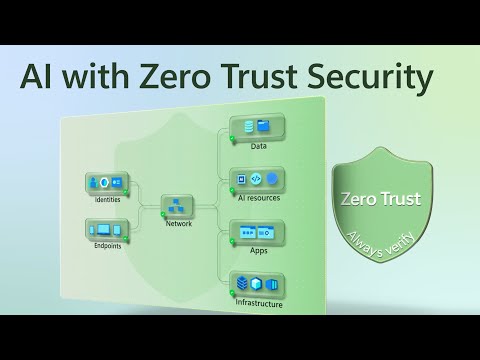
- Layered protection: Apply overlapping controls across identities, endpoints, networks, data, AI resources, apps, and infrastructure to avoid single points of failure.
- Runtime security: Continuously assess risk, secure resources while they run, and adapt policies as conditions change using segmentation, observability, and governance.
- AI-powered threats: Growing AI use enables new, automated attacks that target identities and agents. Treat AI agents as high-value assets and monitor their behavior closely.
- Practical next steps: Verify every access request (human or AI), enforce least-privilege, automate policy checks, and plan for rapid containment to protect data and models.
Video Summary and Context
In a recent YouTube video produced by Microsoft, Security Product Manager Michael Madrigal outlines why organizations must adopt a Zero Trust approach for modern artificial intelligence systems. The presentation breaks the topic into practical segments, covering identities, endpoints, networks, data, AI resources, app layers, and infrastructure to show how each element fits into an overall defense strategy. Accordingly, the video emphasizes continuous verification of every access request—whether it comes from humans, machines, or AI agents—and argues that security must be applied at runtime. As a result, the message targets IT leaders who need a defensible method to protect productivity while managing new AI-driven risks.
Moreover, the video argues that rapid adoption of AI tools like Copilots and automation increases both opportunity and exposure for enterprises. Therefore, IT teams should reduce risk by explicitly validating identity, enforcing least-privilege access, and assuming breach across every step of their environment. The segments make clear that layered protection across identities, endpoints, networks, data, AI resources, applications, and infrastructure prevents attackers from exploiting weak links. In short, the video frames Zero Trust not as a single control, but as a continuous, adaptive security posture.
Core Principles Explained
The video distills the approach into three core principles: verify explicitly, apply least-privilege, and assume breach. By prioritizing continuous verification of identity and permissions, organizations can avoid giving standing, excessive rights to services and agents that operate autonomously. Additionally, the advice stresses limiting access by scope and time, which reduces the attack surface when AI systems interact with sensitive models and data. Consequently, treating compromise as inevitable drives design choices that isolate and monitor workloads to limit impact.
Importantly, Michael Madrigal ties these principles directly to AI scenarios, advising that every AI agent, API, and service identity should be authenticated before accessing models or datasets. He further recommends adapting policies dynamically as conditions change, so protections remain effective during runtime and as threats evolve. This continuous assessment model favors automation and observability to maintain security without causing unnecessary delays. As a result, the video positions real-time signals and policy adaptation as essential when protecting AI-driven workflows.
Practical Controls and Implementation
The video walks through practical controls across major layers: identities, endpoints, networks, data, applications, and infrastructure, showing how each layer contributes to overall resilience. For identities, it highlights strong authentication and credential hygiene; for endpoints, it recommends continuous posture checks and device attestation before access is allowed. For networks and data, the approach favors segmentation, encryption, and strict data access controls so that AI systems see only the data they truly need. Consequently, layered controls reduce the risk that a single compromise will cascade across systems.
Furthermore, the presentation stresses observability and governance as enablers for effective controls, urging teams to build logging, telemetry, and audit capabilities that track agent behavior and policy enforcement. It also notes that segmentation and runtime protections can limit the reach of misbehaving or compromised agents, while governance processes ensure that changes follow risk-aware approval flows. Yet, implementing these controls requires integration work across platforms and a consistent identity fabric to avoid gaps. Therefore, organizations should plan for incremental deployment that ties into existing tools and workflows.
Tradeoffs and Operational Challenges
Adopting a Zero Trust posture for AI introduces tradeoffs between security, cost, and productivity, which the video addresses candidly. For example, stricter access controls and frequent verification may add friction for users and increase latency in some workflows, while broader telemetry and logging increase storage and analysis costs. At the same time, relaxing controls to preserve experience creates blind spots that attackers can exploit, especially when employees use unvetted AI tools, a problem often called shadow AI. Thus, teams must balance protection with usability, and they must accept that perfect security is unattainable.
Operationally, challenges include tuning policies to reduce false positives, providing developer-friendly authentication patterns, and managing multi-cloud complexity where controls and telemetry differ by provider. Staffing also matters because skilled engineers are required to design runtime checks, build observability pipelines, and respond to incidents involving agent behavior. Moreover, the rise of agentic AI that can act autonomously increases the need for governance and behavior controls that are harder to test in advance. As a result, organizations should plan for ongoing adjustments rather than a one-off deployment.
Recommendations and Next Steps for IT Teams
The video concludes with actionable guidance that IT teams can adopt immediately while planning long-term improvements. First, inventory AI assets and service identities so teams understand which agents and APIs require protection; next, enforce least-privilege and runtime checks so access is verified continuously. Additionally, build observability and incident playbooks specifically for AI behaviors, and use segmentation to limit potential damage in the event of compromise. These steps provide a pragmatic path for teams that must protect sensitive models and datasets without blocking legitimate productivity.
Finally, the video recommends treating Zero Trust as a journey rather than a one-time project, iterating on policy, telemetry, and automation as threats evolve. Invest in staff training and clear governance to reduce the risks posed by shadow AI and misconfigured permissions. By doing so, organizations can better balance security with the operational demands of modern AI, and they can adapt protections as new agent capabilities appear. In this way, the video offers a clear, actionable blueprint grounded in continuous verification and adaptive control.

Keywords
AI zero trust security, zero trust for AI, zero trust architecture for AI, AI cybersecurity best practices, secure AI deployment zero trust, zero trust AI model protection, data protection for AI zero trust, zero trust governance for AI