- All of Microsoft
Project Perception: AI-Speed Security
Principal Cloud Solutions Architect
Project Perception AI cybersecurity on Azure Sentinel with Microsoft Defender and Security Copilot for rapid response
Key insights
- Project Perception is presented as Microsoft’s new agentic security system that uses AI agents to detect, investigate, and remediate threats while keeping humans in control.
- The architecture combines specialized agents, purpose-built models like MAI-Cyber-1-Flash, full-estate sensors, actuators, and an orchestration harness to coordinate continuous workflows.
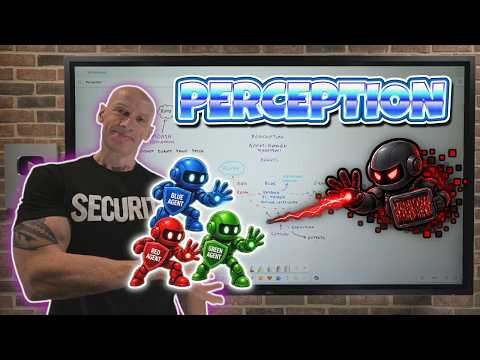
- The video defines three core agent roles: red agents probe for weaknesses, blue agents investigate and prioritize alerts, and green agents remediate and harden systems.
- Key innovation is moving from alert-heavy tools to continuous loops of exposure, investigation, and remediation so teams can fix issues faster and at machine speed.
- Project Perception is designed to integrate across the Microsoft security stack (starting with Defender) and entered public preview in mid‑2026 to extend protections across products.
- Practical takeaway: treat Project Perception as Microsoft’s current blueprint for autonomous defense; reported benchmarks look promising but come from vendor sources and need independent validation.
Overview: A new model for AI-era defense
The YouTube video by John Savill's [MVP] presents Microsoft's vision for Project Perception, a coordinated, agent-driven cybersecurity architecture built for the age of AI. The presenter outlines how the system aims to reason across signals, detect threats continuously, and shorten the time between discovery and remediation. Moreover, the video includes a whiteboard walkthrough and a live demo that illustrate how agents interact with existing security tools and workflows.
Importantly, the presenter frames Project Perception as an orchestration layer rather than a single product, and he highlights Microsoft's claim that the system operates at machine speed while keeping humans in control. Consequently, viewers learn that the initiative complements rather than replaces existing Microsoft security capabilities, beginning with integrations into Defender and related products. In addition, the video notes a public preview and discusses a dedicated cybersecurity model called MAI-Cyber-1-Flash.
How the multi-agent design works
The video breaks the architecture into three specialized agent roles: red agents, blue agents, and green agents, each assigned different responsibilities. For instance, red agents simulate attacker paths to probe for weaknesses, while blue agents investigate and prioritize alerts, and green agents focus on remediation and hardening. This separation mirrors human team functions and allows parallel, continuous activity across those domains.
Moreover, the demo shows an orchestration harness that coordinates agents and triggers purpose-built models and actuators for approved actions. The video stresses that action still requires human oversight for critical decisions, so teams retain control over destructive or high-impact responses. At the same time, the presenter emphasizes continuous loops of exposure, investigation, and remediation rather than isolated, one-off scans.
Demonstration highlights and claimed performance
During the demonstration, the presenter walks through playbooks and a concrete "Perception in action" scenario that connects signals to automated investigations and suggested fixes. He mentions reported benchmark results on CyberGym and positions MAI-Cyber-1-Flash as a model trained for cybersecurity use cases. Therefore, the narrative suggests reduced latency between detection and remediation when the agents and models operate together.
Nevertheless, the video also cautions viewers to treat vendor-reported performance claims carefully because launch messaging and internal benchmarks are not substitutes for independent validation. Consequently, organizations should plan evaluation steps and proof-of-concept trials that test the system against their own estate and threat profiles. In addition, the demo highlights integration with Microsoft tooling, which may influence both ease of adoption and long-term architectural choices.
Tradeoffs: automation, control, and integration
The video carefully addresses tradeoffs between speed and governance, noting that automation can accelerate response but increases the need for robust oversight. For example, automating containment or remediation reduces dwell time, but it also raises concerns about false positives, unintended disruptions, and the need for human review of high-risk actions. Therefore, teams must balance automated actions against policies that preserve availability and compliance.
Furthermore, the presenter discusses integration tradeoffs: tighter integration with Microsoft products can simplify deployment and telemetry exchange, yet it may increase dependency on a single vendor stack. Simultaneously, the use of a dedicated model like MAI-Cyber-1-Flash promises specialized performance, while also prompting questions about model evaluation, ongoing tuning, and transparency. Thus, defenders must weigh benefits against risks such as vendor lock-in and model lifecycle management.
Challenges and what security teams should consider
The video outlines several practical challenges that organizations will face when adopting agentic defenses, including data quality, signal coverage, and playbook authoring. In particular, continuous, estate-wide reasoning requires broad sensor coverage and consistent contextual data, and gaps in telemetry can reduce effectiveness or create blind spots. Consequently, teams will need to invest in data hygiene and operational readiness before they can rely on fully automated loops.
Lastly, the presenter raises broader concerns about adversaries using AI, which makes rapid detection and response more urgent yet more complex. For this reason, he underscores the importance of human-in-the-loop controls, rigorous testing, and staged rollouts that validate behavior under realistic conditions. Overall, the demo serves as a useful primer for security teams to start evaluating agentic defenses, while also reminding them to balance agility with governance and independent testing.

Keywords
Project Perception cybersecurity, AI-driven cybersecurity, real-time threat detection, AI-powered cyber defense, machine learning threat intelligence, automated incident response, security operations automation, generative AI security