- All of Microsoft
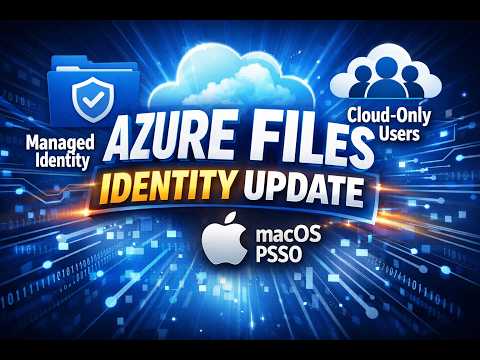
Azure Files: Identity Update Deep Dive
Principal Cloud Solutions Architect
Microsoft expert: Azure Files Entra integrated auth updates managed identity cloud only and macOS PSSO with PowerShell
Key insights
- Video overview: The video summarizes Microsoft’s update to Azure Files, shifting SMB access from shared keys to Microsoft Entra ID–based authentication.
It explains why this change matters for security and cloud-native operations. - New, generally available features: The update delivers managed identities for SMB, Entra-only identities for cloud-only access, and Azure File Sync support using system-assigned managed identities.
The portal now offers NTFS permission controls and expanded RBAC support in selected regions. - How authentication works: SMB access uses the Kerberos protocol against an identity source (AD DS, Entra Domain Services, or Microsoft Entra Kerberos).
Clients obtain a Kerberos ticket and Azure Files validates that ticket to authorize access. - Security and management benefits: You no longer need to distribute storage account keys or SAS tokens for supported workflows, which reduces secret handling and exposure.
Centralized identity in Microsoft Entra ID lowers operational overhead and improves security posture. - Scope and current limits: Identity-based access applies to SMB only (not NFS), and each storage account can use a single identity source for all file shares.
Some advanced RBAC and portal features are limited to specific regions for now. - Practical impact and next steps: For cloud-first deployments, adopt Entra-only identities to simplify architecture and remove AD DS dependency.
Test migration paths and Azure File Sync scenarios in a staging account and use the portal’s NTFS controls to set permissions before rolling out widely.
Introduction to the video and its focus
In a recent YouTube briefing, John Savill's [MVP] unpacks a significant update for Azure Files that shifts authentication toward Microsoft Entra ID. The short video walks through chapters that include managed identity access, cloud-only identity options, and a macOS single sign-on demonstration. Consequently, the presentation frames this move as a broader effort to make file access more secure and easier to manage in cloud-first environments.
Moreover, the host emphasizes practical outcomes rather than only technical detail, showing how organizations can replace shared keys with identity-based authentication. He notes that these changes affect virtual machines, applications, and end users who access SMB shares. Therefore, IT teams should weigh both the benefits and the operational tradeoffs when planning adoption.
Overall, the video serves as a concise update and a call to assess existing storage access models. It highlights general availability of key features and demonstrates basic configuration options. Thus, the message is clear: identity-driven access is now a mainstream option for Azure Files.
Managed identity and VM access
The video explains how managed identities let Azure VMs and services access SMB file shares without stored secrets. In practice, managed identities obtain tokens that are validated by the identity layer, which removes the need to distribute or rotate Storage account keys. As a result, administrators gain a simpler and safer authentication path for workloads running in Azure.
However, there are tradeoffs to consider when relying on managed identities. For example, operations teams must ensure proper role assignments and scoped permissions in Microsoft Entra, and they must monitor identity lifecycle and VM configuration changes. In addition, managed identities work best when the entire access path remains within Azure, so hybrid scenarios sometimes require extra planning.
Furthermore, the video highlights that Azure File Sync now supports system-assigned managed identities, which reduces secret handling for sync jobs. This change streamlines cloud-backup and cache architectures, yet it also requires updating sync servers and validation of permission mappings. Consequently, organizations should test sync behavior in a staging environment before making global changes.
Entra-only and cloud-only identity access
Another major topic is the general availability of Entra-only identities for Azure Files SMB access, which enables cloud-only users to authenticate without on-premises Active Directory. This simplifies architectures for organizations that operate entirely in the cloud or are shifting away from domain controllers. Therefore, the update can shorten deployment timelines and reduce dependency on legacy identity infrastructure.
Nevertheless, this approach presents tradeoffs that IT teams must evaluate. For instance, the video notes region-limited features and the rule that a storage account uses a single identity source for all file shares, which can complicate mixed environments. In addition, centralized permission management shifts the burden to identity administrators, who must design group structures and RBAC assignments carefully.
Importantly, the presenter demonstrates portal-based NTFS permission management for Entra-only and hybrid users, making it easier for administrators to set file-level rights. This capability reduces scripting and manual ACL edits, but organizations should still validate inherited permissions and audit trails. Thus, while the portal simplifies common tasks, robust governance remains essential.
Kerberos, macOS PSSO and cross-platform challenges
The update relies on the Kerberos protocol for SMB authentication, and the video outlines several identity sources such as AD DS, Entra Domain Services, and Microsoft Entra Kerberos. Kerberos brings mature ticketing and delegation semantics, which help ensure secure ticket exchange and authorization checks. However, Kerberos also introduces operational complexity, especially when non-Windows clients enter the picture.
For example, the video briefly covers macOS PSSO access, showing how single sign-on can work on Apple clients, but it also hints at configuration nuances. Cross-platform compatibility often requires extra client-side configuration, troubleshooting of keytab files or ticket renewal, and careful attention to clock skew and DNS. Therefore, teams should plan for extended validation and support overhead for diverse client fleets.
Moreover, when organizations mix on-premises and cloud identity sources, Kerberos interoperability can become a bottleneck during migration. The presenter suggests testing end-to-end scenarios and documenting fallback paths if identity synchronization or ticketing fails. Consequently, robust Monitoring and support processes are a critical complement to the technical changes.
Operational implications and migration considerations
Finally, the video stresses that identity-based access reduces reliance on shared secrets, which improves security posture and lowers the risk of key leakage. Transitioning away from Storage account keys simplifies credential management and allows teams to apply central identity controls and conditional access policies. As a result, organizations gain better alignment with zero-trust principles.
On the other hand, migration brings challenges such as permission mapping, role design, and potential downtime during cutover. The presenter recommends phased adoption: start with non-critical shares, validate RBAC and NTFS behavior, and then expand coverage. In addition, change management and staff training help reduce surprises when different teams begin using identity-based access.
In summary, John Savill's [MVP] video provides a practical, balanced look at the Azure Files identity update, outlining both clear advantages and realistic hurdles. IT leaders should weigh improved security and simpler cloud-native operations against the administrative work of redesigning permissions and testing interoperability. Accordingly, careful planning and staged rollouts will help teams realize the benefits while minimizing risk.

Keywords
Azure Files identity update, Azure Files managed identity, Azure Files Azure AD authentication, Azure Files identity-based access, Azure Files service principal, Azure File share authentication, Azure Files hybrid identity, Azure Files identity announcement