- All of Microsoft
Fabric: AI-Ready Data Warehouses
Founder | CEO @ RADACAD | Coach | Power BI Consultant | Author | Speaker | Regional Director | MVP
Microsoft expert on Fabric Data Warehouse vs Snowflake and Databricks, GPU AI, Power BI semantic models, data careers
Key insights
- Fabric as an integrated analytics platform: Microsoft positions Fabric as a single SaaS surface that unifies data integration, lakehouse and warehouse analytics, Power BI, and AI tools.
It stores data in open formats and aims to simplify setup, governance, and end-to-end analytics delivery. - AI-assisted workflows and Copilot: The episode stresses that AI is embedded into everyday data tasks, not bolted on later.
Semantic models and conversational access enable copilots to query and explain data directly to users. - Open data and the Delta format: Fabric centers on open formats so data remains interoperable across tools and platforms.
This approach helps blur the traditional lakehouse vs. warehouse boundary and supports multi-tool analytics. - GPU acceleration for the SQL warehouse: Microsoft discussed adding GPUs to improve large-scale analytical queries and AI workloads.
These accelerations aim to boost real-world performance, not only benchmark results. - Semantic model and governance: The semantic layer is evolving to serve both BI authors and conversational agents while maintaining security and compliance.
Fabric’s integrated governance simplifies data access across personas like analysts, engineers, and data scientists. - Data engineers and skills to learn: AI will shift roles rather than eliminate them; the episode advises engineers to learn AI tooling, lakehouse patterns (Delta), semantic modeling, and hybrid skills across SQL, notebooks, and MLOps.
Practical skills plus domain knowledge will keep professionals relevant in the AI era.
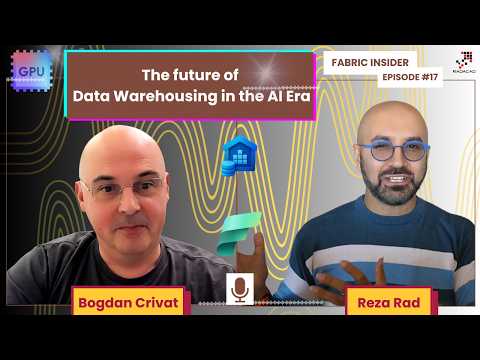
Reza Rad (RADACAD) [MVP] recently published a blog post summarizing a YouTube interview titled Fabric Insider Ep. 17, in which he speaks with Bogdan Crivat, Corporate Vice President at Microsoft. The conversation centers on the evolving role of the Data Warehouse within Microsoft’s broader analytics vision, and it explores how AI is reshaping tools and careers. Notably, the interview addresses competitive positioning against vendors such as Snowflake and Databricks, while also examining technical advances like GPU acceleration. Consequently, the piece provides a clear snapshot of where Microsoft aims to take analytics in the AI era.
Platform Vision and Key Differentiators
First, the interview highlights Microsoft’s goal to present Microsoft Fabric as a unified, SaaS-based analytics platform that combines ingestion, storage, warehousing, BI, and AI into a single environment. Moreover, Microsoft emphasizes open data formats such as Delta Lake to avoid vendor lock-in and to support interoperability across tools. As a result, organizations can use the same governed dataset for SQL queries, notebooks, semantic models, and AI copilots, which simplifies governance (for example, with Microsoft Purview) and speeds deployment. However, this integrated approach trades the flexibility of best-of-breed point solutions for a more consolidated operational surface.
AI, Copilots, and Semantic Models
Second, the episode stresses that AI is becoming embedded into everyday workflows rather than being an add-on product, and the semantic model is being extended to serve both BI users and conversational agents like Copilot. Thus, a single semantic layer can power both Power BI dashboards and natural language queries, helping to bridge technical and business personas. Still, this integration presents challenges because semantic models must remain performant and maintainable at scale, while also being expressive enough for AI consumption. Therefore, teams must balance the need for rich business logic against the risk of creating brittle or overly complex models.
Technical Directions: GPUs, Lakehouse, and Convergence
Third, the interview examines technical innovations such as GPU acceleration for data warehousing workloads in Azure Analytics environments and the blurring lines between warehouse and lakehouse paradigms. On one hand, GPUs can accelerate specific analytic and AI-heavy workloads, offering substantial performance gains for inference and large-scale transformations. On the other hand, adopting GPU acceleration raises tradeoffs in cost, operational complexity, and tooling maturity, and it may not benefit every workload equally. Meanwhile, combining lake and warehouse capabilities facilitates unified pipelines but requires careful design around data layout, consistency, and governance.
Competitive Tradeoffs: Fabric vs. Snowflake and Databricks
Fourth, Microsoft positions Fabric to compete on integration, governance, and AI readiness, while Snowflake and Databricks continue to emphasize specialized strengths and ecosystem depth. For some organizations, a consolidated SaaS platform reduces integration overhead and governance gaps, which can translate into faster time to value. Conversely, companies with highly specific or advanced workloads may prefer a best-of-breed setup that allows finer-grained control and specialized optimizations. Thus, decision-makers must weigh operational simplicity against the potential need for specialized performance and custom tooling.
Career Implications and Practical Advice
Fifth, the episode addresses the common fear that AI will replace data engineers, and it offers practical guidance for professionals seeking to stay relevant. Bogdan argues that while AI can automate routine tasks, it also creates demand for skills in platform design, model governance, and semantic modeling, so professionals should focus on higher-value responsibilities. Consequently, learning about semantic models, data governance, AI-assisted development, and cross-functional collaboration can provide resilience against automation. Moreover, organizations will likely value people who can translate between business needs and technological capabilities.
Outlook and Challenges Ahead
Finally, the conversation closes with a forward-looking view: data platforms will continue to converge around open formats, AI integration, and shared semantics, but real-world adoption will require solving hard problems in cost management, model lifecycle, and governance. Importantly, teams must design for observability and control so that AI-driven workflows remain auditable and reliable in production. In short, while the integrated vision promises faster delivery and stronger governance, it also demands careful tradeoffs and new skill sets to manage complexity effectively.
Overall, Reza Rad’s summary of the YouTube interview with Bogdan Crivat offers a balanced account of Microsoft’s strategy for the future of data warehousing. It combines technical detail with practical career advice, and it invites organizations to weigh the benefits of integration against the realities of cost, complexity, and specialization. Therefore, readers can use these insights to make more informed decisions about architecture, tooling, and professional development in the AI-driven data era.

Keywords
Future of data warehousing, AI-era data warehousing, Microsoft Fabric data warehouse, AI-driven analytics, Modern data warehouse architecture, Fabric Insider Ep 17, Bogdan Crivat interview, Cloud data warehousing trends