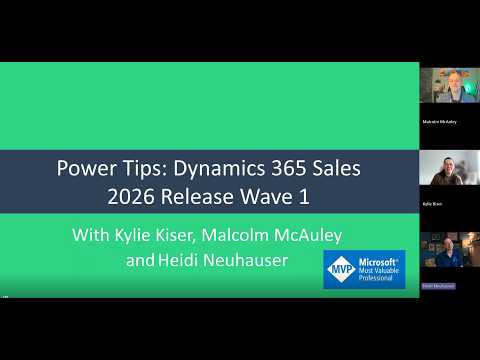
Dynamics 365 Sales: 2026 Wave 1 Updates
Microsoft MVP | User Adoption, Dynamics 365 + Power Platform Expert at Reenhanced
Microsoft expert guide to Dynamics Sales release with Sales Qualification Agent, Sales Close Agent and Copilot AI
Key insights
- 2026 Release Wave 1 — Overview and timestamps:
Video highlights cover Sales Qualification Agent updates at 0:00, Sales Close Agent updates at 3:45, and Copilot advances at 10:35. The wave runs April–September 2026 and focuses on AI agents, productivity, and smoother deal motion. - Sales Qualification Agent — Smarter lead triage:
Agents automatically research and score leads using CRM signals and Microsoft Graph data (emails, meetings). They enrich records, disqualify low-intent leads, and suggest personalized outreach to raise response rates. - Sales Close Agent — Guided deal acceleration:
The Close Agent offers Delta Guidance and an Ask-and-Refine flow to recommend next-best-actions, surface missing steps by stage, and produce concise deal summaries that help reps close faster. - Copilot — Unified, contextual support:
Copilot integrates Dynamics 365 and Microsoft 365 data to power Sales Research Agent workflows, contextual summaries, and in-app chat across Outlook, Teams, and Sales Home for faster decision making. - AI-powered automation — Business benefits:
Expect higher seller productivity, cleaner pipelines through automatic validation and disqualification, improved forecasting from richer signals, and better team collaboration via shared Copilot experiences. - Rollout & Governance — Availability and controls:
Features appear in staged previews before general availability; admins get controls for data sources, privacy, and model use so organizations can enforce compliance and scale safely.
Video overview and release context
Heidi Neuhauser [MVP] published a concise YouTube video that walks viewers through the highlights of the Dynamics 365 Sales 2026 Release Wave 1, with clear timestamps marking key segments: Sales Qualification Agent at 0:00, Sales Close Agent at 3:45, and Copilot updates at 10:35. Moreover, she situates the features within Microsoft’s April–September 2026 rollout window and notes that public previews begin earlier in the year. Consequently, the video serves both as an orientation for sales teams and a practical look at what administrators should expect during the phased release.
Neuhauser explains how this wave centers on background AI that enriches data and suggests next actions, thereby shifting seller focus toward higher-value work. In addition, she highlights integrations across Microsoft 365, Microsoft Graph, and Fabric to underscore a unified data approach. Thus, the video frames the update as part of Microsoft’s broader push for agentic AI experiences in CRM.
Sales Qualification Agent: smarter lead triage
The video opens with the Sales Qualification Agent, which automates lead research and fit scoring to speed early-stage decisions. Neuhauser demonstrates how the agent pulls context from emails, meetings, and CRM records to suggest whether a lead should move forward, and she emphasizes that this reduces manual research time for representatives. Furthermore, the agent can disqualify low-intent leads and enrich contact data automatically, which lowers noise in the pipeline.
However, the narrator also points out tradeoffs: relying on automated qualification improves efficiency but can risk excluding nuanced opportunities that need human judgment. Therefore, organizations must tune thresholds and permit overrides so salespeople retain control when context matters. In practice, balancing automation with manual review requires clear governance and change management to preserve deal quality.
Sales Close Agent: guidance at deal stages
At 3:45, Neuhauser shifts to the Sales Close Agent, showing how Delta Guidance and the Ask-and-Refine flow provide stage-specific recommendations to help finalize opportunities. She plays back examples where the agent summarizes recent activity, highlights missing information, and suggests next-best-actions to nudge deals forward. As a result, sellers can follow guided steps while still customizing outreach, which helps shorten sales cycles and reduce stalled opportunities.
Yet the video also signals challenges around dependency and accuracy, since recommendations depend heavily on the completeness of CRM data. Consequently, teams must invest in data hygiene and ongoing monitoring to ensure the agent’s advice remains relevant and reliable. Ultimately, combining agent guidance with human oversight tends to deliver the best results, but it forces organizations to balance speed with caution.
Copilot enhancements and cross-app productivity
Neuhauser’s final segment covers Copilot improvements beginning at 10:35, emphasizing a consistent assistant across Outlook, Teams, and Dynamics apps that leverages CRM and Microsoft 365 data. She illustrates Copilot generating summaries, drafting emails, and surfacing insights woven from meeting notes and Fabric data, which can save sellers hours each week. Moreover, the unified experience aims to reduce context switching so teams stay focused on conversations that matter.
On the other hand, the video underscores integration tradeoffs: while deeper links to Microsoft Graph deliver richer context, they also increase governance complexity and surface questions about privacy and consent. Therefore, IT leaders must balance usability with strict controls, establishing policies that limit data exposure while enabling useful AI assistance. In short, Copilot’s promise depends on a coordinated approach to security, permissions, and user training.
Tradeoffs, adoption challenges, and next steps
Neuhauser closes by discussing the broader implications for adoption: the new agents accelerate routine tasks, but success depends on data quality, user trust, and clear governance models. Furthermore, she warns that organizations that skip training or neglect configuration risk frustration and low uptake, which would blunt the features’ intended productivity gains. Therefore, administrators should plan pilot programs and involve sellers early to refine thresholds and guidance flows.
In conclusion, the YouTube video offers a practical, balanced look at the Dynamics 365 Sales 2026 Release Wave 1, illustrating real capabilities while candidly addressing limitations. As Microsoft rolls features into public preview and general availability, teams will need to weigh automation benefits against oversight needs and integration complexity. Finally, early pilots, data cleanup, and governance provide a pathway to capture value while managing the inherent tradeoffs of agent-driven sales automation.
Keywords
Dynamics 365 Sales 2026 Wave 1, D365 Sales 2026 release, Dynamics 365 Sales 2026 features, D365 Sales Wave 1 updates, Dynamics 365 Sales release notes 2026, Dynamics 365 Sales roadmap 2026, Dynamics 365 Sales AI features 2026, D365 Sales enhancements 2026