Foundry IQ: Deep Dive into Foundry IQ
Principal Cloud Solutions Architect
Microsoft expert on Foundry IQ and Azure AI Search for RAG retrieval, agentic reasoning and unified knowledge sources
Key insights
- Foundry IQ: a managed knowledge system that gives AI agents a single, secure endpoint to access enterprise data.
It runs in public preview and connects services like SharePoint, OneLake, databases, and web sources without moving files. - Multi-source unification: collects structured, unstructured, and multimodal data into a unified knowledge graph.
It links concepts and context so agents understand relationships (for example, connecting a project to its department or policy). - Retrieval-augmented generation (RAG): automates RAG pipelines using Azure AI Search and vector indexing (DiskANN) for fast semantic retrieval.
It supports query planning, iterative search, multiple knowledge sources, and reduces prompt engineering work. - Trust & security: assigns authority scores, checks document freshness, and enforces permissions to reduce hallucinations and surface verified facts.
It integrates with Microsoft Purview for governance, Entra for identity, and Defender for runtime protection. - Foundry Control Plane: offers centralized observability and lifecycle management for agent fleets and knowledge collections.
Teams can monitor performance, track SKU limits, and manage models and costs across deployments. - Agentic reasoning & output modes: lets agents plan, reflect, and produce different output styles (stepwise reasoning, summaries, or direct answers).
It handles multiple collections and remote sources to improve response relevance and trustworthiness.
Overview of the Video
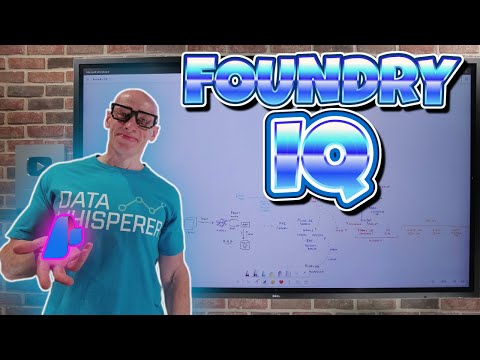
John Savill's [MVP] YouTube video, titled "Deep Dive into Foundry IQ," offers a focused walkthrough of Microsoft's new knowledge system in public preview. The presenter explains the main components, demonstrates capabilities, and highlights practical scenarios for enterprise AI agents. Overall, the video aims to show how this system can unify diverse data sources while keeping security and governance in mind.
Core Concepts and Architecture
At the center of the video is Foundry IQ, described as a unified endpoint that simplifies how agents access enterprise knowledge. Savill emphasizes that it builds a dynamic knowledge graph which maps relationships and senses intent, enabling agents to interpret queries more accurately. Furthermore, the system relies on retrieval-augmented generation, so the video explains how RAG pipelines and semantic indexing work together to ground model outputs in real data.
The narrator also explores the technical glue behind the solution, such as Azure AI Search and vector indexes backed by technologies like DiskANN. These components enable semantic searches and fast retrieval across text and other modalities without moving files from their native stores. In addition, Savill covers integrations with identity, governance, and security layers to ensure enterprise controls remain intact.
Capabilities Demonstrated
Through a sequence of demonstrations, the video shows how agents can query multiple knowledge sources at once, including cloud services, internal apps, and public web content. Savill points out that Foundry IQ supports agentic RAG patterns, query planning, and iterative searches to improve answer relevance and reduce hallucination risk. He also highlights how the system can prioritize authoritative sources and surface the freshest information when available.
Moreover, the video walks through output modes and reasoning displays that let viewers peek inside the agent's decision process. This transparency helps operators understand why certain documents were used or how the system synthesized an answer. Savill demonstrates this feature to argue for better debugging, compliance, and trust when AI supports decision-making.
Benefits, Tradeoffs, and Practical Considerations
Savill presents clear benefits such as faster time-to-value, centralized observability, and reduced need to build custom RAG pipelines from scratch. These efficiencies, however, come with tradeoffs: organizations must weigh costs of managed services, limits tied to SKUs, and the complexity of mapping enterprise permissions. Thus, while Foundry IQ reduces development work, it shifts effort toward integration planning and governance design.
Another tradeoff involves model selection and latency. Although the platform supports a range of models, including newer and specialized variants, choosing the right model affects cost, response speed, and the type of reasoning available. Consequently, teams must balance accuracy, budget, and performance, and plan for ongoing monitoring to adapt to changing workloads.
Integration, Security, and Governance
The video stresses integrations with Microsoft services such as Fabric IQ, OneLake, and typical enterprise stores like SharePoint and databases. Savill also notes the role of governance tools like Purview and identity controls such as Entra to preserve permissions and audit trails. These links matter because they let organizations keep sensitive data in place while enabling controlled access for AI agents.
In addition, the presenter discusses operational controls available through the companion Foundry Control Plane, which provides monitoring and lifecycle management across models and deployments. This visibility helps detect drift or misuse, yet it adds another layer that teams must configure and maintain. Therefore, security gains depend on careful setup and ongoing oversight.
Challenges and the Road Ahead
Savill does not shy away from challenges such as SKU limits, reasoning effort, and the need for clear descriptions and instructions to guide agents. He points out that poor metadata or weak prompts can lead to suboptimal results, requiring human effort to refine and curate sources. Self-reflection features and enhanced diagnostics help, but they do not eliminate the requirement for skilled operators and domain experts.
Finally, the video frames Foundry IQ as part of a growing ecosystem that promises more integrated, trustworthy AI for enterprises. As it moves from public preview to broader availability, organizations should pilot carefully, measure tradeoffs in cost and complexity, and plan governance policies from the start. In summary, Savill's walkthrough offers practical insights and a balanced view for teams considering this managed knowledge approach for their AI agents.
Keywords
Foundry IQ review, Foundry IQ tutorial, Foundry IQ features, Foundry IQ pricing, Foundry IQ demo, Foundry IQ analytics, Foundry IQ integrations, Foundry IQ use cases