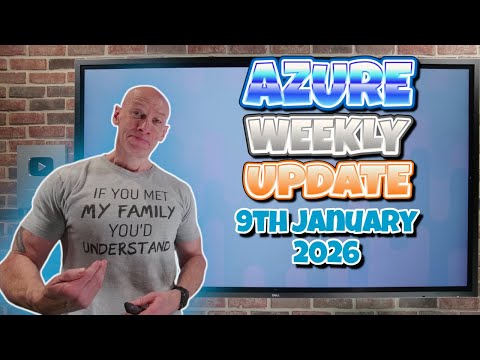
Azure Update - 9th January 2026
Principal Cloud Solutions Architect
Azure update AKS pricing, Premium SSD second gen regions, Service Bus geo replication, TTS and GPT fouro CRP deprecation
Key insights
- From the video: Azure introduced an AKS cloud-native pricing calculator to estimate full costs for Kubernetes clusters, including compute, storage and networking.
Use it for FinOps planning and right-sizing clusters; it helps compare node types and storage tiers before deployment. - The update announced wider regional availability of Premium SSD v2, Azure’s higher-performance managed disk tier.
Expect more IOPS, higher throughput, and finer performance tuning for databases and I/O‑intensive workloads while keeping data in-region. - Azure now supports Service Bus Premium geo-replication to improve messaging resilience and disaster recovery.
Teams can replicate namespaces across regions to reduce downtime and run failover tests; plan for network and latency trade-offs. - Microsoft acquired Osmos to strengthen built-in data ingestion and integration capabilities across Azure services.
Organizations should expect simplified pipelines and faster movement of streaming and batch data into Azure tools. - The video warns that Custom Resource Provider (CRP) is scheduled for deprecation at the end of October 2026.
Start an inventory of CRP usage, identify supported alternatives (ARM, managed providers, or native services), and test migrations to avoid disruption. - AI highlights: a new Dragon HD Omni TTS voice model and scheduled retirements of specific gpt-4o model versions were announced.
Audit any production dependencies, migrate to supported models, and apply the short prompt-engineering tips in the update to improve results.
John Savill's [MVP] recent YouTube briefing, titled Azure Update – 9th January 2026, delivers a concise weekly roundup of platform changes, new features, and one major deprecation affecting Azure users. The video mixes short lessons, product availability notes, and ecosystem news to help cloud architects and operators stay current. Importantly, this article summarizes the update objectively and is not authored by John Savill, but rather synthesizes key takeaways for our readers. Consequently, the following sections break down the main points, tradeoffs, and operational challenges raised in the update.
Overview and community guidance
The episode opens with reminders about channel resources and a brief lesson on prompt engineering for AI, which aims to quickly help viewers get more useful responses from models. Moreover, the host explains that due to channel growth he can no longer personally answer questions, and he recommends using community forums for follow-up discussion. This shift highlights a common tradeoff: as creator reach expands, personal engagement falls, so communities must pick up the support burden. Therefore, teams should weigh the value of one-on-one guidance against the scalability of shared community resources.
AKS cloud-native pricing calculator
One of the prominent items is the new AKS cloud-native pricing calculator, which estimates the end-to-end cost of running Kubernetes workloads on Azure, including compute, storage, and ancillary services. By providing a more holistic view, the tool helps FinOps and platform teams make informed tradeoffs between performance and cost, yet it remains an estimate rather than a replacement for actual billing reconciliation. While this visibility improves planning and rightsizing, it also exposes complexity: modeling real-world usage patterns accurately can be difficult and requires careful input assumptions. Consequently, organizations should treat the calculator as guidance for design decisions and pair it with monitoring and cost allocation once workloads run in production.
Storage expansion: Premium SSD v2
The update notes that Premium SSD v2 is rolling into additional regions, allowing more customers to adopt higher-performance managed disks closer to their users and data residency requirements. This expansion reduces latency for I/O-heavy workloads such as databases and analytics, and offers finer-grained performance scaling that can lower cost per workload. However, teams must balance the benefits of higher IOPS and throughput against disk costs and the operational complexity of tuning performance independently of capacity. In short, Premium SSD v2 delivers stronger performance options, but effective use demands testing and careful cost-performance tradeoff analysis.
Resilience and messaging: Service Bus premium geo‑replication
The briefing highlights Service Bus Premium geo‑replication, a feature that strengthens messaging resilience and disaster recovery for mission-critical applications. This capability helps architects design multi-region failover patterns and meet recovery time objectives, yet it introduces replication costs and potential latency tradeoffs for cross-region operations. Moreover, implementing geo-replication requires aligning identity, routing, and security models across regions, which can complicate deployment and testing. Therefore, organizations should validate failover processes and measure the cost of continuous replication versus their risk tolerance.
AI and integration updates: Osmos, TTS, and model retirements
On the AI front, Microsoft’s acquisition of Osmos and the introduction of the Dragon HD Omni text-to-speech model were called out as moves to enhance data ingestion and voice quality in Azure services. Additionally, John Savill mentions planned retirements of certain gpt-4o versions in the Azure OpenAI service, urging users to plan migrations. These changes bring better capabilities but also demand migration planning, potential rework of prompts, and validation of integrations. As a result, teams should budget time to test new models and update operational playbooks to maintain performance and compliance during transitions.
Deprecation of Custom Resource Providers and operational impact
Perhaps the most significant operational note is the announced deprecation of Custom Resource Providers (CRP), scheduled for the end of October 2026, which will affect customers who rely on them for custom resource types and provider-based automation. While CRPs offered flexibility to extend Azure resource models, their retirement forces organizations to adopt supported alternatives or refactor automation and lifecycle tooling. This change creates a clear tradeoff: maintain bespoke integrations that may be deprecated, or migrate to standard, supported patterns that can require upfront engineering effort. Therefore, teams should inventory CRP usage, estimate migration costs, and begin phased refactoring to avoid disruption.
In conclusion, the Azure Update – 9th January 2026 packs a range of practical updates that touch cost planning, storage performance, messaging resilience, AI capabilities, and an important deprecation notice. Each item offers clear benefits but also presents tradeoffs in cost, complexity, or migration effort, so teams should approach adoption deliberately and test changes before wide rollout. Finally, while the video aims to be a compact weekly briefing, organizations should combine these announcements with their own operational metrics and governance processes to make sound, long-term decisions.
Keywords
Azure update 9 January 2026, Microsoft Azure update Jan 9 2026, Azure 2026 new features, Azure security updates January 2026, Azure pricing changes 2026, Azure AI services update 2026, Azure governance and compliance 2026, Azure regional outages Jan 2026