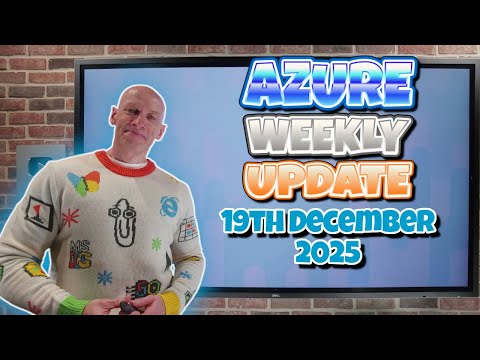
Azure Update - 19th December 2025 with Christmas Song
Principal Cloud Solutions Architect
Microsoft Azure update: holiday song, Functions Service Bus trigger, ANF ransomware, Azure SQL, Cosmos DB, Foundry GPT
Key insights
- Azure Update — Weekly December 19, 2025 roundup that mixes short technical notes with a seasonal intro.
It highlights recent releases across AI, storage, security, databases, and platform operations. - Functions Service Bus Trigger — Improved support for Service Bus triggers in Azure Functions simplifies event-driven apps.
Developers can wire messaging to serverless code with less custom plumbing and faster deployments. - ANF CZRR and ANF ransomware protection — Azure NetApp Files adds cross-zone replication for better resilience and new ransomware defenses for detection and recovery.
These features reduce downtime risk and speed recovery after attacks. - Blob resumable uploads and ASM blob-to-blob — Resumable transfers and direct blob-to-blob operations improve reliability for large data moves and migrations.
Teams get fewer failed uploads and faster, simpler data transfers. - Serverless auto-resume for Azure SQL Database — Clarified auto-resume behavior helps balance cost and responsiveness by pausing compute when idle and resuming on demand.
This reduces bills for low-usage workloads while keeping startup latency manageable. - Foundry AI models and platform operations — GPT-image-1.5 and updated GPT voice models expand multimodal app capabilities, while Azure SRE for Cosmos DB and Databricks serverless workspaces improve reliability and scaling.
Combined, these updates make AI features easier to build and run at production scale.
John Savill's [MVP] published a concise YouTube update titled "Azure Update - 19th December 2025 with Christmas Song," summarizing the week's notable Azure changes and adding a seasonal interlude. The video blends technical briefings with light commentary, and the host even jokes about the Christmas song being an abomination. For readers, the clip provides a quick scan of product announcements, previews, and operational notes across storage, compute, AI, and security. Consequently, the update serves as a practical weekly pulse for Azure practitioners and cloud decision-makers.
Video Snapshot and Presenter Tone
The video runs briefly through a set of chaptered topics that include a playful seasonal piece followed by targeted technical highlights. John Savill presents each item in a pragmatic style, and his commentary balances expert detail with accessible phrasing for broad audiences. Moreover, the format makes it easy to jump to items like Functions Service Bus Trigger and ANF advanced ransomware protection using timestamps. Thus, viewers can quickly locate points of interest and follow up on items that affect their environments.
While the update is intentionally succinct, it packs a variety of items from GA notices to preview features, and it prioritizes changes with operational impact. The host refrains from deep-dive demos, instead framing each change with practical context and implications for administrators and architects. As a result, the video functions as a briefing that signals what to investigate further in documentation or test environments. This makes it useful as a triage tool for teams managing Azure estates.
Key Feature Highlights
Among the most prominent items are serverless and AI-related enhancements, storage resiliency updates, and new SRE guidance for managed services. For instance, the update calls attention to detailed behavior for Azure SQL DB serverless auto-resume, which impacts cost and availability trade-offs in bursty workloads. Additionally, there is mention of improved integrations like a Functions Service Bus Trigger that simplifies event-driven patterns for serverless applications. These changes aim to reduce operational friction while enabling more efficient architectures.
Storage and database items also appear, including notes around blob transfers and NetApp Files features geared toward protection and performance. The video highlights resumable blob operations and mentions advanced ransomware protection for ANF, which signals Microsoft’s continued focus on data safety for enterprise workloads. Meanwhile, lifecycle improvements such as zonal placement for premium file shares and migration aids for managed databases reduce migration risk. Consequently, organizations can plan for incremental resiliency gains while weighing potential complexity in operations.
AI, Models, and Foundry Updates
AI surfaced as a recurring theme, with the host summarizing updates like GPT-image-1.5 appearing in Foundry and refreshed GPT voice models that broaden generative abilities. These enhancements make it easier to integrate multimodal AI into applications, and they reflect the industry trend of tighter cloud-AI integration for production workloads. Furthermore, model updates bring opportunities for richer user experiences, yet they also introduce considerations around cost, latency, and governance. Therefore, teams must balance innovation speed with responsible deployment practices.
In addition, the video touches on tooling that supports agentic scenarios, and it notes ecosystem moves that accelerate RAG (retrieval-augmented generation) and connector availability. While such tools can shorten development cycles, they often require careful data curation and observability to avoid hallucination risks and compliance gaps. Thus, enterprises should pair new AI capabilities with testing, monitoring, and a clear data strategy to control outcomes. This tradeoff between rapid feature adoption and governance remains central to cloud AI rollouts.
Security and Operational Resilience
Security and resilience topics receive specific attention, including the aforementioned ANF ransomware protections, Azure Sphere OS updates, and SRE guidance for managed services like Cosmos DB. These items reinforce an increasing emphasis on built-in safeguards and operational practices that reduce incident windows and improve recovery posture. Moreover, the video highlights administrative changes and certificate transitions that administrators should plan for during the next maintenance windows. Consequently, change management and testing become essential when applying these updates to production systems.
However, strengthening defenses often increases operational overhead in the short term, as teams must validate settings, update runbooks, and confirm compatibility with existing architectures. For example, advanced anti-ransomware features can require configuration changes and potential performance tuning, which calls for staged rollouts. In the same way, certificate rotations and authentication preview features might necessitate client updates and policy reviews. Therefore, organizations should budget time and resources for these transitional activities to avoid unexpected disruptions.
Tradeoffs, Challenges, and Next Steps
The update underscores familiar tradeoffs between adopting new features quickly and maintaining predictable operations. Embracing serverless scaling and AI models offers cost and agility benefits, yet it introduces variability in billing and introduces new monitoring needs. Likewise, increased automation reduces manual toil but elevates the need for robust observability and rollback plans. As a result, teams should prioritize pilots, clear success criteria, and incremental adoption where feasible.
Finally, the video functions as a practical weekly brief rather than a comprehensive technical guide, so viewers should follow up with official docs and test labs. John Savill’s approachable delivery helps surface where attention is most needed, and his concise format supports busy engineers and architects who must triage updates. In summary, the December 19, 2025 update offers a balanced snapshot of Azure’s trajectory, emphasizing AI integration, resilience features, and operational refinements while highlighting the management effort required to adopt them safely.

Keywords
Azure update December 19 2025, Microsoft Azure news Dec 2025, Azure December 2025 release notes, Azure Christmas song update, Azure new features 2025, Azure security updates December 2025, Azure service changes Dec 2025, Azure holiday update 2025