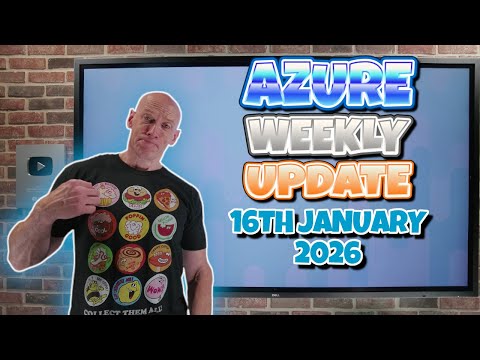
Azure Update - 16th January 2026
Principal Cloud Solutions Architect
Azure update: AKS on Ubuntu twenty four, Cosmos DB Fabric private networking, Azure OpenAI Codex Microsoft expert tips
Key insights
- Video summary: Quick recap of a YouTube Azure update from 16 January 2026 that covers security fixes, service previews, and operational notes.
I am summarizing the video for editorial use, not as the original presenter. - Patch Tuesday: Microsoft released a large security bundle fixing around 112 CVEs, including eight rated Critical.
A key issue is CVE-2026-20965, a flaw in Azure AD SSO for Windows Admin Center that can allow tenant-wide access if systems remain unpatched. - Mitigation and patching: Apply the Windows Admin Center extension update (version 0.70.00+) and Windows updates via the usual channels to block the SSO token bypass.
Monitor WAC service accounts and unusual tenant sign-ins for signs of compromise. - Data platform updates: Cosmos DB now supports automatic mirroring to Fabric’s One Lake, letting analytics tools query data without manual ETL and reducing latency.
Also noted: AKS adds support for Ubuntu 24.04 nodes to improve stability and package support. - AI and models: New model mentions include GPT-5.2-Codex for code generation and OptiMind SLM, a small language model optimized for specialized, low-cost edge inference available via Microsoft’s model services.
- Operations and partner changes: Clarified VM maintenance will only affect listed VMs, minimizing surprises.
Azure VMware Solution (AVS) partner checks were simplified to speed migrations and reduce old certification barriers.
Overview of the Video Update
In a concise YouTube update, John Savill's [MVP] reviewed a number of recent developments across the Azure ecosystem on 16 January 2026. The video covered security patches, platform previews, and new AI model options, and it aimed to give viewers a practical snapshot of what matters right now. Importantly, the presenter noted growing channel traffic and explained that he can no longer keep up with individual questions in the comments. As a result, he encouraged viewers to seek community forums for follow-up, which highlights a scaling challenge for independent technical creators.
Security: Patch Tuesday and a Critical WAC Fix
The update emphasized the January security releases that Microsoft rolled out during Patch Tuesday, including multiple high-severity and critical fixes for widely used services. In particular, the presenter focused on a critical vulnerability identified as CVE-2026-20965 that affects Windows Admin Center (WAC) integration with Azure AD Single Sign-On, and he explained the risk of tenant-wide compromise if systems remain unpatched. He recommended patching the WAC Azure extension to the latest version and monitoring service accounts that follow the WAC identity pattern to detect potential misuse. Thus, the takeaway was clear: administrators must balance rapid patch deployment with testing to avoid service disruption.
Data Platform Developments: Cosmos DB and Fabric
Next, the video highlighted an integration that simplifies data workflows: Cosmos DB mirroring into Fabric’s One Lake storage. This approach reduces the need for manual ETL by enabling near-real-time mirroring so analytics tools can query data directly. However, the presenter also noted tradeoffs such as potential cost implications for storage and egress, and the need to manage consistency models across operational and analytic stores. Therefore, teams must weigh faster analytics and reduced pipeline complexity against the operational overhead of controlling costs and ensuring data correctness.
Compute and Orchestration: AKS on Ubuntu
On the compute side, John mentioned support for newer Linux node images, with AKS now running on modern Ubuntu releases. This upgrade brings fresher kernels and improved package availability, which can enhance security and performance for container workloads. Yet, he cautioned that upgrading node images requires careful planning because node OS changes can surface compatibility issues with drivers, custom agents, or privileged workloads. Consequently, organizations should test node upgrades in staging environments and consider rolling strategies to preserve uptime.
AI Models and Edge Options: GPT-5.2-Codex and OptiMind
The update also reviewed AI options now visible in Microsoft’s stack, including a code-focused model labeled GPT-5.2-Codex and a smaller, specialized model called OptiMind SLM. According to the video, the larger model excels at complex code generation and broad reasoning, while the OptiMind SLM targets domain-specific inference with lower cost and latency. As a result, teams face a tradeoff between general-purpose accuracy and specialized efficiency; choosing the right model depends on workload constraints, available compute, privacy needs, and acceptable latency. Moreover, the presenter suggested that Foundry-hosted small models can be advantageous for edge use, but they require careful benchmarking against quality and safety requirements.
Practical Implications and Community Support
Throughout the update, John framed each announcement in operational terms, stressing what administrators should do next and what to watch for in production. He recommended prioritizing the critical WAC fix, testing AKS node image upgrades, and evaluating the business case for mirrored analytics versus bespoke pipelines. However, he also acknowledged that as his audience grows, his capacity to answer technical queries has diminished; thus, community forums become an essential complement to creator-led guidance. In this way, the video not only informed viewers about product changes but also surfaced the broader challenge of scaling independent technical support.
Conclusion: Actionable Steps and Tradeoffs
In conclusion, the update by John Savill's [MVP] delivered a compact set of action items: apply critical security updates, validate node image upgrades in controlled environments, and assess AI model selection for cost and performance. While the new integrations promise reduced development friction and faster analytics, they also introduce operational choices around cost, consistency, and lifecycle management. Therefore, teams should adopt a measured approach that balances speed with risk controls, and they should leverage community resources when one-on-one guidance is no longer feasible.
Keywords
Azure update January 16 2026, Microsoft Azure January 2026 update, Azure 2026 new features, Azure security update January 2026, Azure AI service updates 2026, Azure pricing changes 2026, Azure compliance updates January 2026, Azure roadmap January 2026