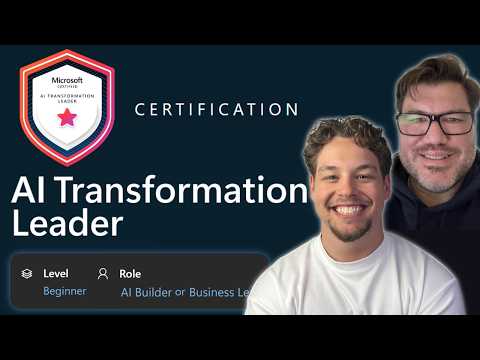
AI Transformation Leader AB-731 Guide
Certified Power Apps Consultant & Host of CitizenDeveloper365
AI Transformation Leader exam prep for Microsoft Copilot, Azure AI, Copilot Studio, Microsoft Graph, RAG and governance
Key insights
- AI Transformation Leader (AB-731): This Microsoft certification validates strategic skills for leading enterprise AI adoption and focuses on business value, governance, and change management rather than coding.
It targets business leaders and decision-makers who will drive AI initiatives across teams. - Microsoft 365 Copilot and Azure AI services: The course and exam cover how to use Copilot, Copilot Studio, Microsoft Graph, Foundry tools, and Azure AI to improve productivity, scale solutions, and support innovation.
Use these tools to map AI capabilities to real business scenarios and measurable outcomes. - Exam domains: Key tested areas include identifying benefits and opportunities for Microsoft AI apps (about 35–40%) and planning implementation and adoption strategies (about 20–25%).
Expect scenario-based leadership questions that assess strategy, governance, and ROI understanding. - Responsible AI: The certification emphasizes practical governance and ethics, including fairness, reliability, safety, privacy, security, inclusiveness, transparency, and accountability.
Create governance models, AI councils, or champions programs to embed these principles into deployments. - Licensing and cost considerations: Learn Microsoft 365 Copilot licensing and Azure AI subscription models to estimate total cost and ROI.
Factor subscriptions, usage patterns, and governance costs into business cases for AI projects. - Preparation steps: Study the official Microsoft guide, take the AB-731T00-A prep course, practice scenario-based questions, and use exam sandboxes to gain confidence.
The exam moved from beta to general availability in Feb 2026; practice real-world scenarios and focus on strategy over coding.
Overview of the Video
The YouTube video by Griffin Lickfeldt (Citizen Developer) presents a full study guide for the AB-731 exam, which certifies the Microsoft Certified: AI Transformation Leader title. The presenter frames the course as a practical path for business leaders who must guide AI adoption without writing code, and he emphasizes strategic skills over technical depth. Consequently, the video aims to translate Microsoft technologies into business value, focusing on adoption, governance, and cost considerations. In addition, the host positions the material for non-technical decision-makers who need confidence in leading enterprise AI initiatives.
Exam Focus and Course Structure
Lickfeldt outlines the exam’s main domains and maps them to course modules, making the scope clear for prospective test takers. He highlights that the exam emphasizes recognizing AI opportunities, planning implementations, and establishing responsible practices, and he notes the relative weighting for each domain. Moreover, the video walks viewers through preparation options such as the introductory course, scenario-based practice, and sandbox demos that simulate real-world leadership questions. Therefore, the structure blends conceptual lessons with applied scenarios to help learners connect study topics to workplace decisions.
The presenter explains that the course does not require coding background and instead centers on strategy, governance, and stakeholder alignment. He recommends reviewing official study guides and practicing scenario-based questions to build familiarity with exam-style thinking. Furthermore, the video references recommended study pathways and sample practice sets to boost readiness. As a result, viewers can prioritize study time around high-weighted topics and leadership scenarios rather than developer-level details.
Core Technologies and Practical Topics
Throughout the video, Lickfeldt highlights several Microsoft tools and platforms that matter for AI transformation, including Microsoft 365 Copilot, Copilot Studio, Microsoft Graph, Foundry Tools, and Azure AI services. He explains how these technologies support different business needs, from productivity improvements to scalable AI deployments, and he provides real-world examples to illustrate each use case. In addition, the video covers prompt engineering, data grounding, and RAG (retrieval-augmented generation) as practical techniques for improving model relevance and reliability. Thus, the content connects technical capabilities to tangible business outcomes, helping leaders decide which tools fit their goals.
Lickfeldt also addresses licensing and subscription models, clarifying cost factors that influence strategic decisions. He discusses how Microsoft licensing for Copilot and Azure services can affect project budgets and adoption timelines, and he urges leaders to model costs against expected productivity gains. Moreover, the video stresses that governance, security, and privacy considerations must be built into solution design from the start. Consequently, leaders are reminded to balance innovation with compliance and risk mitigation.
Tradeoffs and Implementation Challenges
The video takes a realistic view of tradeoffs inherent in AI adoption, noting that speed of deployment can conflict with robust governance and data privacy. For example, while rapid pilots may demonstrate value quickly, they can also create shadow AI use that increases risk if not tracked and governed. Therefore, Lickfeldt recommends establishing governance models—such as AI councils or champion programs—to align stakeholders and manage risks systematically. At the same time, he warns that overly rigid governance can slow adoption and diminish momentum if it lacks practical guardrails.
Another tension the video explores involves model choice and data strategy: organizations must decide between prebuilt services for speed and custom models for specific business needs, which impacts cost, control, and maintenance. Additionally, grounding data and designing retrieval strategies improve accuracy but add complexity to implementation and operational overhead. Thus, leaders face tradeoffs between simplicity and tailored performance, and they should weigh factors like scalability, cost, and internal skills when selecting an approach.
Audience, Preparation Tips, and Conclusion
Lickfeldt clearly targets business decision-makers, transformation leaders, and non-technical professionals who need AI fluency to guide organizational change. He encourages learners to combine conceptual study with scenario practice and to engage stakeholders early to ensure adoption planning aligns with business objectives. Moreover, he suggests that candidates prioritize understanding responsible AI principles—such as fairness, transparency, and accountability—because these topics feature prominently on the exam and in real deployments.
In conclusion, the video offers a structured, practical path toward the AB-731 exam by tying Microsoft tools to business outcomes and governance needs, while also calling out realistic tradeoffs and operational challenges. Consequently, viewers can expect a study experience that blends strategic thinking with applied examples, enabling them to lead AI initiatives more confidently. Overall, the presentation serves as a concise guide for leaders who must balance innovation, risk, and cost when adopting generative AI across the enterprise.

Keywords
AI Transformation Leader AB-731, AB-731 exam prep, AB-731 full course, AI Transformation Leader certification, Pass AB-731 exam, AB-731 study guide, AI leadership certification exam, AI transformation training