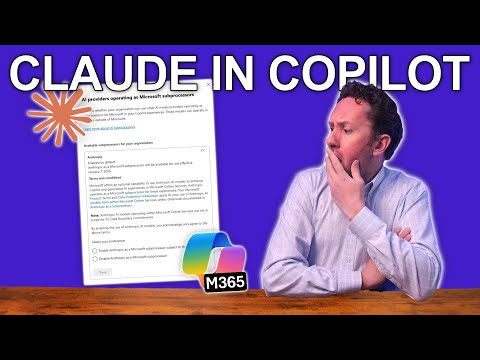
Anthropic Claude in Microsoft 365, Azure
Consultant at Bright Ideas Agency | Digital Transformation | Microsoft 365 | Modern Workplace
Anthropic Claude in Microsoft Copilot and Azure Foundry changes data privacy, Responsible AI and Copilot adoption
Key insights
-
Claude models are now integrated into Microsoft tools like Microsoft 365 Copilot and Azure Foundry.
They offer strong reasoning, long-context handling, and coding support compared with some other models. -
Anthropic acts as a subprocessor for Microsoft services starting January 7, 2026, and models run via Azure infrastructure.
Microsoft serves the models through Foundry while Anthropic hosts the runtime, so you access them inside the Microsoft environment. -
Claude supports practical enterprise workflows such as agentic workflows, multi-step automation, and data analysis in apps like Excel Agent Mode and Researcher.
Teams can use Claude for diagnosing issues, generating formulas, and running repeatable “Skills” inside Copilot experiences. -
Microsoft covers Claude under its standard compliance terms, including the Data Protection Addendum, so customers usually do not need separate Anthropic contracts.
Review how data processing and retention apply to your tenant and test controls before broad adoption. -
Users can pick models inside Copilot via UI options such as “Try Claude,” and admins can control availability through tenant settings and Copilot configuration.
Confirm controls and visibility in Copilot Studio or admin portals to manage who can use Claude. -
Benefits include a multi-model strategy that improves accuracy for reasoning and coding tasks, and potential cost advantages using existing Azure commitments.
Consider security, auditability, and a phased rollout with testing to validate outputs and guard against unexpected behavior.
Video summary and context
In a recent YouTube video, Nick DeCourcy (Bright Ideas Agency) explains how Anthropic's Claude models are arriving inside the Microsoft 365 Copilot and Azure. He outlines the timing and the practical implications for enterprise users, and he contrasts this arrangement with the way Microsoft integrates OpenAI models. Consequently, the video aims to clarify where data is processed, what control administrators have, and how organizations might choose between models.
How Claude is integrated into Microsoft services
DeCourcy walks viewers through the technical placement of Claude inside Microsoft services, explaining that models are available via Microsoft Foundry on Azure and as an option in several Copilot experiences. He notes that Microsoft accesses Anthropic-hosted models through Azure, which means organizations can use Claude without separate Anthropic contracts because Anthropic appears as a subprocessor under Microsoft's terms. As a result, teams can select Claude in places like Researcher or certain agent modes while staying inside Microsoft's compliance framework.
Benefits and practical tradeoffs
According to the video, Claude offers strengths in reasoning, long-context handling, and coding tasks, so it can be preferable for complex analyses and multi-step agentic workflows. However, DeCourcy stresses tradeoffs: while Claude may outperform for certain tasks, it is just one option in a multi-model strategy and may not be the best fit for every use case, so choice introduces complexity for decision makers. Furthermore, although Claude runs through Azure and benefits from Microsoft billing and enterprise features, organizations must weigh performance gains against governance, policy, and cost implications.
Governance, data residency, and administrative controls
The video digs into governance issues and clarifies how Microsoft treats Anthropic as a subprocessor, which affects where data flows and who is accountable for data handling. DeCourcy emphasizes that, on the plus side, Microsoft’s Data Protection Addendum and other enterprise commitments extend to this setup, yet administrators still need to configure who can access which model and in what context. Therefore, the practical challenge is balancing the desire for model choice with a firm controls posture so that compliance, data residency, and auditability are preserved.
Operational challenges and adoption considerations
DeCourcy highlights operational hurdles that organizations often face when a new model becomes available, beginning with user decision fatigue and ending with change management for IT teams. For example, enabling multiple models increases the cognitive load for end users who must learn what each model does best, while IT teams must update policies, tenant settings, and documentation to avoid inconsistent usage. Moreover, administrators will need clear mechanisms to enable or disable Claude in specific Copilot experiences, and training must accompany rollout so users benefit from the model without creating risk.
What this means for businesses and next steps
In conclusion, the video encourages businesses to view Claude as an additional tool rather than a wholesale replacement, and it suggests testing Claude in controlled pilots to identify where it adds measurable value. DeCourcy also recommends that organizations map use cases to model strengths, update governance playbooks, and communicate changes to users so the transition preserves productivity and security. Ultimately, while the integration expands options and technical capability, it requires deliberate governance, training, and cost-awareness to succeed.

Keywords
Anthropic Claude Microsoft 365 Copilot, Claude Azure integration, Microsoft 365 Copilot Claude features, Claude AI security compliance, Anthropic Claude pricing availability, Claude models for enterprise, Using Claude in Microsoft Copilot, Claude multimodal capabilities Azure