- All of Microsoft
AI for Newsletters: Boost Growth
Principal Cloud Solutions Architect
Microsoft expert guide to Azure AI adoption, responsible AI, MLOps, GitHub workflows, trust, Azure DevOps and PowerShell
Key insights
- Frontier-firm playbook: Microsoft says AI success starts with the business outcome, then redesigns end-to-end workflows and builds reusable control, evaluation, and observability layers that outlast any single model.
- Three layers: The strategy spans the products Microsoft ships, the infrastructure it provides, and the internal operating lessons enterprises should copy to scale AI use.
- Adoption patterns: Choose one of three approaches — Persona Acceleration (role-focused tools), AI-Powered Process Redesign (rebuild workflows), or AI-First Possibility (create new AI-native offerings) — each aimed at clear business value.
- Platform & models: Microsoft expands its model family (for example Phi-3 and the MAI series) and positions Azure, Foundry, and Copilot as the core stack to run, monitor, and govern enterprise AI.
- Model strategy: Avoid relying on one foundation model. Durable advantage comes from proprietary evaluations, context-aware orchestration, feedback loops, and institutional knowledge that improve results over time.
- Human-AI and trust: Combine human judgment with AI to amplify work, enforce safety and transparency, and add monitoring and human review to reduce misuse and build organizational trust.
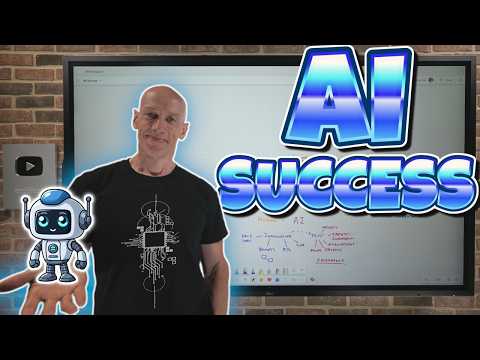
John Savill's [MVP] recent YouTube presentation, titled Succeeding with AI, frames artificial intelligence as an organizational opportunity rather than merely a new set of tools. In the video, Savill walks viewers through a series of lessons Microsoft has distilled from internal programs and customer engagements, emphasizing practical steps to turn AI into measurable business outcomes. Accordingly, he argues that successful AI adoption starts with the result you want and then reshapes workflows, people, and controls to sustain that change. As a result, his guidance shifts the conversation from model selection to building lasting organizational capabilities.
Redefining success: outcomes over tools
Savill stresses that organizations often make the mistake of treating AI as a technology rollout instead of a workflow redesign, and therefore he recommends beginning with the business outcome. Furthermore, he advises redesigning end-to-end processes rather than inserting AI into isolated tasks so that gains compound across teams and steps. This approach requires cross-functional collaboration and a willingness to change roles, expectations, and performance measures as systems evolve.
Moreover, Savill highlights the need to pair automated capabilities with human judgment, arguing that AI should expand what people can do rather than replace essential human oversight. Consequently, he encourages continuous feedback loops and reusable evaluation layers that capture institutional knowledge and improve systems over time. In practice, this creates a durable advantage that is not tied to any single model or vendor.
The frontier-firm playbook and practical patterns
One of the central themes in the video is what Savill calls the frontier-firm playbook, which organizes AI adoption into repeatable patterns rather than ad hoc pilots. He outlines three main patterns: Persona Acceleration for role-specific productivity gains, AI-Powered Process Redesign for rebuilding workflows around AI, and AI-First Possibility for entirely new offerings enabled by AI. By categorizing efforts this way, teams can choose an approach that matches ambition, risk tolerance, and available resources.
However, Savill cautions that each pattern carries tradeoffs. For example, persona acceleration can deliver quick wins but may not alter broader processes, while AI-first designs can invent new markets but require higher investment and cultural change. Therefore, leaders must weigh speed against scale and experiment in ways that preserve the ability to generalize lessons across the organization. This balance between early wins and long-term transformation is a recurring challenge in the video.
Models, platform, and evolving vendor strategy
Savill notes Microsoft’s movement beyond a single-provider narrative by discussing in-house models and platform investments, and he stresses the importance of infrastructure in scaling AI responsibly. He references recent model developments such as Phi-3 and Phi-3.5, along with newer family members under the MAI label, to illustrate how vendors are diversifying capabilities. At the same time, Savill emphasizes that stable value comes from orchestration, evaluation, and context integration—components that outlast any one model.
On the platform side, the video frames solutions like Copilot, Azure, and Microsoft Foundry as parts of a stack that supports deployment, governance, and observability. Yet Savill also draws attention to responsibility work, noting initiatives such as model behavior guidelines and safety constraints that help mitigate misuse. Therefore, adopting platform capabilities requires parallel investment in governance, monitoring, and human-in-the-loop controls.
Tradeoffs, risks, and organizational challenges
Savill is clear that AI brings both opportunity and risk, and he spends considerable time addressing the tradeoffs organizations face when choosing how to adopt these technologies. For example, relying on a single large model may simplify integration but increases vendor, security, and long-term lock-in risks, whereas building proprietary evaluation layers supports differentiation but demands more talent and resources. Thus, companies must decide whether to prioritize speed, control, or cost while recognizing that hybrid strategies often make sense.
Additionally, the video explores governance challenges such as trust, explainability, and misuse, including how bad actors might exploit capabilities if safeguards are absent. Savill suggests investing in observability and transparent evaluation processes so that decision-makers can detect drift, bias, or harmful outputs quickly. Ultimately, these safeguards add complexity and cost, but Savill argues they are essential to scale AI in a way that preserves trust and regulatory compliance.
Business implications and next steps
For business leaders, Savill’s message is pragmatic: aim for measurable outcomes, redesign workflows, and build repeatable governance, rather than chasing model benchmarks alone. He presents potential benefits such as faster productivity gains and improved decision-making while also reminding viewers that meaningful change requires cultural and structural adjustments. Therefore, organizations should pilot patterns that align to clear objectives and then invest in the people and processes that let those pilots generalize.
In closing, Savill’s Succeeding with AI video offers a realistic blueprint for companies that want to move from experimentation to sustained impact. By emphasizing outcomes, durable evaluation, and a blend of human and AI capability, his recommendations aim to reduce common failure modes while accepting that tradeoffs will always be part of the journey. Readers and leaders who watch the presentation will find a practical set of lenses for planning AI initiatives, along with concrete questions to guide next steps.

Keywords
succeeding with AI, AI strategy for business, AI adoption best practices, how to implement AI, AI transformation roadmap, AI leadership and skills, AI deployment tips, measuring AI success